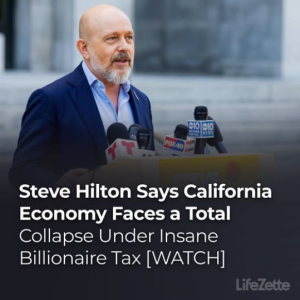
Steve Hilton Says California Economy Faces a Total Collapse Under ‘Insane Billionaire Tax’
California has long been viewed as one of the world’s economic powerhouses. Home to Silicon Valley, Hollywood, leading universities, and some of the nation’s largest corporations, the Golden State boasts an economy that rivals those of many countries. Yet despite its remarkable wealth, California also faces significant challenges, including a high cost of living, housing shortages, homelessness, and ongoing debates over taxation and government spending.
Those issues returned to the spotlight after political commentator and former California gubernatorial candidate Steve Hilton sharply criticized proposals aimed at increasing taxes on the state’s wealthiest residents. During interviews and public appearances, Hilton argued that what he described as an “insane billionaire tax” could have devastating consequences for California’s economy if enacted.
His comments quickly generated widespread discussion among political leaders, economists, business owners, and voters. Supporters praised Hilton for speaking out against what they see as excessive taxation, while critics argued that his warnings exaggerate the likely economic impact and overlook the potential benefits of raising additional revenue for public services.
The debate illustrates a broader national conversation about how governments should balance economic growth, tax fairness, and funding for essential programs.
Hilton’s central argument is straightforward. He believes imposing significantly higher taxes on billionaires and other ultra-wealthy individuals could encourage them to relocate their businesses, investments, and personal residences to states with lower tax burdens. According to Hilton, such an exodus would ultimately reduce tax revenue rather than increase it, leaving California with fewer resources to support education, infrastructure, healthcare, and other public priorities.
In his view, California’s economy depends heavily on successful entrepreneurs, investors, and innovators who have helped build industries ranging from technology and biotechnology to entertainment and clean energy. If those individuals conclude that remaining in California has become financially disadvantageous, Hilton argues they may choose to establish themselves elsewhere.
He has frequently pointed to states such as Texas, Florida, and Nevada, all of which have attracted businesses and high-income residents in recent years due in part to their comparatively lower state tax burdens.
Supporters of Hilton’s position cite examples of major companies relocating headquarters outside California over the past decade. They argue that lower taxes, reduced regulatory costs, and more affordable housing have made other states increasingly attractive destinations for both employers and workers.
Some business leaders also contend that California’s existing tax structure already places substantial financial obligations on top earners. Adding another targeted tax, they argue, could discourage investment and entrepreneurship at a time when global competition for capital remains intense.
Hilton further argues that wealthy individuals often contribute disproportionately to state tax revenues. Because California relies heavily on income taxes from high earners, any reduction in that taxpayer base could create significant budget volatility during economic downturns.
According to this perspective, encouraging wealth creation ultimately generates more sustainable tax revenue than imposing higher tax rates on a relatively small group of taxpayers.
Critics, however, strongly disagree with Hilton’s conclusions.
Supporters of increased taxes on billionaires argue that California’s wealth gap has expanded dramatically over recent decades. While many residents have benefited from booming industries such as technology, millions continue to struggle with rising housing costs, healthcare expenses, and stagnant wages.
Advocates contend that asking the wealthiest individuals to contribute more could provide additional funding for affordable housing initiatives, public schools, transportation systems, wildfire prevention, and healthcare services.
They also note that billionaires possess financial resources far beyond those of ordinary taxpayers, making them uniquely capable of absorbing higher tax obligations without experiencing significant hardship.
Some economists argue that relocation decisions involve far more than taxes alone.
Businesses often choose locations based on access to skilled workers, research institutions, transportation infrastructure, venture capital, and large consumer markets. California continues to offer advantages in many of these areas, particularly in technology, entertainment, aerospace, and life sciences.
Critics therefore suggest that predictions of a mass departure may overstate the influence of tax policy relative to other economic considerations.
The debate also reflects differing economic philosophies.
Those favoring lower taxes generally argue that allowing individuals and businesses to retain more of their earnings encourages investment, innovation, hiring, and long-term economic growth. From this perspective, competitive tax policies help attract entrepreneurs while supporting job creation.
Those favoring higher taxes on the wealthiest residents often emphasize reducing inequality and ensuring adequate funding for public services. They argue that investments in education, transportation, healthcare, and public safety create long-term economic benefits that support businesses and residents alike.
California’s economic performance provides evidence that both sides reference in support of their positions.
Despite ongoing concerns about taxes and regulation, California remains home to many of the world’s most valuable companies and continues to lead in venture capital investment, technological innovation, and entertainment production. The state’s gross domestic product ranks among the largest in the world, reflecting its broad and diverse economy.
At the same time, California faces persistent challenges that concern policymakers across the political spectrum. Housing affordability remains among the worst in the nation. Many businesses report high operating costs, while employers and workers alike have expressed concerns about permitting delays, energy prices, and regulatory complexity.
Population trends have also become part of the discussion. While California continues to attract talent from around the world, domestic migration patterns have shown some residents moving to other states seeking lower living expenses and different economic opportunities.
Hilton argues that additional taxes could accelerate those trends.
Supporters of wealth taxes, however, maintain that many residents leave primarily because housing costs have become unaffordable rather than because of income tax policy alone. They argue that increased public investment could help address those underlying problems.
Economists remain divided over the likely effects of billionaire-specific taxes.
Some research suggests that very high tax rates may encourage tax planning, relocation, or changes in investment behavior among the wealthiest individuals. Other studies indicate that moderate increases may generate additional revenue without causing large-scale migration, particularly when accompanied by investments that improve quality of life and economic opportunity.
The design of any proposed tax also matters considerably.
Questions surrounding thresholds, exemptions, enforcement mechanisms, constitutional considerations, and interactions with federal tax law can significantly influence both revenue estimates and taxpayer behavior.
Political observers note that emotionally charged language often dominates debates over taxation.
Terms such as “insane tax” or “tax giveaway” can energize supporters but may oversimplify complex policy questions involving economics, public finance, and long-term growth.
Ultimately, the effectiveness of any tax proposal depends not only on the rates imposed but also on how revenue is collected, how funds are spent, and how businesses and individuals respond over time.
California lawmakers continue to face difficult choices as they seek to balance competing priorities. Maintaining economic competitiveness, expanding affordable housing, improving infrastructure, supporting education, addressing homelessness, and ensuring fiscal stability all require significant financial resources.
Whether higher taxes on the wealthiest residents would strengthen or weaken those efforts remains the subject of vigorous public debate.
For voters, the discussion raises broader questions about the role of government, economic incentives, and shared responsibility. How much should high-income individuals contribute to public services? At what point might higher taxes discourage investment? How should states compete for businesses while still funding essential programs?
These questions extend far beyond California and are increasingly relevant across the United States as policymakers consider different approaches to taxation and economic development.
Steve Hilton’s criticism has ensured that the issue remains in the public eye. His warning that California could face severe economic consequences under a significantly higher billionaire tax reflects one perspective in an ongoing policy debate. Others argue that carefully designed tax reforms could provide resources needed to address longstanding challenges while preserving economic growth.
As lawmakers, economists, business leaders, and voters continue to evaluate competing proposals, the ultimate outcome will depend on detailed policy design, economic conditions, and the choices made by both government officials and taxpayers. Rather than being settled by political slogans alone, the debate over taxation is likely to remain a central issue shaping California’s economic future for years to come.