George Harrison in Haight-Ashbury: The Beatles’ Quiet One Meets the Summer of Love
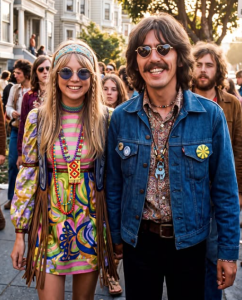
The moustachioed musician in heart-shaped sunglasses is George Harrison, the youngest member of the Beatles. Beside him is his first wife, the model Pattie Boyd. The photograph captures one of the most fascinating moments of the so-called Summer of Love: a world-famous rock star, already deeply immersed in Indian music and spirituality, walking through San Francisco’s legendary Haight-Ashbury district to see for himself what the counterculture was really about.
The visit took place on August 7, 1967, during the height of San Francisco’s Summer of Love. Harrison and Boyd had arrived in the city after spending several days in Los Angeles, intending primarily to visit Boyd’s sister Jenny. They were accompanied by several members of Harrison’s circle, including Beatles aide Neil Aspinall, publicist Derek Taylor and Alexis “Magic Alex” Mardas. During their stay, they decided to visit the neighborhood that had become internationally famous as the heart of America’s hippie movement.


The man behind the sunglasses
By the summer of 1967, George Harrison was undergoing a remarkable transformation.
The Beatles were at the absolute height of their fame. Sgt. Pepper’s Lonely Hearts Club Band had recently been released, and songs such as “Within You Without You” demonstrated just how far Harrison had traveled from the role of simply being the group’s lead guitarist.
His fascination with India had become central to his identity. He had studied the sitar with legendary Indian musician Ravi Shankar and had increasingly explored Hindu philosophy, meditation and spirituality. His interest was not merely musical. Harrison was searching for something he felt Western celebrity culture and material success could not provide.
His first experiences with LSD had also contributed to this spiritual exploration. Harrison later connected psychedelic experiences with his growing interest in Eastern philosophy and religion.
So when he heard stories about Haight-Ashbury, it was easy to understand why he was curious.
The neighborhood had acquired almost mythical status. It was portrayed as a place where young people had rejected conventional society, embraced alternative lifestyles and experimented with music, art, communal living and altered states of consciousness. San Francisco had become a symbol of a new generation.
For Harrison, Haight-Ashbury seemed like a place where the psychedelic revolution might have produced exactly the kind of spiritual awakening he was seeking.
What he encountered was considerably more complicated.
Entering the heart of the Summer of Love
Harrison and Boyd reportedly dressed in clothing that allowed them to blend into the scene. Harrison wore his long hair, moustache, denim jacket and distinctive heart-shaped sunglasses, while Boyd had the long blonde hair and fashionable bohemian appearance associated with the era.
Contemporary accounts describe the couple walking along Haight Street and eventually making their way toward Golden Gate Park. Harrison initially attracted attention because people recognized him, but the situation rapidly escalated.
This was not simply a celebrity being politely approached by a few fans.
Word spread through the neighborhood that one of the Beatles was there.
Suddenly, Harrison was surrounded.
Contemporary reporting described Harrison and Boyd initially moving through the area relatively unnoticed before people began following them. The crowd grew as more people realized who was walking among them.
For someone who had spent years being protected from crowds by managers, security arrangements and carefully controlled public appearances, the experience was extraordinary.
The Beatles were not merely popular musicians. By 1967, they had become cultural icons of almost unimaginable scale.
And in Haight-Ashbury, Harrison discovered that his celebrity could become a problem even among people who supposedly rejected mainstream celebrity culture.
The uncomfortable reality behind the fantasy
Perhaps the most revealing part of the story is that Harrison did not come away enchanted by Haight-Ashbury.
He had expected something much more idealistic.
Instead of encountering a peaceful community of enlightened artists and musicians, he found a neighborhood struggling under the enormous influx of young people attracted by its reputation.
Haight-Ashbury had become a victim of its own mythology.
The media had transformed the district into a symbol. Thousands of young people traveled there, expecting to discover freedom, drugs, music and communal happiness. But the reality included poverty, overcrowding, drug abuse, homelessness and exploitation.
Boyd later described the experience in her autobiography Wonderful Tonight. According to her recollection, she and Harrison had been expecting Haight-Ashbury to be a creative, artistic place filled with what she called “Beautiful People.” Instead, they encountered a much rougher environment populated by large numbers of intoxicated young people and dropouts.
That distinction is important.
The Summer of Love was real, but the romantic image later attached to it was only part of the story.
There were musicians, poets, artists and political activists. There were communal experiments and charitable projects. But there were also people who had arrived with no housing, no money and little understanding of what they were getting into.
The neighborhood was already under enormous pressure.
Harrison, arriving as an internationally famous musician, could observe the situation for a short time and then leave.
Many of the young people around him could not.
The crowd closes in
The strangest element of Harrison’s visit was the way his own fame became intertwined with the psychedelic atmosphere.
As the group walked around, more and more people gathered behind them.
At one point, Harrison was given a guitar and asked to play. Other people wanted autographs, conversation or simply the chance to touch or see one of the Beatles at close range.
Neil Aspinall later recalled that the crowd became increasingly large and difficult to manage. The group eventually realized they had to get back to their limousine.
The situation became frightening.
Accounts describe the group moving faster and eventually running toward the waiting car. According to Boyd’s recollection, the crowd followed them and people even began rocking the vehicle after they reached it.
It was a bizarre reversal.
Harrison had gone to Haight-Ashbury hoping to observe the counterculture.
Instead, the counterculture had turned its attention toward him.
He was not an anonymous visitor experiencing the movement from the inside. He was George Harrison, Beatle, and his presence automatically transformed the atmosphere around him.
The LSD question
The visit also became significant because of Harrison’s changing attitude toward psychedelic drugs.
There are different recollections of exactly what the group took and when, but Boyd’s account describes the party taking LSD before entering Haight-Ashbury. She remembered the experience as intensely psychedelic, with the environment taking on an overwhelming quality.
The irony was striking.
Harrison had become interested in altered consciousness partly because psychedelic experiences had encouraged him to look beyond ordinary material existence. Yet what he witnessed in Haight-Ashbury convinced him that drugs alone could not provide the spiritual answers he wanted.
The scene was, in a sense, a warning.
If enlightenment was the goal, endless intoxication was not necessarily the route.
Later accounts of Harrison’s thinking suggest that the experience contributed to his decision to move away from LSD and toward meditation and more disciplined spiritual practices. His interest in Indian philosophy therefore became increasingly important.
This was not a rejection of experimentation so much as a realization that experimentation had limits.
From psychedelic music to spiritual searching
That distinction helps explain Harrison’s extraordinary trajectory during the late 1960s.
While John Lennon and Paul McCartney remained primarily associated with songwriting, recording and the increasingly complex world of the Beatles, Harrison was exploring an entirely different intellectual and spiritual landscape.
Indian music had become more than an exotic influence. It became part of his search for meaning.
His friendship with Ravi Shankar was especially important. Harrison’s sitar playing helped introduce millions of Western listeners to Indian classical music, while his interest in meditation helped bring Eastern spirituality into the vocabulary of Western pop culture.
By 1968, Harrison and the other Beatles would travel to Rishikesh, India, to study meditation with Maharishi Mahesh Yogi.
The Haight-Ashbury experience therefore sits neatly in the middle of this transformation.
Harrison had seen the psychedelic dream from close range.
And he had found it wanting.
A photograph that captured an era
That is what makes the photograph so memorable.
Harrison looks almost perfectly suited to the scene. The moustache, long hair, heart-shaped glasses and denim jacket make him look like a natural participant in the counterculture.
Yet appearances can be deceptive.
The man dressed like a hippie was actually a global superstar who had arrived in a limousine.
The woman beside him, Pattie Boyd, was a successful model whose image had become part of the visual culture surrounding the Beatles and the 1960s.
And the people around them were living a very different reality.
The photograph captures that contradiction beautifully: celebrity and anonymity, fashion and poverty, idealism and disorder, spirituality and intoxication.
Harrison’s visit has therefore become one of the defining snapshots of the Summer of Love.
The legacy of that brief walk
George Harrison spent only a short time in Haight-Ashbury. Yet the experience stayed with him.
He had gone looking for a vision of the counterculture and discovered something much less glamorous. The encounter helped reinforce his belief that genuine spiritual development required something deeper than drugs, fashionable clothes or rebellion for its own sake.
The Haight was not simply a failure, however.
Its ideals — community, artistic freedom, experimentation, rejection of materialism and interest in alternative forms of spirituality — would influence generations that followed.
Harrison himself would become one of the most important bridges between Western popular music and Eastern spirituality.
So, the answer to the mystery photograph is George Harrison, accompanied by Pattie Boyd, during their August 7, 1967 visit to San Francisco’s Haight-Ashbury district.
It is an extraordinary image because Harrison appears, for a moment, to be exactly where he belongs: surrounded by flower children, psychedelic fashion and the restless energy of 1967.
But behind the heart-shaped glasses was a musician already beginning to look beyond the psychedelic dream.
He had gone to Haight-Ashbury expecting to find a community experiencing some kind of collective awakening.
Instead, he found confusion, crowds and the darker side of the drug culture.
And perhaps that was precisely why the visit mattered.
For George Harrison, the Summer of Love did not end with a celebration of LSD.
It helped send him in another direction — toward meditation, Indian philosophy and a lifelong search for something he believed was more lasting than fame, fashion or intoxication.
In that sense, his brief walk through Haight-Ashbury was much more than a celebrity sighting.
It was one small but revealing chapter in the extraordinary spiritual journey of the Quiet Beatle.