What Risks Do You Run When You Sleep on Your Right Side?
For many people, sleeping on the side is simply the most comfortable way to rest. Some naturally settle onto their right side every night and may have done so for years without giving it much thought.
But is sleeping on your right side actually bad for you?
The short answer is: usually, no. For most healthy adults, there is no strong evidence that routinely sleeping on the right side is dangerous. In fact, side sleeping can have important benefits, including helping keep the airway open and reducing snoring. Mayo Clinic notes that sleeping on the side can help prevent airway collapse and is generally a good sleeping position. (Mayo Clinic News Network)
However, your individual health circumstances can make one position more comfortable—or less comfortable—than another. People with acid reflux, certain heart conditions, pregnancy-related discomfort, shoulder problems or back pain may notice differences depending on which side they choose.
So rather than thinking of right-side sleeping as inherently dangerous, it is better to understand when it might cause problems and how to make side sleeping more comfortable.
1. Acid reflux may be worse
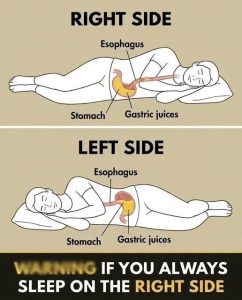
One of the biggest potential disadvantages of sleeping on your right side involves acid reflux and heartburn.
When stomach acid travels upward into the esophagus, it can cause burning chest discomfort, a sour taste, coughing and other symptoms. Lying down can make reflux worse because gravity is no longer helping keep stomach contents in place. (Mayo Clinic)
For people who experience nighttime reflux, the left side is generally considered preferable.
Mayo Clinic specifically recommends starting sleep on the left side because this can make reflux less likely. (Mayo Clinic)
That does not mean everyone who sleeps on the right side will develop GERD. It simply means that if you already suffer from nighttime heartburn, changing sides may make a noticeable difference.
If you regularly wake up with burning in your chest, an acidic taste, coughing or throat irritation, your sleeping position could be one factor worth discussing with a healthcare professional.
2. It can put pressure on your shoulder
Another possible problem has less to do with internal organs and more to do with simple mechanics.
When you sleep on one side for several hours, your body weight is concentrated through your shoulder and hip.
If you already have a painful shoulder, arthritis, an injury or inflammation, lying directly on that side can aggravate the discomfort.
Sometimes the problem isn’t the side itself but the pillow or mattress.
A pillow that is too high can push the neck sideways. One that is too low can allow the head to drop toward the mattress.
Over several hours, that awkward position can leave you waking with neck stiffness, shoulder soreness or upper-back discomfort.
If you prefer right-side sleeping, you don’t necessarily need to change sides. Instead, try improving your alignment.
3. Poor alignment can contribute to back or hip discomfort
Side sleeping can actually be beneficial for people with certain types of back pain, but positioning matters.
Mayo Clinic recommends bending the knees slightly and placing a pillow between the legs. This can help keep the spine, pelvis and hips aligned and reduce strain. (Mayo Clinic)
Without adequate support, the upper leg can rotate downward, pulling the pelvis out of alignment.
You might not notice this while asleep, but you may feel the effects when you wake.
A simple pillow between the knees can sometimes make a surprisingly large difference.
A full-length body pillow can also provide support if you tend to move around during the night.
4. Your shoulder may become numb
Have you ever woken up with an arm that feels like it has disappeared?
Pressure from sleeping on your side can temporarily compress nerves or blood vessels around the shoulder and arm. This may produce the familiar sensation of pins and needles.
Usually, the sensation disappears quickly after you change position.
But if numbness happens frequently, lasts for a long time after waking, or occurs together with weakness or significant pain, it shouldn’t simply be blamed on sleeping position.
Persistent numbness deserves medical evaluation.
5. Pregnancy requires a little more consideration
Pregnancy is one situation in which sleep position receives considerably more attention.
But there is an important misconception to clear up.
Many people have heard that pregnant women must sleep exclusively on their left side.
That isn’t quite accurate.
The American College of Obstetricians and Gynecologists says pregnant women can sleep on either side—right or left. What matters particularly later in pregnancy is avoiding prolonged sleeping flat on the back because the growing uterus can compress a major blood vessel and potentially affect blood flow. (ACOG)
Mayo Clinic likewise recommends side sleeping during pregnancy and notes that pillows between the knees and under the abdomen can improve comfort. (Mayo Clinic News Network)
The left side may be particularly helpful for some pregnant people experiencing heartburn, but right-side sleeping isn’t automatically dangerous.
If pregnancy makes sleeping difficult, the best position is one that is comfortable while following your obstetrician’s specific advice.
6. What about your heart?
This is where online discussions can become unnecessarily frightening.
You may encounter claims that sleeping on your right side is dangerous because of its effect on the heart.
For most healthy people, there is not good evidence that simply sleeping on the right side damages the heart.
In fact, side sleeping in general can be beneficial because it may help keep the airway open. Mayo Clinic experts describe side sleeping as generally preferable to back sleeping for many people because the airway is less likely to collapse. (Mayo Clinic News Network)
However, people with significant heart disease can have individual symptoms that change depending on their position.
For example, someone with heart failure may experience shortness of breath when lying down. Mayo Clinic notes that breathing symptoms can sometimes overlap with other conditions and should be medically evaluated when persistent or concerning. (Mayo Clinic News Network)
Therefore, if a particular sleeping position causes chest discomfort, breathlessness, palpitations or unusual symptoms, don’t assume the problem is harmless simply because you think it is related to sleep position.
7. Snoring and sleep apnea may actually improve
Here’s an important counterpoint.
If you sleep on your right side, you may actually be helping your breathing compared with sleeping flat on your back.
When someone sleeps on their back, the tongue and jaw can move backward and narrow the airway. Side sleeping can help prevent that collapse.
Mayo Clinic specifically notes that side sleeping can reduce snoring and help prevent airway collapse. (Mayo Clinic News Network)
So if someone tells you that right-side sleeping is inherently unhealthy, that’s far too simplistic.
For many people with snoring or obstructive sleep apnea, side sleeping may be preferable to back sleeping.
Of course, side sleeping isn’t a cure for sleep apnea. If you regularly stop breathing during sleep, gasp for air, wake with headaches or remain excessively sleepy during the day, you should speak with a healthcare professional.
8. Your face may be affected
There is also a cosmetic consideration.
If you always sleep on the same side, that side of your face spends hours pressed against a pillow.
Over time, repeated pressure and skin friction may contribute to temporary sleep lines and, potentially, some long-term skin changes.
This isn’t a major medical danger, but it is one reason some people choose to alternate sides.
Keeping pillowcases clean and choosing a comfortable, breathable pillow can also help reduce skin irritation.
9. When right-side sleeping is perfectly fine
For the average healthy adult, sleeping on the right side is usually nothing to worry about.
If you sleep comfortably, wake feeling rested, don’t experience significant pain and don’t have symptoms such as nighttime reflux or breathing difficulties, there may be no reason to force yourself into another position.
Sleep quality matters enormously.
A theoretically “perfect” sleeping position isn’t useful if it prevents you from getting enough restful sleep.
The goal should be comfortable, well-supported sleep, not obsessing over whether your body is turned a few degrees in one direction or another.
How to make right-side sleeping healthier
If the right side is your favorite position, a few simple adjustments can make it more comfortable.
Use the right pillow. Your pillow should support your head without pushing your neck sharply upward.
Put a pillow between your knees. This can help maintain alignment between your hips and spine. (Mayo Clinic)
Support your upper arm. If your shoulder feels strained, hugging a pillow can reduce pressure.
Avoid sleeping immediately after a large meal. If reflux is a problem, allowing time between eating and lying down can help. Mayo Clinic also recommends lifestyle changes such as avoiding foods that trigger symptoms and elevating the upper body when appropriate. (Mayo Clinic)
Consider changing sides occasionally. If one shoulder or hip becomes sore, shifting position can distribute pressure more evenly.
Pay attention to symptoms. Your body can tell you when a position isn’t working.
When should you talk to a doctor?
Sleeping on your right side isn’t itself a reason to see a doctor.
But certain symptoms should not be dismissed as merely a sleeping-position issue.
Seek medical attention for unexplained or persistent chest pain, significant difficulty breathing, fainting, persistent numbness or weakness, or severe pain.
Mayo Clinic specifically advises urgent evaluation for severe chest pain or pressure, particularly when accompanied by breathing difficulty or pain in the arm or jaw. (Mayo Clinic)
Likewise, frequent nighttime heartburn deserves attention. GERD can cause repeated irritation of the esophagus and may require treatment if symptoms are persistent. (Mayo Clinic)
The bottom line
So, what risks do you run when you sleep on your right side?
For most healthy people, the risks are relatively minor.
The most common potential issues are pressure on the shoulder or hip, poor spinal alignment, temporary numbness and, in people prone to reflux, potentially worse nighttime heartburn.
At the same time, right-side sleeping can have advantages. Side sleeping generally helps keep the airway open and may reduce snoring compared with sleeping on the back. (Mayo Clinic News Network)
And if you’re pregnant, you don’t need to panic if you naturally sleep on your right side. ACOG says pregnant people can sleep on either side; the bigger concern later in pregnancy is prolonged back sleeping. (ACOG)
Ultimately, there is no universal sleeping position that is perfect for everyone.
Your health conditions, body shape, mattress, pillow, pregnancy status and personal comfort all matter.
If your right side lets you sleep deeply and wake without pain or concerning symptoms, there is usually no reason to fear it.
The best sleeping position is often the one that allows you to breathe comfortably, keeps your body reasonably aligned and—most importantly—helps you get the restorative sleep your body needs.