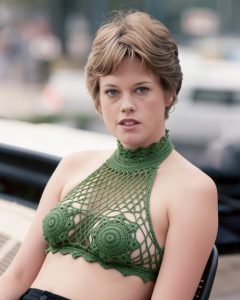
NAME THE FUTURE WORKING GIRL STAR MAKING WAVES IN 1975!
Long before Melanie Griffith became the unmistakable voice and face of Tess McGill in Working Girl, before the blonde hair, husky voice and New York determination made her one of Hollywood’s most recognizable leading ladies, she was a teenager standing on the edge of an extraordinary career.
The actress pictured in the 1975 Warner Bros. publicity still from The Drowning Pool is, of course, Melanie Griffith.
Born in New York City on August 9, 1957, Griffith grew up surrounded by Hollywood. Her mother was actress Tippi Hedren, famous for Alfred Hitchcock’s The Birds and Marnie, while her father, Peter Griffith, had worked as an actor before moving into advertising. Melanie’s childhood therefore unfolded unusually close to the movie business. (IMDb)
Yet having famous parents did not automatically guarantee a successful acting career. Griffith still had to establish an identity of her own, and that process began while she was remarkably young.
By the time 1975 arrived, she was only 17, but she was already appearing in a remarkable collection of films. Among them were Arthur Penn’s Night Moves, Michael Ritchie’s Smile, and Stuart Rosenberg’s The Drowning Pool. The three pictures gave audiences very different glimpses of a young actress who was clearly capable of commanding attention.
In The Drowning Pool, Griffith played Schuyler Devereaux, the provocative teenage daughter of Joanne Woodward’s Iris Devereaux. The movie reunited two of Hollywood’s biggest stars, Paul Newman and Woodward, while placing Griffith in the middle of a complicated Louisiana mystery.
The film starred Newman as private investigator Lew Harper, who travels to Louisiana after being contacted by Iris, an old flame concerned about a blackmail scheme. What initially appears to be a relatively straightforward investigation gradually becomes much more dangerous and tangled. (IMDb)
Schuyler is one of the movie’s most memorable supporting characters, and Griffith gives her an unmistakable mixture of confidence, curiosity and youthful rebellion.
The contrast between the young Griffith and the established stars around her is fascinating today. Newman was already a major Hollywood icon. Woodward was an Oscar-winning actress and one of the most respected performers of her generation. Griffith, meanwhile, was still trying to prove that she belonged in the same world.
But she did not disappear into the background.
Instead, she created a character that audiences remembered.
The Drowning Pool was released in 1975, with Griffith credited as Schuyler Devereaux. The American Film Institute’s catalog lists Newman, Woodward, Tony Franciosa, Murray Hamilton, Gail Strickland and Griffith among the principal cast. (AFI Catalog)
The film itself was based on Ross Macdonald’s novel and served as the second and final movie appearance of Newman as private detective Lew Harper. The earlier film, Harper, had been released in 1966. (Wikipedia)
But for Griffith, The Drowning Pool represented something much bigger than simply another acting credit.
It was part of the beginning of a career.
The same year, audiences saw her in Night Moves, Arthur Penn’s dark neo-noir thriller starring Gene Hackman. Griffith played Delly Grastner, a troubled teenage runaway whose disappearance sets the story in motion. Night Moves was released by Warner Bros. in June 1975 and became one of the early films that established Griffith as an actress worth watching. (Wikipedia)
Her appearance in Night Moves was especially striking because of the film’s adult themes and the atmosphere of uncertainty surrounding her character. Griffith was still a teenager, yet the film placed her opposite experienced performers and gave her a complicated role.
Then came Smile, Michael Ritchie’s satirical comedy about a beauty pageant. Griffith played Karen Love, a pageant contestant, adding yet another dimension to her growing collection of 1975 performances. Contemporary film references list Night Moves, The Drowning Pool and Smile among her notable work from that year. (Encyclopedia.com)
Three films in one year was an impressive beginning.
And there was another fascinating detail: Griffith was not simply another young actress entering Hollywood. She was already carrying the expectations that came with being Tippi Hedren’s daughter.
That family connection attracted attention, but it could also have become a burden. Hollywood has always been fascinated by famous families, and the temptation to define an actor through their parents can be difficult to escape.
Griffith eventually proved she was much more than a famous actress’s daughter.
Her career developed unevenly, as many long careers do. The immediate years following 1975 did not transform her into an instant superstar. She worked steadily, taking roles in movies and television while gradually developing the screen presence that would later become her trademark.
The major turning point arrived in the 1980s.
In 1984, Griffith appeared in Brian De Palma’s Body Double, playing Holly Body. The role was provocative and controversial, but it demonstrated a new confidence. Griffith was no longer simply the teenage performer audiences remembered from the mid-1970s.
She was becoming a mature screen actress.
Two years later, Jonathan Demme’s Something Wild gave her another opportunity to show her range. As Audrey Hankel, also known as Lulu, Griffith delivered a performance that mixed comedy, sexuality, danger and unpredictability. The movie helped convince critics that there was much more to her than the provocative young roles that had initially defined her.
Then came 1988.
And everything changed.
Mike Nichols’ Working Girl cast Griffith as Tess McGill, an ambitious Staten Island secretary determined to break into the world of corporate finance. Tess is smart, insecure, hopeful and fiercely ambitious. She is also surrounded by people who underestimate her.
The role turned Griffith into a major Hollywood leading lady.
Opposite Harrison Ford and Sigourney Weaver, she delivered a performance that combined comedy with genuine emotional vulnerability. Tess was not simply an underdog; she was a woman trying to prove that her ideas and ambitions deserved to be taken seriously.
The performance earned Griffith a Golden Globe for Best Actress and an Academy Award nomination for Best Actress. The Academy recognition marked the culmination of a journey that had begun years earlier with small and supporting roles. (Golden Globes)
Looking back at the 1975 publicity photograph from The Drowning Pool, therefore, makes the story even more interesting.
There is the young Melanie Griffith, still only 17, photographed in a style unmistakably belonging to the era. She was already working with Paul Newman and Joanne Woodward, already appearing in major studio pictures, and already accumulating experiences that would eventually shape one of Hollywood’s most recognizable careers.
But she could not have known what was ahead.
She could not have known that Night Moves would become an important early entry in her filmography. She could not have known that Smile would form part of the same extraordinary year. And she certainly could not have known that thirteen years later she would walk into Tess McGill’s shoes and receive an Oscar nomination.
That is what makes old Hollywood publicity photographs so fascinating.
A single image can preserve a moment before the future becomes obvious.
In 1975, Melanie Griffith was a promising teenager making an impression alongside some of the industry’s biggest stars. In 1988, she was an Oscar-nominated leading lady.
The journey between those two points included successes, disappointments, controversial roles, personal struggles and career reinventions. But the determination was there from the beginning.
Her performance in The Drowning Pool may not have been the role that made her famous, but it occupies an important place in the story. It captures Griffith at the beginning of a career that would eventually include films such as Body Double, Something Wild, Working Girl, Pacific Heights, The Bonfire of the Vanities, Born Yesterday and many others.
Today, as Melanie Griffith celebrates her 69th birthday, that 1975 photograph offers a wonderful reminder of just how early the journey began.
The young woman in the picture was not yet Tess McGill.
She was not yet an Oscar nominee.
She was not yet the established Hollywood star recognized around the world.
She was simply a talented 17-year-old actress getting her chance.
And Hollywood was about to discover what she could do.
From Schuyler Devereaux in The Drowning Pool to Tess McGill in Working Girl, Melanie Griffith’s career became a story of evolution — from teenage performer to major leading lady.
That is why the photograph from 1975 feels so significant today.
It does not merely show a young actress in a Warner Bros. publicity still.
It captures the beginning of a Hollywood journey that was still waiting to unfold.
The identification is strongly supported by the film’s cast records and Griffith’s documented 1975 filmography, while her August 9, 1957 birth date confirms the birthday clue. (AFI Catalog)