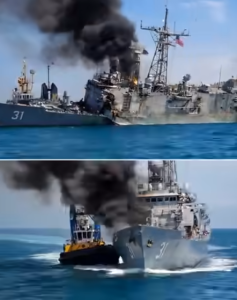
USS Rodney M. Davis (FFG-60) Sinks After Being Hit During a Major Naval Exercise
The dramatic photographs showing a gray warship burning heavily at sea can look like scenes from an actual naval battle. Thick black smoke pours into the sky, flames rise from the ship’s damaged superstructure, and the vessel appears to be listing badly as another ship moves nearby.
But there is an important detail behind these images: the ship was not an active U.S. Navy vessel when these photographs were taken.
The vessel was the ex-USS Rodney M. Davis (FFG-60), a retired Oliver Hazard Perry-class guided-missile frigate that was deliberately used as a target during RIMPAC 2022, the world’s largest international maritime exercise. On July 12, 2022, forces from Australia, Canada, Malaysia and the United States conducted a live-fire sinking exercise against the former frigate in the Pacific Ocean. (DVIDS)
So while the headline “USS Rodney M. Davis sunk after being hit” sounds like breaking combat news, the reality is very different—and in some ways just as fascinating.
A Warship With Nearly Three Decades of Service
The Rodney M. Davis was named after U.S. Marine Corps Sergeant Rodney Maxwell Davis, a Marine who was posthumously awarded the Medal of Honor for extraordinary bravery during the Vietnam War.
The frigate was built as part of the Oliver Hazard Perry class, a family of American warships designed primarily to provide escort, anti-submarine warfare and surface-defense capabilities.
The ship was laid down in February 1985 and launched in January 1986. She entered commissioned service in 1987, beginning a career that would take her across some of the world’s most strategically important waters.
For years, Rodney M. Davis operated with the U.S. Navy’s Pacific forces. She made deployments to the Western Pacific, Indian Ocean and Persian Gulf regions and participated in maritime security operations.
Photographs from her active-duty years show a very different ship from the burning wreck seen in the viral images. She was once a fully operational Navy frigate, complete with sailors aboard, radar systems operating, weapons systems maintained and helicopters using her aviation facilities.
A U.S. Navy photograph from 2014, for example, shows Rodney M. Davis arriving at Fleet Activities Yokosuka during operations in the Indo-Asia-Pacific region. (Wikimedia Commons)
Eventually, however, every warship reaches the end of its operational life.
Retirement Came in 2015
Rodney M. Davis was decommissioned in January 2015.
That did not mean her story immediately ended.
Instead, the former frigate entered the long process of disposal and was ultimately selected for use in a SINKEX—a sinking exercise.
This is an important distinction.
A SINKEX is not an accidental sinking and is not an ordinary naval battle. It is a controlled military exercise in which a decommissioned and specially prepared ship is used as a realistic surface target.
The purpose is to allow military forces to practice detecting, tracking and engaging a ship-sized target with real weapons.
For sailors and military planners, exercises like this provide an opportunity that computer simulations cannot completely reproduce.
A real ship behaves differently from a digital target.
Its metal hull reacts to impacts. Compartments can flood. Fires can spread. Structures can collapse. Smoke can obscure portions of the vessel. And the damage caused by different weapons can be observed directly.
That makes a SINKEX an important training tool.
The Final Mission: RIMPAC 2022
The Rodney M. Davis received one final assignment during Rim of the Pacific, or RIMPAC, 2022.
RIMPAC brings together naval forces from numerous countries for large-scale exercises in and around the Pacific.
The 2022 edition involved 26 nations, 38 ships, four submarines and more than 170 aircraft, with approximately 25,000 personnel participating. (DVIDS)
Among the participating countries were Australia, Canada, Malaysia and the United States.
On July 12, the former Rodney M. Davis became the target for a multinational live-fire event.
The U.S. Navy described the exercise as an opportunity to improve proficiency in tactics, targeting and live firing against a surface target at sea. (Navy Civilian Personnel Federation)
That explains the dramatic photographs.
The ship was intentionally attacked.
It was supposed to be.
Malaysia’s Missile Strike
One of the most notable elements of the exercise involved the Royal Malaysian Navy.
The Kasturi-class corvette KD Lekir conducted its first missile firing outside Malaysian territorial waters during the exercise.
According to the U.S. Navy’s account, the crew had prepared extensively for the event and successfully engaged the intended target. (DVIDS)
The weapon involved was an Exocet MM40 Block II anti-ship missile.
The strike produced exactly the sort of damage that makes the photographs so dramatic: an impact against a large steel target, followed by fire, smoke and structural damage.
But Malaysia was not the only participant.
The former frigate was subjected to fire from multiple partner forces during the overall SINKEX.
Canada’s navy also participated.
The Royal Canadian Navy frigate HMCS Winnipeg fired two Harpoon missiles during the exercise. The Canadian military described the Rodney M. Davis as the environmentally prepared, decommissioned hull being used to provide realistic training. (DVIDS)
The combination of weapons and participating forces made the event a particularly significant multinational demonstration.
Why Didn’t the Ship Sink Immediately?
One fascinating aspect of the photographs is that the frigate appears to absorb enormous punishment while remaining afloat.
To someone unfamiliar with naval warfare, that can seem surprising.
After all, modern anti-ship missiles are designed to cause devastating damage.
But a decommissioned warship used in a SINKEX is not comparable to a fully operational combat vessel.
The former Rodney M. Davis had no crew fighting to save her.
She was not carrying the fuel, ammunition and operational systems of an active warship.
And the exercise was designed to provide useful training opportunities rather than simply destroy the target as quickly as possible.
This distinction is crucial when viewing the images.
A real warship at sea would have a damage-control organization working immediately after an impact. Sailors would fight fires, isolate damaged compartments, control flooding, restore electrical systems and attempt to keep the vessel operational.
The Rodney M. Davis had no such crew.
Her fate was predetermined.
A Controlled End to a Long Career
The former frigate eventually sank in deep Pacific waters.
The U.S. Pacific Fleet reported that the ship went down in waters approximately 15,000 feet deep, about 50 nautical miles north of Kauai. (Navy Civilian Personnel Federation)
That location is significant because the Navy does not simply dump an old ship into the ocean and fire weapons at it.
Before a vessel can be used for a SINKEX, it must undergo extensive environmental preparation.
The Navy states that target vessels are cleaned of environmentally harmful materials, including trash, floatable materials, mercury, fluorocarbons and petroleum products. (DVIDS)
The objective is to create a realistic military target while minimizing environmental risks.
In that sense, the final mission of Rodney M. Davis was carefully planned from beginning to end.
What the Photograph Really Shows
The photograph accompanying the headline can therefore be misleading if viewed without context.
It looks like an American warship has suddenly been attacked.
The black smoke makes it resemble a wartime casualty.
The flames suggest an uncontrolled disaster.
But the ship was already retired.
There were no sailors trapped aboard.
There was no surprise attack.
There was no enemy ambush.
Instead, the former USS Rodney M. Davis was performing its final service to the Navy and its international partners.
Its last mission was to help other sailors learn how to fight at sea.
That is perhaps the most remarkable part of the story.
A warship that had spent decades protecting and escorting other vessels eventually became the thing that other ships trained to destroy.
From Active Warship to Target Ship
There is something almost symbolic about the transformation.
For decades, Rodney M. Davis represented American naval power.
Her radar scanned the horizon.
Her crew stood watches.
Her weapons were maintained for potential combat.
Her sailors lived and worked aboard her while she crossed thousands of miles of ocean.
Then came retirement.
The sailors left.
The weapons were removed.
The ship’s operational career ended.
Yet instead of immediately disappearing into a scrapyard, she received one final purpose.
She became a training target.
And on July 12, 2022, she helped multinational naval forces practice the very skills they might someday need in an actual conflict.
The official U.S. Navy description emphasizes that RIMPAC’s live-fire events help partner nations develop the ability to plan, communicate and conduct complex maritime operations, including precision and long-range strikes. (Navy Civilian Personnel Federation)
That is why the sinking mattered beyond the destruction of one old frigate.
It was about interoperability.
Australian, Canadian, Malaysian and American forces were operating together, learning how their ships, weapons and crews could function as part of a multinational force.
The Final Image of Rodney M. Davis
The burning frigate in the photograph is therefore not evidence of a new naval disaster.
It is the final chapter of a ship that had already completed its active service.
The USS Rodney M. Davis (FFG-60) served the United States Navy for nearly three decades before being decommissioned in 2015. Seven years later, she returned to sea for one last mission.
This time there was no crew aboard.
No sailors were waiting on the decks.
No captain was trying to save the ship.
Instead, the former frigate sat in the Pacific as aircraft and warships from several nations practiced their skills against her.
Missiles struck.
Fire erupted.
Black smoke climbed into the sky.
And eventually, after absorbing repeated attacks, the old warship disappeared beneath the Pacific.
Her final voyage was not a defeat.
It was a training mission.
And although the photographs may look like scenes from a real battle, they actually document something very different: the carefully planned final act of an American warship that had already served its country for decades.
The Rodney M. Davis had gone from warship, to veteran, to training target—and finally to an artificial reef of history resting thousands of feet beneath the Pacific.
Her last mission was to be destroyed.
But in doing so, she helped ensure that the sailors and ships still serving at sea would be better prepared for whatever challenges might come next.