Mexican President Says Trump Is Not an Enemy: What Claudia Sheinbaum’s Message Really Means
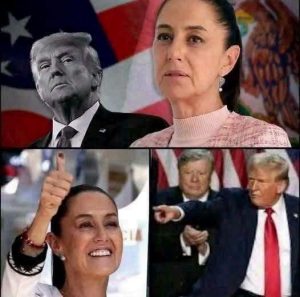
A striking image of Mexican President Claudia Sheinbaum alongside U.S. President Donald Trump has been circulating with a dramatic headline suggesting that the Mexican leader has declared that Trump is “not an enemy.” The wording may sound surprising, particularly given the years of disputes surrounding immigration, tariffs, border security, organized crime and national sovereignty.
But the larger story is more complicated than a viral image or shortened social-media headline might suggest.
Sheinbaum has repeatedly tried to maintain a delicate balance: defending Mexico’s sovereignty and interests while avoiding a destructive confrontation with the United States. That approach is especially important because the two countries are deeply connected economically, geographically and socially.
A statement describing Trump as “not an enemy” should therefore be understood in the broader context of diplomacy. It does not mean that Mexico agrees with every Trump policy, nor does it mean that disagreements between Washington and Mexico City have disappeared.
Instead, it reflects a familiar principle of international relations: governments can strongly disagree without treating one another as permanent enemies.
A Relationship Too Important to Ignore
Mexico and the United States share one of the world’s most consequential bilateral relationships.
The countries share a border stretching for nearly 2,000 miles, enormous trade flows, integrated manufacturing industries and millions of family connections. American companies rely on Mexican production networks, while Mexico sends a huge proportion of its exports to the United States.
That interdependence makes political confrontation particularly complicated.
A dispute over tariffs can affect manufacturers. A disagreement about migration can affect border communities. Security disagreements can influence cooperation against drug trafficking and organized crime.
For Sheinbaum, therefore, diplomacy with Washington isn’t simply about personal relations with Trump.
It is about protecting Mexico’s broader national interests.
Sheinbaum’s Approach to Trump
Since taking office in October 2024, Sheinbaum has developed a reputation for combining firmness with measured language.
She has not hesitated to reject American proposals that she believes threaten Mexican sovereignty.
One of the clearest examples came in 2025, when Trump said he had offered to send U.S. troops into Mexico to help fight drug cartels. Sheinbaum said Mexico could cooperate with the United States on security but would not accept the presence of American forces on Mexican territory. (YouTube)
That distinction is extremely important.
Sheinbaum’s position has generally been that Mexico and the United States can cooperate against common problems without one country controlling or militarily intervening in the other.
It is possible, therefore, to reject a president’s proposal while still recognizing that the president himself is not an enemy.
“Not an Enemy” Does Not Mean “No Disagreements”
Political headlines often reduce complicated statements to a few emotionally powerful words.
If Sheinbaum describes Trump as not being an enemy, readers should not automatically interpret that as an endorsement of his policies.
Mexico has had serious disagreements with Trump over tariffs, immigration, border enforcement and military intervention.
During Trump’s second presidency, Washington has used economic and diplomatic pressure to push Mexico toward stronger action against illegal migration and drug trafficking. Trump has also repeatedly emphasized the flow of fentanyl and other drugs into the United States as a major national-security concern.
Mexico, meanwhile, has argued that the United States must also address its own role in the problem—including the flow of firearms south into Mexico.
Sheinbaum’s government has therefore attempted to negotiate rather than simply accept Washington’s demands.
The Sovereignty Question
For Mexico, sovereignty is a particularly sensitive issue.
The history between the two countries includes war, territorial disputes and repeated disagreements over American involvement in Mexican affairs. Consequently, any suggestion that U.S. forces could operate independently inside Mexico immediately raises profound political concerns.
Sheinbaum has made that position clear.
Her government has emphasized that Mexico is willing to cooperate with American authorities but does not want cooperation to become intervention.
That position was evident during the dispute over Trump’s proposal for U.S. military assistance against cartels.
Sheinbaum rejected the idea while maintaining that bilateral security cooperation was possible. (YouTube)
That is a diplomatic balancing act.
She must demonstrate strength to Mexican voters without allowing a disagreement with Washington to spiral into an economic or security crisis.
Why Trump Matters So Much to Mexico
Regardless of political differences, Trump occupies an unusual position in Mexico’s foreign-policy calculations.
The United States is Mexico’s largest economic partner, and changes in American trade policy can have immediate consequences for Mexican businesses and workers.
Trump’s use of tariffs has been particularly important.
In early 2025, the Trump administration announced a 25% tariff on Mexican goods. After negotiations with Sheinbaum, portions of the tariff policy were modified or delayed, demonstrating how quickly presidential conversations could affect economic policy. (Wikipedia)
For Mexico, avoiding unnecessary economic disruption is therefore a major priority.
That does not mean surrendering.
It means recognizing that diplomacy can sometimes achieve more than confrontation.
A Different Kind of Political Strength
Sheinbaum’s strategy has also challenged the assumption that strength in diplomacy must always involve aggressive rhetoric.
Her approach is often more controlled.
When Trump has made provocative statements, she has sometimes responded firmly without turning every disagreement into a personal battle.
In 2025, after Trump suggested she was afraid of Mexican cartels because she had rejected the possibility of U.S. military intervention, Sheinbaum declined to escalate the dispute publicly. She emphasized that the relationship between the two countries remained important and said she did not want to continue a media back-and-forth. (YouTube)
That style may frustrate people who expect leaders to respond immediately and aggressively.
But diplomacy often works differently.
A leader can refuse a proposal without insulting the person making it.
The Importance of Trade
Trade is another reason why the “not an enemy” message matters.
Mexico, the United States and Canada are deeply integrated through the United States-Mexico-Canada Agreement.
Factories in Mexico produce components for American industries. American companies operate in Mexico. Agricultural products cross the border in both directions. Automotive supply chains can span several countries before a finished vehicle reaches a customer.
A prolonged trade war could therefore hurt businesses on both sides.
That reality gives both governments incentives to negotiate even when their political rhetoric becomes heated.
Mexico also hopes to take advantage of nearshoring—the movement of manufacturing closer to the North American market.
Maintaining a predictable relationship with Washington is essential if Mexico wants to attract long-term investment.
Migration Remains a Major Challenge
Immigration is another central issue.
Trump has made border security a defining part of his political agenda. His administration has demanded stronger enforcement and has repeatedly criticized illegal crossings into the United States.
Mexico has responded with its own enforcement measures and cooperation with American authorities.
Yet the two countries don’t always agree about how migration should be handled.
Mexico has emphasized the importance of addressing the economic and social conditions that encourage migration, while the Trump administration has placed much greater emphasis on enforcement and deterrence.
Still, both governments have an incentive to keep talking.
Neither country can solve every aspect of the migration system alone.
Organized Crime and Fentanyl
Security cooperation is perhaps the most sensitive area of all.
American officials have focused heavily on fentanyl trafficking and Mexican cartels. The Trump administration has sought to pressure major criminal organizations through sanctions, law enforcement measures and increased rewards for cartel leaders. In August 2026, for example, the United States announced more than $100 million in rewards connected to eight Jalisco cartel leaders. (Al Jazeera)
Mexico has also pursued major organized-crime targets.
The disagreement is largely over how the problem should be confronted.
Washington has sometimes advocated more aggressive American involvement.
Mexico insists that its sovereignty must remain intact.
That doesn’t mean the two sides cannot cooperate.
It means cooperation has to occur within boundaries acceptable to Mexico.
Why the Viral Image Can Be Misleading
The photograph accompanying the headline should also be treated carefully.
Political images are frequently reused online with new captions. A photograph of two leaders standing together does not necessarily prove that a particular statement was made at the time the image was posted.
This is especially important with Sheinbaum-related viral content.
Fact-checkers have previously documented fabricated statements attributed to the Mexican president. PolitiFact found no evidence that Sheinbaum made a viral insulting comment about Trump and noted that the quotation originated from social-media content rather than a verified presidential statement. (PolitiFact)
Another viral statement supposedly directed at Trump about a border wall was also found to be unfounded, with versions of the message circulating online years before Sheinbaum became president. (PolitiFact)
That history provides an important lesson.
A dramatic headline is not necessarily the same thing as a verified quotation.
A Relationship Defined by Pragmatism
Ultimately, the significance of Sheinbaum’s supposed “Trump is not an enemy” message lies in the larger diplomatic philosophy behind it.
Mexico does not need to agree with Trump on every issue.
The United States does not need to agree with Sheinbaum on every issue.
The two governments nevertheless have to work together because geography makes the relationship unavoidable.
Their economies are connected.
Their security challenges overlap.
Their people are connected through families, businesses and communities.
And their decisions can affect the entire North American region.
That reality makes pragmatic diplomacy more valuable than theatrical confrontation.
The Bigger Picture
Claudia Sheinbaum’s relationship with Donald Trump is likely to remain complicated.
There will be disputes over trade.
There will be arguments about migration.
There will be disagreements about cartels and security.
And questions about sovereignty will remain extremely sensitive.
But describing another leader as an enemy would fundamentally change the diplomatic framework.
Calling Trump a negotiating counterpart rather than an enemy allows Sheinbaum to maintain a firm Mexican position while leaving room for cooperation.
That distinction is crucial.
A government can say no without declaring war.
It can defend its sovereignty without closing the door to cooperation.
It can criticize another country’s policies without treating its people as adversaries.
And perhaps that is the most important lesson behind the headline.
The relationship between Mexico and the United States has never been simple. It has always contained elements of competition, cooperation, disagreement and mutual dependence.
Sheinbaum’s challenge is to navigate all of those realities at once.
Whether Trump and Sheinbaum ultimately reach lasting agreements will depend on much more than their personal relationship. It will depend on trade negotiations, migration policy, security cooperation, domestic political pressure and the willingness of both governments to recognize that neither country can simply ignore the other.
For now, the strongest interpretation of the “not an enemy” message is not that tensions have disappeared.
It is that Mexico is choosing negotiation over permanent confrontation.
And in one of the world’s most important international relationships, that distinction could matter enormously.