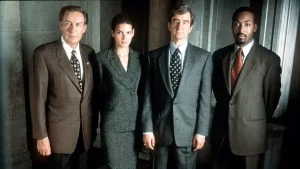
20 Arresting Facts About Law & Order
Few television shows have become as recognizable as Law & Order. With its distinctive opening narration, unforgettable “dun-dun” sound and stories divided between police investigations and courtroom prosecutions, the series created a formula that became one of television’s most durable inventions.
The original Law & Order premiered in 1990 and eventually became a television institution. Its success produced numerous spin-offs, including Law & Order: Special Victims Unit, Criminal Intent, Trial by Jury and Organized Crime. Yet behind that familiar formula are plenty of fascinating facts.
Here are 20 things you might not know about Law & Order.
1. The original series premiered in 1990
Law & Order debuted on NBC on September 13, 1990.
The show was created by Dick Wolf, who wanted to build a crime drama that did something different from many conventional police procedurals.
Instead of spending an entire episode following detectives, Law & Order divided its stories into two major sections: the investigation and the prosecution.
That simple idea became the foundation of the franchise.
2. The famous “dun-dun” wasn’t originally part of the concept
One of television’s most recognizable sounds is the dramatic “dun-dun” heard during scene transitions.
Composer Mike Post created the show’s distinctive theme music. The sound effect became so closely associated with Law & Order that viewers eventually recognized it almost instantly.
The combination of the music, typewriter-like sounds and police sirens created a sonic identity unlike almost any other television program.
3. The opening narration became iconic
The show’s opening begins with a narration explaining that the criminal-justice system consists of two separate but equally important groups: the police who investigate crime and district attorneys who prosecute offenders.
That introduction became one of television’s most recognizable opening sequences.
Even viewers who had never watched a full episode often recognized the words and the accompanying music.
4. The show was inspired partly by real events
Many Law & Order episodes were inspired by real crimes or legal controversies.
The writers did not simply recreate famous cases word for word. Instead, they often took elements from actual events and transformed them into fictional stories.
This allowed the series to explore contemporary issues while maintaining enough distance from the real people involved.
That approach became one of the franchise’s trademarks.
5. Dick Wolf originally envisioned an unusual structure
Wolf’s concept was ambitious because he wanted the series to combine two genres.
The first half would resemble a traditional police procedural.
The second half would function more like a legal drama.
The result was essentially two television shows inside one episode.
That structure allowed the series to appeal simultaneously to viewers interested in detective work and viewers fascinated by courtroom strategy.
6. The cast changed constantly
One of the most unusual characteristics of Law & Order was its willingness to change major characters.
Detectives left.
Prosecutors left.
District attorneys changed.
Judges and supporting characters came and went.
Yet the series continued.
This helped create the impression that the city itself was the constant character, rather than any individual actor.
7. Jerry Orbach became one of the show’s defining stars
Jerry Orbach joined the series as Detective Lennie Briscoe in 1992.
His dry humor, world-weary personality and unmistakable voice quickly made Briscoe one of the most beloved characters in the franchise.
Orbach remained with the original series for more than a decade.
His performance became so strongly associated with Law & Order that Briscoe remains one of the most recognizable detectives in television history.
8. Sam Waterston became another franchise institution
Sam Waterston joined Law & Order as Executive Assistant District Attorney Jack McCoy.
McCoy was intelligent, passionate and sometimes willing to push the boundaries of conventional courtroom strategy.
Waterston’s performance helped establish the character as one of the franchise’s most enduring figures.
He remained associated with the show for decades, eventually returning when the original series was revived.
9. The show was not afraid to tackle controversial subjects
Law & Order frequently addressed subjects that were dominating headlines.
Cases involving politics, race, celebrity culture, terrorism, corruption, corporate crime and controversial social issues became part of the series.
The stories were often fictional, but their subject matter reflected the real world.
This gave the program a sense of immediacy that helped distinguish it from purely escapist television.
10. The series became famous for its “ripped from the headlines” reputation
Although the phrase “ripped from the headlines” became strongly associated with the franchise, the idea was broader than simply copying newspaper stories.
Writers could take a current controversy and construct an entirely new fictional case around it.
That gave Law & Order an unusual ability to respond quickly to events in American society.
Sometimes the similarities were obvious.
Other times they were subtle.
11. New York City was central to the show’s identity
The series was filmed extensively in New York, and the city became almost a character itself.
Courthouses, streets, offices, restaurants and neighborhoods gave the show an authenticity that would have been difficult to reproduce entirely on a soundstage.
The visual identity of New York became inseparable from the franchise.
12. Many famous actors appeared as guest stars
Over the years, Law & Order featured an astonishing number of actors before or during their rise to greater fame.
Some appeared in single episodes.
Others returned in different roles.
The guest-star tradition became one of the show’s pleasures because viewers could suddenly recognize a future movie star, Broadway performer or television favorite.
The series became something of a showcase for acting talent.
13. The show helped create the modern television franchise
The success of the original series allowed Dick Wolf and NBC to build an interconnected universe.
Law & Order: Special Victims Unit premiered in 1999 and became an enormous success in its own right.
Other series followed.
The result was one of television’s most successful procedural franchises.
14. Special Victims Unit eventually outlasted the original
The original Law & Order ended its initial run in 2010 after 20 seasons.
But Law & Order: SVU continued.
That meant the spin-off eventually became the longest-running series in the franchise.
Its success also helped keep the Law & Order name in the public consciousness even after the original program disappeared from the schedule.
15. The original show returned
After more than a decade away, Law & Order returned to NBC in 2022.
The revival brought back familiar elements of the original formula while introducing new characters and storylines.
Sam Waterston returned as Jack McCoy, giving longtime viewers a direct connection to the classic series.
The revival demonstrated just how durable the brand had become.
16. The show’s title became part of everyday language
The phrase “Law & Order” was already familiar before the television series, but the program gave it an entirely new cultural identity.
The opening narration, courtroom structure and “dun-dun” became instantly recognizable references.
Parodies of the series appeared everywhere from comedy shows to late-night television.
17. The show influenced other crime dramas
The Law & Order format proved that audiences would follow multiple stages of a criminal case.
Later procedural dramas adopted elements of the same structure.
Some focused heavily on forensic science.
Others emphasized courtroom strategy.
Still others concentrated on detectives.
But Law & Order demonstrated how effectively these worlds could be combined.
18. It made prosecutors television heroes
Traditional police dramas tend to focus on detectives.
Law & Order gave prosecutors equal importance.
That was significant because courtroom attorneys had often been supporting characters in crime stories.
Here, prosecutors became central figures.
Their decisions could determine whether a case succeeded or collapsed.
19. The show became a television marathon favorite
Because individual episodes were largely self-contained, Law & Order became ideal for syndication and reruns.
A viewer could watch an episode without knowing every detail of previous seasons.
This made the series particularly well suited to cable television and later streaming.
Its enormous episode library meant viewers could easily spend hours watching one case after another.
20. Its greatest achievement may be its longevity
Perhaps the most impressive fact about Law & Order is not a particular actor, episode or storyline.
It is the fact that the basic concept has remained relevant for decades.
The original show proved that television viewers would repeatedly watch stories about crime, investigation, justice and the complicated decisions made by prosecutors.
Its success created a franchise that has survived changing television fashions, changing audiences and enormous changes in the entertainment industry.
A Television Institution
When Law & Order premiered in 1990, nobody could have predicted how influential it would become.
The series transformed a simple idea — follow a criminal case from investigation through prosecution — into a television formula capable of supporting decades of programming.
It also created unforgettable characters.
Detectives such as Lennie Briscoe became cultural icons. Prosecutors such as Jack McCoy became synonymous with television courtroom drama. Guest appearances became events, and the show’s opening narration and “dun-dun” sound became instantly recognizable.
Most importantly, Law & Order established a world in which the police and prosecutors were both essential to the story.
That structure helped distinguish the series from its competitors and gave audiences a reason to keep returning.
More than three decades after its debut, the franchise remains one of television’s most recognizable crime brands.
For generations of viewers, hearing that familiar narration followed by the unmistakable sound effect immediately brings back images of New York streets, detectives asking questions, prosecutors building cases and defendants sitting nervously in court.
Few television shows have achieved that level of recognition.
And that may be the most “arresting” fact of all: Law & Order didn’t merely become a successful crime drama.
It became a language of television all its own.