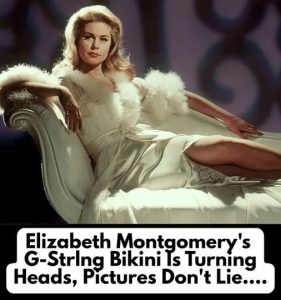
Elizabeth Montgomery’s Bikini Photos Still Turn Heads: The Style and Legacy of a Television Icon
Elizabeth Montgomery remains one of the most recognizable actresses of classic American television. Best remembered for playing the charming and mischievous Samantha Stephens on Bewitched, Montgomery became an enduring symbol of 1960s television, combining elegance, humor and a distinctive screen presence that continues to attract audiences decades after the show ended.
Among the photographs that periodically resurface online are images of Montgomery in swimwear. Modern social media often presents these pictures with sensational headlines, but the photographs are ultimately part of a much larger story: they capture a celebrated actress at a time when Hollywood stars were increasingly photographed away from the television studio and movie set.
Montgomery’s appeal was never based on one particular photograph. Her lasting popularity came from a remarkable combination of acting ability, charisma and an unmistakable personality that made Samantha Stephens one of television’s most beloved characters.
The woman behind Samantha Stephens
Born on April 15, 1933, Elizabeth Montgomery came from a family with deep connections to the entertainment industry. Her father, Robert Montgomery, was a successful actor and director, while her mother, Elizabeth Bryan Allen, had also worked as an actress.
Montgomery therefore grew up surrounded by the world of theater, film and television.
She began building her own acting career in the 1950s, appearing in television programs and theatrical productions before becoming a familiar face to American audiences.
Her major breakthrough arrived in 1964 with Bewitched. The premise was unusual: Samantha Stephens was a suburban housewife who happened to be a witch. Although she promised her husband, Darrin, that she would live an ordinary life, her magical abilities inevitably complicated their everyday existence.
Montgomery’s performance was central to the show’s success.
She could play Samantha as sophisticated, funny, mischievous and affectionate, often shifting between different emotions within a single scene. Her famous nose twitch became one of the most recognizable visual gags in television history.
A different side of a television star
Photographs of Montgomery away from Bewitched offered viewers an opportunity to see her outside the carefully constructed image of Samantha Stephens.
During the 1960s and 1970s, celebrity magazines frequently published photographs of actors at beaches, swimming pools and vacation destinations. These images were a major part of popular entertainment culture.
For modern audiences, such photographs can feel unusually intimate because television stars of Montgomery’s era did not have the constant social-media presence that celebrities have today.
There were no Instagram posts, livestreams or daily celebrity updates.
Instead, fans often encountered their favorite stars through television appearances, magazine covers, newspaper features and professionally taken photographs.
A swimwear photograph could therefore become a memorable part of a celebrity’s public image.
Montgomery’s photographs in bathing attire have occasionally resurfaced online for precisely this reason. They provide a glimpse of the actress in a relaxed setting rather than in Samantha’s trademark dresses or the formal clothing associated with television publicity.
Fashion in the 1960s
The 1960s represented a major period of change in fashion.
Swimwear became increasingly varied, with designers experimenting with different silhouettes, patterns and cuts. The decade also witnessed a broader cultural shift toward youthful styles and more relaxed attitudes toward clothing.
Bikinis, which had already existed for years, became increasingly visible in popular culture.
Hollywood actresses and models were frequently photographed wearing fashionable swimwear, and these images helped define the visual identity of the era.
Montgomery’s own photographs should therefore be viewed within this historical context.
Rather than treating one image as an isolated curiosity, it is more interesting to consider what such photographs reveal about the changing relationship between television celebrities, fashion and popular culture.
Why the pictures continue to attract attention
There is another reason old photographs of Montgomery continue to circulate: nostalgia.
Classic television has experienced repeated revivals among audiences who discover older programs through streaming services, DVD collections and television reruns.
Bewitched remains particularly easy to recognize because its central concept is timeless. The idea of an ordinary household hiding an extraordinary secret still works decades after the original series premiered.
As new generations discover Samantha Stephens, they also become curious about Montgomery herself.
Photographs from her personal and professional life consequently receive renewed attention.
A picture that may have been published decades ago can suddenly become popular again after appearing on a social-media account or classic-television page.
The passage of time can make these photographs even more fascinating.
Elizabeth Montgomery was more than a television beauty
Although discussions of Montgomery’s appearance are common whenever vintage photographs circulate, reducing her career to photographs would overlook one of the most accomplished television performers of her generation.
After Bewitched, Montgomery deliberately pursued roles that were very different from Samantha Stephens.
She appeared in dramatic productions and television movies, demonstrating that her abilities extended far beyond comedy.
Her later career included numerous dramatic performances, many of which dealt with serious subjects.
This was important because Montgomery had become so strongly identified with Samantha that audiences could easily have assumed she was primarily a comic actress.
Instead, she repeatedly demonstrated her range.
Her willingness to tackle difficult roles helped establish her as a respected performer rather than simply a nostalgic television star.
The complicated legacy of Bewitched
Bewitched remains one of the defining sitcoms of the 1960s.
The series used supernatural comedy to explore ordinary domestic life, marriage and social expectations. Samantha possessed extraordinary powers but frequently found herself dealing with everyday problems involving neighbors, relatives, work and family.
That contrast made the program distinctive.
Montgomery’s performance allowed the series to maintain its whimsical tone while still giving Samantha emotional depth.
Her character was also unusual for the period. Samantha was intelligent, capable and frequently more powerful than the people around her, yet she was not portrayed simply as a superhero.
Instead, the series placed her magical abilities inside the familiar world of suburban domestic life.
That combination helped make Samantha one of the era’s most memorable television characters.
Vintage photographs and modern celebrity culture
The way audiences respond to Montgomery’s old photographs also demonstrates how dramatically celebrity culture has changed.
Today, celebrities can control much of their public image through personal social-media accounts. They can choose which photographs to publish, explain the context and communicate directly with fans.
Montgomery lived in a very different era.
Much of a celebrity’s image was shaped by studios, magazines, photographers and television networks.
Publicity photographs were carefully selected, while candid images could appear in entertainment publications without the immediate response mechanisms available today.
As a result, vintage photographs often provide an intriguing historical record.
They show celebrities in settings that feel less polished than modern promotional campaigns, even when the pictures themselves were professionally produced.
Montgomery’s swimwear photographs belong to that broader visual history.
A lasting icon
Elizabeth Montgomery died on May 18, 1995, at the age of 62, but her cultural presence has remained remarkably strong.
For millions of viewers, she will always be associated with Samantha Stephens and the magical world of Bewitched.
Her influence can be seen whenever television historians discuss classic sitcom performances or whenever Samantha’s distinctive nose twitch appears in clips celebrating television history.
Her photographs also continue to circulate because nostalgia has become a powerful force in modern entertainment.
Old images allow audiences to connect with a period they may never have experienced personally.
They provide a visual bridge between generations.
For people who watched Montgomery when Bewitched originally aired, the photographs may bring back memories of the actress at the height of her fame. For younger audiences, they offer another perspective on the woman behind one of television’s most famous characters.
The real story behind the photographs
The most interesting thing about Montgomery’s vintage swimwear photographs is not simply what she was wearing.
It is what the images represent.
They capture a television star during an era when Hollywood fashion, celebrity photography and popular culture were changing rapidly. They also remind viewers that performers who become permanently associated with fictional characters had lives and careers beyond those roles.
Montgomery was Samantha Stephens, but she was also an accomplished dramatic actress, a performer who worked extensively in television and an artist who spent decades developing her craft.
The photographs are therefore best understood as small pieces of a much larger career.
Decades after Bewitched first introduced audiences to Samantha’s magical world, Elizabeth Montgomery remains a familiar name in American entertainment history.
Her style, photographs and performances continue to attract attention, but her greatest legacy remains her work.
The vintage images may capture a particular moment in time, yet it is Montgomery’s talent that has allowed that moment—and the actress herself—to remain memorable for generations.