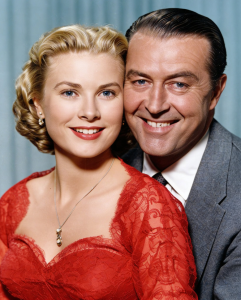
The two classic Hollywood stars are Ray Milland and Grace Kelly, and the bonus answer is Dial M for Murder (1954).
Released on July 23, 1954, Dial M for Murder remains one of Alfred Hitchcock’s most elegant and suspenseful thrillers — a masterclass in how to turn a seemingly simple murder plot into a tightening trap of blackmail, deception, and psychological pressure. The image you’re describing captures the film’s central tension perfectly: Ray Milland as the charming but deeply calculating husband Tony Wendice, and Grace Kelly as the poised, wealthy wife Margot, whose life is suddenly endangered by the man who is supposed to love her.
The clue about “one very important telephone call” is the giveaway. In Dial M for Murder, a ringing telephone becomes the trigger for a carefully orchestrated murder attempt, and Hitchcock builds an extraordinary sequence around that single moment.
By 1954, Grace Kelly was already emerging as one of Hollywood’s brightest stars, but Dial M for Murder was the film that truly announced her as Hitchcock’s new blonde muse. She had appeared in Mogambo the previous year and earned an Academy Award nomination, yet it was her collaboration with Hitchcock that transformed her from a promising actress into an icon of cinematic elegance.
Hitchcock was fascinated by Kelly’s ability to project composure while hinting at vulnerability beneath the surface. As Margot Wendice, she appears almost impossibly refined: immaculate gowns, controlled manners, and the kind of cool sophistication that became her trademark. But Hitchcock understood that suspense works best when danger threatens someone who seems protected by privilege and grace.
Ray Milland provides the perfect counterbalance. Tony Wendice is not a ranting villain; he is intelligent, articulate, and outwardly charming. A former tennis player whose career has faded, Tony discovers that his wife has had an affair with American crime writer Mark Halliday, played by Robert Cummings. Rather than confront the situation emotionally, Tony approaches it like a strategic problem to be solved.
That is what makes him so unsettling.
He devises an elaborate scheme to murder Margot and inherit her fortune while creating an airtight alibi for himself. His plan involves blackmailing an old acquaintance, Captain Lesgate, into carrying out the killing. The method is chillingly precise: Tony arranges for Lesgate to enter the apartment while Margot is alone, then places a telephone call at a specific time so that she will answer the phone with her back turned, making her an easy target.
Hitchcock stages this sequence with almost unbearable tension. The audience knows the plan in detail, which is a hallmark of Hitchcockian suspense. Instead of surprising viewers with the murder attempt, he forces them to watch it approach second by second. We see the clock, the key hidden under the stair carpet, the waiting intruder, and finally the ringing telephone.
Then everything goes wrong.
Margot answers the call, but when Lesgate attacks her, she fights back and kills him with a pair of scissors. It is one of the film’s most famous moments: Grace Kelly, usually associated with elegance and restraint, suddenly transformed into a desperate woman defending her life.
Tony’s reaction reveals his true nature. Rather than being horrified that his wife has nearly been murdered, he immediately begins constructing a new plan. He manipulates the evidence so that Margot appears guilty of premeditated murder, turning her act of self-defense into a capital crime.
This shift is what elevates Dial M for Murder beyond a simple murder mystery. The film becomes a battle of intelligence between Tony and the forces trying to expose him, particularly Inspector Hubbard, played brilliantly by John Williams.
John Williams’s performance is one of the great supporting turns in Hitchcock’s career. His Inspector Hubbard seems mild and almost absent-minded, but beneath the polite exterior is a razor-sharp mind. Hitchcock delights in allowing the audience to underestimate him, just as Tony does.
Much of the film takes place within the Wendices’ London apartment, and this confinement is crucial to its effectiveness. Hitchcock had adapted the story from Frederick Knott’s successful stage play, and instead of disguising its theatrical origins, he embraced them. The apartment becomes a pressure cooker where every object — a key, a handbag, a pair of scissors, a telephone — acquires enormous significance.
The key is especially important. Hitchcock repeatedly returns to it as a visual motif, using it to reveal the flaws in Tony’s supposedly perfect scheme. The climax hinges not on a dramatic chase or violent confrontation, but on a small inconsistency involving which key fits which lock. It is a wonderfully Hitchcockian resolution: the villain undone by detail rather than brute force.
What makes the film particularly fascinating today is its position within Grace Kelly’s remarkable Hitchcock trilogy. In the span of a single year, she appeared in Dial M for Murder, Rear Window, and later To Catch a Thief. These films established the archetype of the Hitchcock heroine: beautiful, intelligent, self-possessed, yet placed in situations where appearances cannot guarantee safety.
Kelly’s performance in Dial M for Murder is often overshadowed by Rear Window, but many critics argue it is one of her finest pieces of acting. She must convey terror, confusion, resilience, and emotional betrayal while maintaining the character’s essential dignity. The scenes after Margot’s arrest are especially powerful because Kelly allows the character’s composure to crack just enough for the audience to feel the enormity of her predicament.
Ray Milland, meanwhile, delivers a masterclass in controlled villainy. He never raises his voice unnecessarily, never indulges in melodrama, and never stops thinking. Tony Wendice is terrifying precisely because he treats murder as an administrative task. Milland’s smooth delivery and effortless charm make the character believable as a man who could deceive friends, police, and even his wife.
The film was also notable for being shot in 3D, part of Hollywood’s early-1950s attempt to compete with television. Hitchcock used the format more subtly than many directors of the period. Rather than relying on gimmicky objects flying toward the audience, he employed depth to enhance the spatial relationships within the apartment, making the confined setting feel both intimate and claustrophobic.
Over the decades, Dial M for Murder has endured because its suspense is fundamentally human. The story is not driven by elaborate technology or spectacle, but by jealousy, greed, fear, and the desperate desire to escape consequences. A telephone call, a hidden key, and a moment of panic are enough to set the entire plot in motion.
Looking back from the perspective of film history, the pairing of Grace Kelly and Ray Milland feels almost perfect. She represents the luminous glamour of 1950s Hollywood at its peak; he embodies the sophisticated leading man capable of revealing darkness beneath a polished surface. Together, under Hitchcock’s direction, they create a thriller that remains astonishingly modern in its precision and psychological insight.
So the answer is Grace Kelly and Ray Milland, and the film released on this day in 1954 is Dial M for Murder — Alfred Hitchcock’s brilliantly tense tale of blackmail, jealousy, a murder plot gone wrong, and one unforgettable telephone call that changed everything.