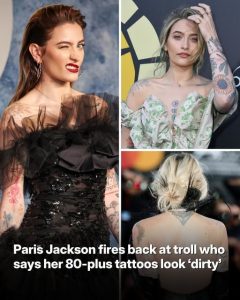
Paris Jackson Fires Back at Troll Who Says Her 80-Plus Tattoos Look ‘Dirty’
Paris Jackson has never been someone who hides her individuality. From her music and fashion choices to her distinctive tattoos and outspoken personality, she has built a public image around embracing the person she wants to be rather than fitting neatly into someone else’s idea of beauty. So when an online critic recently took aim at her extensive collection of tattoos, Jackson answered in the irreverent, self-assured way that has become part of her personality.
The latest exchange began after an Instagram post featuring Jackson drew attention to her heavily tattooed appearance. One commenter criticized her ink, arguing that the tattoos made her look “dirty.” Rather than ignoring the remark completely, Jackson responded with humor, effectively turning the insult back on the person who posted it. The exchange quickly attracted attention because it reflected something Jackson has dealt with throughout her years in the public eye: strangers feeling entitled to tell her what she should look like.
The controversy is hardly surprising when it comes to Jackson. With more than 80 tattoos covering different parts of her body, her appearance is considerably more tattooed than the conventional celebrity aesthetic. But for Jackson, the designs are not simply decorations. They are part of an evolving visual language that represents her interests, memories, relationships, creativity and personal journey.
A tattoo collection that tells a story
Jackson has accumulated tattoos since she was young, and she has frequently spoken about her love of body art. In a 2022 interview, she described getting her first tattoo as something of an impulsive decision. She has also explained that some of her tattoos have deep personal meaning, while others were simply designs she liked at the time.
That mixture is important because it demonstrates that there is no single explanation for Jackson’s collection. Some pieces commemorate people and experiences, while others reflect music, nature, spirituality or visual art.
Among her best-known tattoos are designs connected to her late father, Michael Jackson. Her body art has included references and tributes that carry emotional significance, making her collection much more than a random assortment of images.
Jackson has previously described tattoos as a way of changing how she viewed her own body and past. In an earlier discussion of her tattoos, she explained that she saw the artwork as a way of transforming painful memories into something creative and meaningful.
That history makes comments describing tattoos as simply “dirty” particularly simplistic. A tattoo can be judged aesthetically, of course, but for the person wearing it, the meaning can be considerably deeper than what a photograph reveals.
The criticism says more about beauty standards than tattoos
The reaction to Jackson’s tattoos also highlights an enduring debate surrounding celebrity appearance. Public figures are constantly photographed, analyzed and criticized, with social media making it easier than ever for strangers to offer unsolicited opinions.
Tattoos remain especially controversial because they can challenge traditional ideas about femininity and conventional beauty. For decades, visible tattoos were associated in popular culture with rebellion or counterculture. Although attitudes have changed significantly, some people still regard heavily tattooed skin as incompatible with elegance or glamour.
Jackson has consistently rejected that assumption.
Her red-carpet appearances demonstrate that tattoos do not prevent her from participating in high-fashion environments. She has appeared in everything from elaborate gowns to edgy alternative looks, sometimes allowing her tattoos to become a major part of the overall styling.
And interestingly, Jackson has also demonstrated that embracing tattoos does not mean she believes they must always be visible.
The time she covered every tattoo
One of the clearest examples came at the 2024 Grammy Awards.
Jackson arrived on the red carpet wearing a striking black Celine dress, and fans immediately noticed something unusual: her tattoos appeared to have disappeared.
They had not actually been removed. Instead, Jackson and her makeup team spent hours covering her more than 80 tattoos with specialized makeup. The transformation created the illusion of completely tattoo-free skin.
Rather than indicating that she had suddenly rejected her body art, Jackson explained that she simply wanted to experiment with another aesthetic. She said she loved her tattoos and piercings but also enjoyed changing things up and allowing the clothing itself to take center stage.
That moment is revealing because it shows that Jackson does not view her tattoos as a prison. She can display them proudly one day and conceal them for a special event the next.
The choice ultimately belongs to her.
Why the “dirty” comment struck a nerve
Calling someone’s tattoos “dirty” is different from simply saying that tattoos are not personally attractive. The former turns an aesthetic preference into a judgment about the person.
That distinction matters.
People can dislike tattoos. They can prefer uninked skin. They can even believe that extensive tattoos are unattractive. But telling another person that their body looks dirty because of their choices crosses into personal criticism.
Jackson’s response was therefore less about convincing every critic to love tattoos and more about refusing to accept somebody else’s judgment as a definition of her appearance.
Her humorous response made the exchange even more notable. Instead of delivering a lengthy angry statement, she essentially treated the insult as ridiculous. That approach can sometimes be more effective than a furious rebuttal because it refuses to give the critic the reaction they may have wanted.
More than 80 tattoos, but no single identity
Another interesting aspect of Jackson’s appearance is that her tattoos do not define everything about her.
She is a musician, model and actress who has worked across different areas of entertainment. Her fashion choices range from glamorous to punk-inspired, while her musical career has developed its own identity.
Her tattoos are simply one component.
That is worth remembering in an era when celebrity images are frequently reduced to a single feature. Someone can become “the tattooed celebrity,” “the fashion celebrity,” or “the controversial celebrity,” even though a real person is obviously more complicated.
Jackson’s career has repeatedly demonstrated that complexity.
She can be photographed with a heavily tattooed body and then appear at a major awards show with every tattoo concealed. She can experiment with makeup and fashion while also appearing in relatively stripped-down looks. She can be outspoken online while choosing not to respond to every criticism.
There is no contradiction in any of that.
Tattoos as personal expression
For many tattoo enthusiasts, body art functions much like clothing, jewelry or hairstyles: it provides a way to communicate personality.
The difference is permanence.
That permanence can make tattoos especially meaningful. A design may represent a particular period of someone’s life, a favorite artist, an important relationship, an emotional transformation or simply a moment when they wanted to put something beautiful on their skin.
Jackson has previously spoken about her tattoos in precisely those terms. Her collection includes imagery inspired by music, nature and personal experiences, and she has continued adding to it over the years.
Consequently, the criticism that her tattoos make her look “dirty” overlooks the artistic dimension of what she is doing.
Someone does not have to like the artwork to understand why it matters.
The bigger lesson from the exchange
The latest controversy is ultimately less about tattoos than it is about personal autonomy.
Celebrities have always faced criticism, but social media has made the process much more direct. A person can post a photograph and immediately receive thousands of comments about their hair, weight, clothes, makeup, tattoos or body.
Jackson has experienced this kind of commentary repeatedly throughout her public life.
Her decision to respond with humor reflects a broader approach to criticism: not every opinion deserves the power to change how someone feels about themselves.
That is particularly relevant for younger audiences who are growing up surrounded by highly edited photographs and relentless online comparison.
There is no universal definition of beauty.
For some people, beauty means clear skin without tattoos. For others, tattoos are precisely what makes someone’s appearance distinctive. Some people love dramatic body art; others prefer a completely natural look. None of these preferences has to become a rule for everyone else.
Paris Jackson’s choice remains her own
At the center of the controversy is a simple fact: Jackson’s tattoos belong to her.
She has spent years choosing designs, placing them on different parts of her body and deciding when to show or conceal them. She has demonstrated that she can appreciate tattooed skin while also enjoying the visual impact of a completely different look.
The 2024 Grammys proved that dramatically. Her tattoo-free appearance surprised fans precisely because her ink has become such a recognizable part of her image. Yet she was still unmistakably herself.
Her recent response to the online critic follows the same philosophy.
She does not need everyone to approve of her tattoos. She does not need every stranger online to understand their meaning. And she certainly does not have to redesign her body to satisfy somebody else’s definition of attractiveness.
In the end, the most interesting part of the story may not be the number of tattoos Jackson has, but the confidence with which she continues to own them.
More than 80 pieces of ink might seem extreme to someone who prefers traditional beauty standards. To Jackson, however, they form part of a personal canvas — one filled with memories, influences, experimentation and self-expression.
The critic saw something they disliked.
Jackson saw herself.
And her decision to laugh off the insult rather than surrender her individuality may be the strongest response of all.