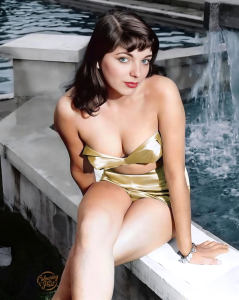
The young British starlet is Joan Collins.
Celebrating her 93rd birthday, the London-born actress photographed in 1951 was standing at the very beginning of a career that would eventually span more than seven decades and make her one of the most recognizable faces in entertainment history. Long before the shoulder pads, diamond earrings, and devastating Dynasty glare, Joan Collins was a fresh-faced teenager emerging from Britain’s postwar film industry — ambitious, glamorous, and already possessing the sharp intelligence that would become her trademark.
Born Joan Henrietta Collins on May 23, 1933, in Paddington, London, she grew up in a creative household. Her father, Joseph William Collins, was a theatrical agent whose clients included many major British performers, while her mother, Elsa, had trained as a dance teacher. The entertainment world was not a distant dream for Joan; it was woven into the fabric of her childhood.
Even as a schoolgirl, she displayed a striking combination of beauty and determination. Teachers reportedly found her spirited and difficult to ignore, and by her late teens she had enrolled at the Royal Academy of Dramatic Art (RADA). Yet the pull of actual film work proved stronger than formal training, and she soon began appearing in British productions.
That 1951 photograph captures Joan at a fascinating transitional moment. Britain was still rebuilding after the Second World War, and the film industry was searching for new stars who could compete with the glamour pouring out of Hollywood. Collins had exactly the kind of screen presence studios wanted: dark, expressive eyes, classical features, and an instinctive understanding of how to command a camera.
Her early breakthrough came with films such as Lady Godiva Rides Again (1951) and I Believe in You (1952), but it was The Woman’s Angle and Turn the Key Softly that began attracting serious attention. British critics quickly noticed that she was not merely decorative; she had a lively, modern energy that distinguished her from many of the era’s more restrained actresses.
Hollywood soon came calling.
In the mid-1950s, 20th Century Fox signed Joan Collins to a contract, seeing in her a potential rival to established glamour stars. The studio system specialized in transforming young actors into international icons, and Collins arrived in Los Angeles at precisely the moment when Technicolor melodrama was flourishing.
One of her most famous early Hollywood roles was opposite Bette Davis in The Virgin Queen (1955), where she played the ambitious Beth Throgmorton. Working with a legend like Davis could have been intimidating, but Collins later recalled the experience with characteristic wit and confidence. She was learning not only how to act for the camera, but how to survive among powerful personalities.
Then came the film that cemented her status as a major international beauty: Land of the Pharaohs (1955), directed by Howard Hawks. As the scheming Egyptian queen Nellifer, Collins delivered a performance filled with sensuality, calculation, and dramatic flair. The role hinted at something that would define much of her later career: she was exceptionally good at playing women who understood power.
Throughout the 1950s and 1960s, Joan Collins became a fixture of Hollywood glamour culture. She appeared in films such as Island in the Sun, The Bravados, Seven Thieves, and Esther and the King. She was photographed constantly, attended premieres and parties, and moved within the orbit of major stars, producers, and directors.
But her life was never merely a fairy tale of studio glamour.
Collins endured intense media scrutiny, complicated relationships, financial setbacks, and the unpredictable shifts of an industry that often discarded actresses once they were no longer considered youthful ingénues. Many performers who reached fame in the 1950s found their careers fading by the 1970s.
Joan Collins did not fade.
Instead, she reinvented herself repeatedly. She wrote novels, appeared in stage productions, embraced television, and cultivated a public persona that was witty, unapologetic, and refreshingly candid. She understood something crucial about celebrity: audiences often remain loyal to stars who reveal personality rather than hiding behind perfection.
Then, in 1981, came the role that transformed her from a respected veteran into a global television phenomenon.
Alexis Carrington Colby.
When Collins joined Dynasty in its second season, the series was struggling to compete with Dallas. Alexis changed everything. Entering the show in a white suit and hat, she immediately radiated danger, intelligence, and deliciously controlled fury.
The “Dynasty glare” mentioned in your clue became legendary. Collins could communicate contempt, amusement, and strategic calculation with a single look across a boardroom or dinner table. Alexis was not a simple villain; she was a brilliantly entertaining force of nature — fiercely protective of her children, ruthlessly ambitious, and endlessly quotable.
The 1980s embraced excess, and Joan Collins became one of its supreme symbols. Massive shoulder pads, sequins, champagne, catfights, and corporate warfare were all part of the Dynasty package, but Collins anchored the spectacle with impeccable timing and self-awareness. She seemed to understand that the show worked best when played with absolute conviction and a hint of wicked humor.
Her rivalry with Linda Evans, who played Krystle Carrington, became one of television’s defining dramatic pairings. Their confrontations were watched by millions around the world, and Dynasty became an international obsession. Collins received a Golden Globe Award for the role and became one of the highest-paid actresses on television.
What makes her story particularly remarkable is the timing. Most stars achieve their greatest fame in their twenties or thirties. Joan Collins became a global cultural phenomenon in her late forties and early fifties. That alone makes her career highly unusual.
Off-screen, she cultivated the image of a sophisticated survivor. Her interviews were often as entertaining as her performances: sharp observations, perfectly delivered one-liners, and a refusal to behave like a retiring former star. She wrote bestselling memoirs and novels, appeared on talk shows, and remained a prominent figure in fashion and celebrity culture.
The phrase “great survivor of show business” is especially apt. Collins lived through the British studio era, the Hollywood contract system, the decline of classical cinema, the rise of television, the tabloid explosion, and the modern celebrity age. At each stage, she adapted.
She also maintained a surprisingly active career well into her later decades, appearing in films, television series, stage productions, and documentaries. Rather than treating aging as a reason to disappear, she embraced visibility and continued to celebrate glamour on her own terms.
Looking back at that 1951 photograph, it is astonishing to realize that the young woman posing at the start of her career would eventually become not just an actress, but a cultural archetype. Joan Collins came to represent a particular kind of indestructible glamour: intelligent, theatrical, slightly dangerous, and entirely aware of her own effect on an audience.
So the answer is Joan Collins — the London-born actress photographed in 1951 as her screen career began, who went on to conquer British cinema, Hollywood melodrama, scandal-filled celebrity culture, and ultimately achieve immortal 1980s television fame as the unforgettable Alexis Carrington Colby in Dynasty. More than seven decades after that early photograph, she remains exactly what the clue promises: sharp-tongued, stylish, and impossible to ignore.