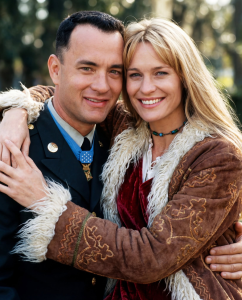
The film is Forrest Gump, and the actress is Robin Wright, who played Jenny Curran.
Born on April 8, 1966, Robin Wright has built one of the most fascinating careers of any actress of her generation. Although many audiences first encountered her as the luminous Buttercup in The Princess Bride, it was Forrest Gump that gave her one of cinema’s most emotionally resonant roles. Standing beside Tom Hanks as Forrest, Wright created a character who is far more complex than the nostalgic surface of the film sometimes suggests.


4
The film that became a cultural phenomenon
Released in 1994, Forrest Gump arrived during an extraordinary year for American cinema, sharing the landscape with films such as Pulp Fiction, The Shawshank Redemption, and The Lion King. Directed by Robert Zemeckis and based on Winston Groom’s novel, the film follows Forrest, a man of limited intellectual ability but extraordinary kindness, as he inadvertently intersects with major events in American history.
The clues in your question point directly to the film’s most iconic images:
- “Life is like a box of chocolates” — delivered by Forrest on the Savannah bench.
- The long run across America — one of the movie’s defining visual sequences.
- The Southern narrator — Tom Hanks’s unforgettable Alabama-inflected performance.
Yet for all the film’s historical spectacle and quotable lines, its emotional core is Forrest’s lifelong connection with Jenny Curran.
Robin Wright’s Jenny: the heart of the story

Jenny is introduced as a lonely, abused little girl whom young Forrest meets on the school bus. Her simple act of kindness — “You can sit here” — becomes the beginning of a relationship that shapes Forrest’s entire life.
What makes Wright’s performance remarkable is that Jenny changes dramatically over the course of the film. She is not a static love interest; she is a woman trying, often unsuccessfully, to escape trauma and find herself amid the turbulence of the 1960s and 1970s.
A character moving through American history
As Forrest drifts through history almost untouched by cynicism, Jenny is deeply affected by it:
- the counterculture movement
- anti-war activism
- drug culture
- sexual liberation
- personal self-destruction
Wright had the difficult task of making these transitions believable while preserving the thread that connects the adult Jenny to the frightened child we first meet. Her performance is filled with small, revealing moments: a glance of shame, a forced smile, a sudden withdrawal when intimacy becomes too frightening.
Why Jenny divides audiences
Few major film characters inspire as much debate as Jenny Curran. Some viewers see her as selfish for repeatedly leaving Forrest; others view her as a tragic survivor of childhood abuse who struggles to believe she deserves unconditional love.
Robin Wright has often defended the character by emphasizing Jenny’s damage and fear rather than interpreting her actions as simple manipulation. Watching the film closely, it becomes clear that Jenny consistently pushes Forrest away not because she does not care for him, but because she believes her chaotic life will harm him.

That complexity is one reason the performance has endured. Wright resists the temptation to make Jenny either saintly or villainous; she allows her to remain contradictory, wounded, and deeply human.
The chemistry with Tom Hanks
The success of Forrest Gump depended enormously on the chemistry between Tom Hanks and Robin Wright. Their relationship spans decades, yet it always retains a sense of emotional continuity.
Hanks plays Forrest with complete sincerity. He never mocks the character, which allows the audience to invest fully in his devotion to Jenny. Wright, meanwhile, provides the counterweight: uncertainty, restlessness, and the painful awareness of how difficult life can be.
Their scenes together often contain very little overt romance. Instead, the connection is communicated through familiarity — the way Forrest looks at Jenny, the way she softens around him even when trying to keep her distance.
Before Jenny: The Princess Bride
Long before Forrest Gump, Robin Wright became a fantasy icon as Princess Buttercup in The Princess Bride.
Directed by Rob Reiner, the film has grown from a modest box-office performer into one of the most beloved cult classics ever made. As Buttercup, Wright projected fairy-tale beauty while maintaining a modern wit that prevented the character from becoming merely ornamental.
The contrast between Buttercup and Jenny is striking:
| Buttercup | Jenny |
|---|---|
| Fairy-tale romance | Real-world trauma |
| Idealized love | Complicated love |
| Mythic setting | American history |
| Playful adventure | Emotional realism |
That range announced Wright as an actress capable of moving between fantasy and serious drama with unusual ease.
The career reinvention: House of Cards

If Forrest Gump established Robin Wright as a major film actress, House of Cards reinvented her for a new era.
As Claire Underwood, she delivered one of television’s most formidable performances. Controlled, intelligent, and ruthlessly ambitious, Claire was almost the opposite of Jenny Curran. The role earned Wright multiple Golden Globe and Emmy nominations and demonstrated her command of minimalist, psychologically precise acting.
What is fascinating is how she uses silence in both roles, but for different purposes:
- Jenny’s silences often express pain or uncertainty.
- Claire’s silences function as power and calculation.
That ability to communicate radically different emotions with restraint is a hallmark of Wright’s acting style.
Wonder Woman and Blade Runner 2049


5
The question also references Wonder Woman and Blade Runner 2049.
In Wonder Woman, Wright played General Antiope, the fierce Amazon warrior who trains Diana. Despite limited screen time, she made a powerful impression through physical authority and emotional warmth.
In Blade Runner 2049, she portrayed Lieutenant Joshi, a hardened police superior operating within a bleak futuristic society. The performance was all steel and weariness, further proving her versatility.
By 2017, audiences could see three entirely different Robin Wrights:
- the compassionate romantic heroine (Forrest Gump)
- the icy political strategist (House of Cards)
- the battle-hardened authority figure (Wonder Woman, Blade Runner 2049)
Few actors manage such distinct identities without losing their essential screen presence.
The emotional legacy of Forrest Gump
More than thirty years after its release, Forrest Gump remains deeply embedded in popular culture. Quotations, memes, parodies, and references have kept the film constantly visible, but its endurance is ultimately emotional rather than merely nostalgic.
The final scenes between Forrest and Jenny are devastating precisely because the film has spent so much time building their history. When Forrest asks, “Is he smart, or is he…” and cannot finish the sentence, Hanks and Wright reduce the story to its most fundamental concern: the fear of passing on pain and the hope of creating something better.

Jenny’s death has often been criticized as melodramatic, yet Wright plays those scenes with remarkable restraint. She does not ask for sympathy; she allows the audience to feel the tragedy of a life spent searching for peace.
From soap opera to cinema legend
It is easy to forget that Robin Wright began her career on the soap opera Santa Barbara. Her journey from daytime television to acclaimed film actress, prestige-TV powerhouse, and respected director is one of Hollywood’s most impressive long games.
What ties all her major roles together is not a particular type of character, but a particular quality of performance: emotional transparency without sentimentality. Whether she is Buttercup declaring eternal love, Jenny struggling with her past, Claire Underwood plotting political domination, or Antiope training an Amazon princess, Wright makes the character’s inner life feel specific and lived-in.
The answer
So the answer is Forrest Gump.
The actress is Robin Wright, born on April 8, 1966, who played Jenny Curran — the restless, troubled, unforgettable woman who remains at the emotional center of Forrest’s journey from childhood through adulthood. Alongside her iconic work in The Princess Bride, House of Cards, Wonder Woman, and Blade Runner 2049, Forrest Gump stands as one of the defining performances of her career and one of the most emotionally enduring films of modern American cinema.