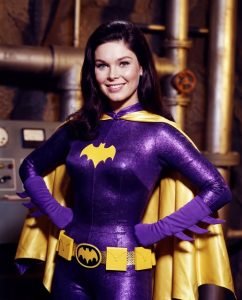
NAME THE ’60s STAR WHO PUT ON THE PURPLE CAPE AS BATGIRL!
The answer is Yvonne Craig, the actress, ballet dancer, and television star who became the first woman to portray Batgirl in live-action television. With her purple-and-yellow costume, distinctive Batcycle, athletic movement, and unmistakable charm, Craig transformed Barbara Gordon from a relatively new comic-book character into one of the most memorable additions to the colorful world of 1960s Batman.
Craig’s Batgirl arrived during the show’s third and final season in 1967, joining Adam West’s Batman and Burt Ward’s Robin as a new member of Gotham’s crime-fighting team. She played Barbara Gordon, the daughter of Gotham City Police Commissioner Gordon and a librarian who secretly became the masked heroine Batgirl. Craig’s performance was energetic, witty, graceful, and physical—a combination that reflected her unusual background as both an actress and professionally trained dancer.
Although Batgirl ultimately became her signature role, Craig’s career stretched well beyond Gotham City. Before putting on the cape and cowl, she had appeared in numerous films and television programs, including two movies with Elvis Presley. She also later became a memorable guest star on Star Trek, playing the green Orion character Marta.
When Craig died on August 17, 2015, at the age of 78, she left behind a remarkable career that crossed ballet, Hollywood movies, television, science fiction, comedy, and superhero entertainment. Her family announced that she had died at her home in Pacific Palisades from complications of breast cancer that had metastasized to her liver. (Yvonne Craig)
From Ballet to Hollywood
Yvonne Joyce Craig was born on May 16, 1937, in Taylorville, Illinois. Long before she became Barbara Gordon, she was a talented dancer.
At only 17, Craig became the youngest member of the Ballet Russe de Monte Carlo and toured with the company for three years. Her training gave her exceptional physical control and athletic ability, qualities that would later prove surprisingly useful when she entered Hollywood. (Yvonne Craig)
Craig’s transition from ballet to acting was not necessarily something she had planned from the beginning. Her official biography states that she was discovered by Patrick Ford, son of legendary filmmaker John Ford, and was subsequently cast in The Young Land. That opportunity helped launch her movie career. (Yvonne Craig)
The combination of beauty, grace, and physical ability made Craig particularly suited to the action-oriented roles that became part of her career.
A Familiar Face of the 1960s
Before Batman, Craig built an impressive collection of film and television credits.
She appeared in movies such as Gidget and The Young Land and became a familiar guest star on television. Her credits included Perry Mason, The Many Loves of Dobie Gillis, 77 Sunset Strip, The Man from U.N.C.L.E., The Wild Wild West, The Big Valley, My Favorite Martian, and many others. (Television Academy)
One particularly notable part of her pre-Batman career involved Elvis Presley.
Craig appeared opposite Presley in It Happened at the World’s Fair in 1963 and Kissin’ Cousins in 1964. The two films helped connect her with one of the biggest stars in popular entertainment at the time. (Yvonne Craig)
Her appearance alongside Elvis is an important reminder that Craig was already an established screen performer before Gotham City came calling.
Enter Batgirl
By 1967, ABC’s Batman had become one of television’s most recognizable shows.
The series was famous for its deliberately exaggerated style. Bright colors, comic-book sound effects, outrageous villains, cliffhangers, and playful performances turned the adventures of Batman and Robin into a cultural phenomenon.
But by the third season, the show’s ratings were declining. Producers wanted a new character who could add energy and potentially attract new viewers.
That character was Batgirl.
Craig was selected to originate the live-action role.
Her first appearance came in the season-three premiere, “Enter Batgirl, Exit Penguin,” which aired on September 14, 1967. She appeared as Barbara Gordon, a librarian and the daughter of Commissioner Gordon, while secretly operating as Batgirl. (The Guardian)
The result was an immediate transformation of the show’s familiar Dynamic Duo into a trio.
Batman, Robin, and Batgirl became the new crime-fighting combination.
The Purple Cape
Batgirl’s costume became one of the most recognizable superhero outfits of the television era.
Craig wore a purple-and-yellow ensemble complete with cape and cowl, creating a striking visual contrast with Batman’s darker costume and Robin’s brighter colors.
But the costume alone was not responsible for the character’s success.
Craig brought physicality to the role.
Her ballet background allowed her to move with unusual grace during action sequences. She also had experience riding motorcycles, an ability that became particularly useful because Batgirl had her own motorcycle.
The Batcycle became almost as memorable as the character herself.
The Emmy Awards’ official biography notes that Craig performed her own stunts and motorcycle riding for the series. (Television Academy)
That was an extraordinary achievement for television at the time.
Craig Did Her Own Stunts
Craig’s athletic background became one of her greatest advantages.
Rather than simply standing beside Batman and Robin, she wanted Batgirl to feel like a genuine participant in the action.
Her experience as a dancer helped enormously.
She understood balance, timing, movement, and choreography. She also knew how to project physical confidence on camera.
Craig later recalled that producers initially did not necessarily expect her to perform all of her own stunts. But she was able to persuade them to let her participate, partly because they discovered she already knew how to ride a motorcycle. (Television Academy)
Ironically, the Batcycle itself was not always comfortable.
Craig explained that modifications made to the motorcycle for the production affected its suspension. According to her recollections, riding over bumps could be an uncomfortable experience. (The Guardian)
Nevertheless, she became an important part of the show’s physical comedy and action.
Barbara Gordon Was More Than a Secret Identity
One of the strengths of the Batgirl character was the contrast between Barbara Gordon and her masked persona.
As Barbara, Craig played a capable professional working as a librarian.
As Batgirl, she became a confident crime fighter who could move through Gotham with Batman and Robin.
That dual identity gave the character a different rhythm from the show’s male heroes.
Barbara was not simply waiting for Batman to rescue her.
She had her own secret, her own motorcycle, her own costume, and her own crime-fighting abilities.
That made the character stand out in a television landscape where female heroes were comparatively rare.
The Television Academy describes Craig as the actress who originated the role of Batgirl in 1967, playing both the masked heroine and Barbara Gordon, the daughter of Commissioner Gordon. (Television Academy)
A Superhero Pioneer
Today, superhero television is everywhere.
Audiences are accustomed to seeing female superheroes leading movies, television series, and streaming shows.
But in the 1960s, the landscape was very different.
Craig’s Batgirl was therefore significant not simply because she was entertaining, but because she represented one of television’s earliest major live-action female superheroes.
Her character helped demonstrate that a woman could occupy the same colorful superhero world as Batman and Robin while maintaining an identity of her own.
Later generations of female superhero characters would become far more complex and prominent, but Craig’s performance remains an important early milestone.
Life After Batman
When Batman ended after its third season, Craig did not disappear from television.
She continued working in a variety of productions.
One of her most memorable post-Batgirl appearances came on Star Trek.
In the 1969 episode “Whom Gods Destroy,” Craig played Marta, a green-skinned Orion woman. The role gave her another unforgettable place in science-fiction history. (The Guardian)
She also appeared in programs including The Mod Squad, The Six Million Dollar Man, Kojak, Starsky and Hutch, and Emergency! among others. (Television Academy)
Her ability to move between genres demonstrated that she was far more versatile than her Batgirl image might initially suggest.
Beyond Acting
Craig eventually stepped away from regular acting and entered the real-estate business.
She continued to maintain an interest in the entertainment world, however, and occasionally returned to voice work. Her later career demonstrated that she had successfully built a life outside Hollywood rather than being defined entirely by her most famous role.
She also published an autobiography, From Ballet to the Batcave and Beyond, reflecting on the extraordinary path that took her from professional ballet to television superstardom. (The Guardian)
The title itself perfectly summarizes her unusual journey.
Few performers could honestly say they had traveled from the ballet stage to Gotham City.
Craig could.
Remembering Yvonne Craig
Yvonne Craig died on August 17, 2015, at her home in Pacific Palisades. She was 78.
Her family said she died from complications of breast cancer that had metastasized to her liver. She was surrounded by family at the time. (Yvonne Craig)
News of her death prompted tributes from across the entertainment world.
For many people, she was forever associated with the purple cape, the Batcycle, and the unmistakable image of Batgirl racing through Gotham.
For others, she was the actress who appeared opposite Elvis Presley.
For Star Trek fans, she was Marta.
And for television historians, she was a pioneer who helped establish one of the earliest major live-action female superhero roles.
The Legacy of Batgirl
The enduring popularity of Craig’s Batgirl says something about the power of a well-designed television character.
The series itself was deliberately campy. The villains were exaggerated, the plots were often absurd, and the action was filled with comic-book humor.
Yet Batgirl survived beyond the original series.
Her costume became iconic.
Her motorcycle became memorable.
Her image appeared in toys, comics, collectibles, retrospectives, and countless celebrations of classic television.
Most importantly, the character became part of the larger history of female superheroes.
Craig did not simply play a character who happened to wear a cape.
She originated the live-action version of a character who would become a major part of DC’s superhero universe.
The Answer: Yvonne Craig
So, who was the ’60s star who put on the purple cape and became Batgirl?
Yvonne Craig.
Born a dancer, transformed into an actress, and eventually immortalized as Barbara Gordon, Craig had one of those careers that seems almost too unusual to be real.
She danced with the Ballet Russe de Monte Carlo.
She appeared alongside Elvis Presley.
She became a familiar face on television.
Then, in 1967, she climbed onto the Batcycle and became Batgirl.
Her time on Batman lasted only one season, but its impact lasted decades.
Craig’s story is a reminder that a performer does not necessarily need hundreds of episodes or decades in one role to leave a lasting impression. Sometimes a single character, played with the right combination of talent, athleticism, humor, and personality, is enough.
For Yvonne Craig, that character was Batgirl.
And every time that purple cape appears on a classic television screen, her legacy comes roaring back into Gotham City.