The Centuries-Old Tool Woodworkers Still Rely On Today
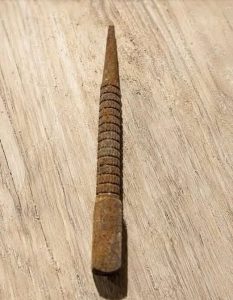
At first glance, the object in this photograph looks almost too simple to be important.
It is a long, weathered metal tool with a tapered end and a series of ridges along its shaft. There is no electric motor, no battery, no complicated mechanism and no digital display. Yet tools of this general type represent an important chapter in the history of woodworking: the nail punch, or nail set.
The basic nail punch is one of those workshop tools whose design is remarkably straightforward. Its purpose is to allow a woodworker to drive a nail head slightly below the surface of timber, creating a small depression that can later be filled and finished. Traditional carpentry references describe nail punches as tapered tools used to sink nail and pin heads beneath the wood surface. (FlipHTML5)
That may sound like a tiny job.
But in woodworking, tiny jobs can make an enormous difference.
A Tool Designed for the Finishing Touch
Imagine building a beautiful wooden cabinet.
The boards have been carefully selected. The joints are aligned. The surfaces have been sanded. The edges are smooth.
Then you look closely and see a row of exposed nail heads.
Suddenly, the finished piece looks unfinished.
This is where the nail punch earns its place.
Instead of striking the nail directly with the hammer again and again, the craftsperson places the punch over the nail head and gives the punch a controlled tap. The nail is driven just below the surrounding surface.
The resulting small hole can then be filled with putty, wood filler or another suitable material. Once it has been sanded and finished, the nail can become extremely difficult to see.
Carpentry training materials describe precisely this process: nail heads are punched below the timber surface and the resulting holes are filled during finishing. (FlipHTML5)
It is a simple technique, but it can transform the appearance of a project.
Why the Punch Has a Special Tip
A proper nail set is not simply a random piece of pointed steel.
Its working end is designed to engage the nail head.
Traditional nail punches commonly have a slightly cupped or hollowed tip. That shape helps the punch stay centered on the nail head instead of slipping sideways and damaging the surrounding wood. (WayBuilder)
That small detail demonstrates something important about traditional tools.
Their designs were refined through experience.
A carpenter did not need an electronic sensor to know that a flat-ended punch could slide off a small nail head. Generations of craftsmen learned what worked, and manufacturers eventually incorporated those lessons into the tools themselves.
The result was a tool that looked simple because the complicated part had already been solved through design.
Different Sizes for Different Nails
One nail punch is not necessarily suitable for every nail.
Nails and pins come in different sizes, and the tip of the punch should correspond to the nail being recessed.
If the punch is too large, it can damage the wood around the nail.
If it is too small, it may fail to engage the nail properly or damage the nail head.
Carpentry references specifically note that nail punches are available in different diameters and that the correct size should be selected for the nail being used. (FlipHTML5)
That is why traditional toolboxes often contained several punches.
A small punch could be used for delicate finishing nails or pins, while a larger one could handle heavier nails.
The principle remained exactly the same.
Before Modern Power Tools
Today, a woodworker can reach for a pneumatic nailer, electric finish nailer or cordless tool and drive fasteners in seconds.
Earlier craftsmen did not have that luxury.
For much of woodworking history, construction depended on hand tools, physical skill and careful technique.
A hammer drove the nail.
A punch recessed it.
A chisel cleaned joints.
A plane refined surfaces.
A scraper removed imperfections.
A hand saw cut the boards.
The tools were simple, but the craftspeople using them developed tremendous skill.
That is part of the reason antique woodworking tools remain so fascinating today. They provide a physical connection to earlier generations of carpenters and joiners.
Historical research into woodworking tools shows that many traditional implements retained essentially the same basic purpose for very long periods, even as their materials and manufacturing methods improved. (Project Gutenberg)
The Image Tells a Story
The photographed tool is especially interesting because of its aged appearance.
The darkened metal, worn surface and old-fashioned shape suggest that it was built for practical work rather than decoration.
But an important caution is necessary when identifying old tools from photographs: appearance alone cannot always establish the exact tool or its age.
Antique punches, center punches, drifts and other striking tools can look remarkably similar.
A nail set normally has a working end shaped to seat on a nail head, whereas other punches may have sharply pointed, flat or differently shaped tips. Historical tool catalogs also distinguish nail sets from center punches, which have different purposes. (Scribd)
So while the headline associated with the image identifies the object as a traditional woodworking tool, determining the exact identity of one particular antique example would require examining its tip, dimensions, markings and construction.
That mystery actually makes photographs of old tools even more interesting.
Why Simple Tools Survive
The modern world tends to associate progress with complexity.
Newer machines have computer controls.
Power tools have electronic speed settings.
Some woodworking equipment can automatically reproduce a design with extraordinary accuracy.
Yet a simple hand tool can survive alongside all of that technology.
Why?
Because some jobs do not need more complexity.
If the task is simply to push a nail head a few millimeters beneath the surface, a small steel punch and a hammer can do it extremely well.
There is no software to update.
There is no battery to charge.
There is no electrical connection.
There is almost nothing to break.
That is one reason traditional hand tools remain useful in workshops today.
More Than Just Woodworking
The basic punch principle extends beyond woodworking.
Different types of punches are used in metalworking, mechanical repair, construction and other trades.
But it is important not to confuse them.
A center punch, for example, is commonly used to create a small starting mark before drilling. A tapered punch can serve different mechanical purposes, including aligning or removing certain components. A nail set has the specific job of recessing nail heads. (WayBuilder)
Using the wrong punch for the wrong job can damage either the tool or the workpiece.
That is why experienced tradespeople pay attention to tool design even when two tools look almost identical.
The Importance of Control
One of the biggest advantages of a nail punch is control.
A hammer has a relatively broad striking face.
The punch concentrates that force into a tiny area.
This means the craftsperson can position the impact exactly where it is needed.
That precision becomes especially valuable when working on finished surfaces.
A misplaced hammer blow can dent the wood.
A slipping punch can leave a mark.
A correctly positioned nail set, however, allows the worker to apply a controlled strike directly to the fastener.
Traditional carpentry guidance emphasizes using appropriately sized punches and maintaining them in good condition. Damaged or chipped punches should not be used because striking tools can fail or send fragments into the air. (WayBuilder)
So even the simplest hand tools deserve proper respect.
Why Old Tools Can Be So Durable
Many traditional woodworking tools were manufactured from hardened steel.
The goal was simple: create a tool capable of absorbing repeated impacts without rapidly deforming.
Historical Stanley catalogs, for example, describe nail sets made from high-grade tool steel and designed specifically for setting nail heads below the surface of wood. (Scribd)
That explains why an old punch can sometimes survive decades of workshop use.
It does not have to be beautiful.
It does not have to be shiny.
It simply needs to remain strong enough to withstand hammer blows and precise enough to transfer those blows where they belong.
A tool that achieves those requirements can remain useful for generations.
The Skill Behind the Tool
It is easy to focus on the object itself and forget the person holding it.
But a nail punch is only as effective as the person using it.
A skilled woodworker knows how much force to apply.
They know when the nail has been recessed far enough.
They know which tip size to choose.
They know when the surrounding wood is too delicate for a heavy strike.
And they know that the final finish can be just as important as the construction itself.
That knowledge cannot be replaced simply by owning an old tool.
The tool is an extension of the craftsperson’s skill.
A Small Depression With a Big Effect
Perhaps the best way to understand the importance of a nail punch is to look at the final result.
After the nail is recessed, the small indentation may seem insignificant.
Then filler is applied.
The surface is allowed to dry.
It is sanded smooth.
Paint, stain or another finish is added.
The tiny hole disappears.
The finished piece looks clean and uninterrupted.
Nobody looking at the completed cabinet may even realize a nail was ever there.
That is the strange beauty of finishing tools.
Their success is often measured by how invisible their work becomes.
Why Woodworkers Still Keep Them
Modern woodworking has not eliminated the need for traditional tools.
Instead, it has given them new surroundings.
A nail punch can sit in a toolbox alongside cordless drills, routers, orbital sanders and precision measuring devices.
The old and new tools do not necessarily compete.
They complement one another.
A power tool might complete the major construction quickly.
A hand tool might provide the final adjustment.
A machine might cut the component.
A craftsman might make the final correction by hand.
That combination is common in modern woodworking because speed and precision do not always come from the same tool.
A Reminder That Good Design Ages Slowly
The real story behind this kind of old woodworking tool is not simply that it is ancient.
It is that the underlying problem has not disappeared.
Woodworkers still drive nails.
They still want smooth surfaces.
They still need to hide fasteners when appearance matters.
And they still benefit from a small tool that can deliver a precise amount of force exactly where it is required.
That is why a design developed generations ago can still make sense today.
Technology changes rapidly.
Basic physical problems often do not.
The Tool That Refuses to Become Obsolete
There is something satisfying about a tool that does not need an upgrade.
A nail punch does not need Wi-Fi.
It does not require an instruction manual hundreds of pages long.
It does not need a charging cable.
It does not send notifications.
It simply waits in the toolbox until somebody needs it.
Then the woodworker places its tip against a nail head, raises a hammer and gives it a carefully controlled strike.
The nail disappears beneath the surface.
The job is done.
That may sound almost too ordinary to celebrate, but ordinary is exactly what makes traditional tools remarkable.
They survived because they worked.
The photograph of this weathered implement therefore represents more than an old piece of metal. It represents a philosophy of craftsmanship in which tools are designed around real problems, refined through experience and kept in use as long as they continue to perform.
And perhaps that is the real secret of the centuries-old woodworking tool.
The newest tool is not always the best tool. Sometimes, the best tool is simply the one that has already solved the problem.