Trump FALLS Again! — What the Latest Evidence Really Shows About His Health
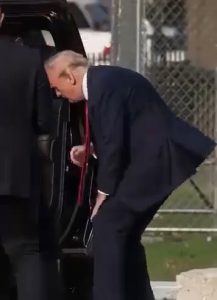
A photograph showing President Donald Trump leaning forward as he enters a vehicle has sparked another wave of online discussion about his health.
The image is dramatic enough to invite an immediate conclusion: Did Trump fall again?
But there is an important problem with that headline.
The photograph by itself does not establish that Trump fell, and as of August 21, 2026, I could not find a credible current report confirming that the image depicts a new fall or that the White House physician has issued a new statement specifically about such an incident.
That distinction matters.
President Trump is 80 years old, and his physical condition has increasingly attracted public attention. Recent reports have focused on visible bruising, swelling and questions about his mobility, while independent physicians have called for greater transparency. At the same time, Trump’s own physician, Capt. Sean Barbabella, reported after Trump’s May physical that the president was in “excellent health” and fit to perform his duties. (The American Presidency Project)
So what is actually known?
The Photograph That Started the Conversation
The image circulating online shows Trump dressed in a dark suit and red tie, bending forward while appearing to enter or exit a vehicle.
His posture immediately catches the eye.
Because the photograph captures only a single moment, however, it cannot tell us exactly what happened immediately before or after the frame was taken.
A person can bend forward while stepping into a vehicle, reaching for something, adjusting clothing or losing balance. Without video or reliable eyewitness reporting, it is impossible to determine from the photograph alone whether a fall occurred.
That is why sensational headlines can be misleading.
A photograph can raise a question.
It cannot automatically provide the answer.
Trump’s Health Has Been Under Greater Scrutiny
The interest surrounding the image is understandable because Trump’s health has already been a subject of intense public discussion this year.
In May, Trump underwent a physical examination at Walter Reed National Military Medical Center. The White House subsequently released a detailed memorandum from his physician, Capt. Sean Barbabella.
The report said Trump remained in “excellent health” and described his cardiac, pulmonary, neurological and overall physical function as strong. It also said he was fully fit to perform his presidential responsibilities. (The American Presidency Project)
The examination reportedly involved consultations with 22 specialty providers, an unusually large number that itself generated questions from outside physicians. (The Washington Post)
That means there are two very different conversations happening simultaneously.
One comes from the White House medical team, which says the president is fit and functioning well.
The other comes from independent observers who say some visible signs deserve additional explanation.
What Did the White House Doctor Actually Say?
The White House physician’s most recent detailed public assessment did not say that Trump had suffered a debilitating neurological condition or was unable to perform his duties.
Quite the opposite.
The May memorandum described his physical and cognitive performance as excellent and concluded that he was fit to continue serving as commander in chief. (The American Presidency Project)
That is the clearest official medical assessment publicly available in the sources reviewed for this article.
It is therefore inaccurate to claim that the White House doctor has suddenly “broken silence” to confirm that Trump suffered a new medical crisis unless a new statement is actually released.
At present, that confirmation is not supported by the evidence I found.
But There Are Genuine Questions
That does not mean every concern about Trump’s health is imaginary.
Recent reporting has highlighted visible changes that have prompted discussion.
One widely reported issue has been swelling in Trump’s lower legs. The White House physician previously diagnosed him with chronic venous insufficiency, a condition in which blood has difficulty returning efficiently from the legs toward the heart.
The White House has also attributed bruising on Trump’s hands to frequent handshaking and his use of aspirin.
These explanations have not ended public debate.
Independent physicians have continued to ask questions about the president’s overall health and the amount of information being released.
In August, cardiologist Jonathan Reiner, who previously served as physician to former Vice President Dick Cheney, publicly argued that Americans deserve greater transparency about Trump’s health. (Cardiovascular Business)
But there is a critical distinction between raising medical questions and diagnosing someone from photographs.
A physician cannot responsibly diagnose a person simply by watching a short video or examining a single photograph.
Why Balance Matters at Trump’s Age
Age is relevant to the discussion.
Trump turned 80 in June 2026, making him the oldest person ever to serve as U.S. president.
As people age, balance, muscle strength, reaction time and cardiovascular function can change.
But aging does not automatically mean someone is medically incapable of performing demanding responsibilities.
Some people remain remarkably active well into their 80s, while others experience substantial physical limitations much earlier.
That is precisely why individual medical evidence matters more than assumptions based on age.
A stumble can happen to an otherwise healthy person.
A moment of awkward movement does not automatically indicate a serious neurological disease.
Likewise, repeated problems with balance could potentially be medically significant.
The only responsible way to determine the difference is through professional evaluation.
What About the Claims of a “Fall”?
This is perhaps the most important point.
The headline says “Trump FALLS Again!”
But the available evidence does not establish that conclusion.
The photograph shows Trump bent forward near a vehicle.
It does not show a complete fall.
It does not show him lying on the ground.
It does not prove that he lost consciousness.
It does not prove that he suffered an injury.
And it does not establish that the White House physician responded to this particular moment.
Those details would require a verified report, video footage or an official statement.
Without that evidence, describing the event as a confirmed fall is premature.
Why Viral Health Headlines Spread So Quickly
Health-related headlines involving presidents and other famous people attract enormous attention because they combine two powerful subjects: politics and fear.
A headline suggesting that a president has suddenly collapsed can spread rapidly before anyone checks whether the underlying event actually happened.
The photograph then becomes “proof” in the minds of readers.
But visual evidence can be deceptive.
A single frame removes context.
A person who appears to be stumbling may simply be turning.
A person who appears confused may be looking at something outside the camera frame.
A person who appears to fall may actually be lowering himself into a seat.
That is why responsible reporting requires more than an emotionally powerful photograph.
The Medical Report Is More Complicated Than the Headlines
Trump’s May medical memorandum contains information that is more nuanced than either extreme narrative.
The report said he was in excellent health, but it also documented conditions and medications.
His listed medications included rosuvastatin and ezetimibe for cholesterol management and aspirin for cardiovascular prevention. The report also recorded his weight at 238 pounds and described recommendations involving increased physical activity and continued weight loss. (The American Presidency Project)
The report further noted chronic venous insufficiency in the context of the president’s medical evaluation, according to reporting on the examination. (The Washington Post)
In other words, “excellent health” does not mean “nothing whatsoever is medically wrong.”
It means the White House medical team assessed his overall condition as sufficiently good for his age and responsibilities.
That distinction is frequently lost in political arguments.
The Question of Transparency
The more serious issue raised by some physicians is not necessarily whether Trump is suffering from a specific disease.
It is whether the public has enough information to independently understand the president’s health.
Presidents occupy an unusual position.
Their health is private in many respects, but their ability to perform the duties of the presidency is a legitimate public concern.
Trump’s May examination involved 22 specialists, according to the White House memorandum. Yet officials did not publicly identify all of those specialists or explain precisely why each specialty was involved. That prompted questions from physicians such as Reiner. (The Washington Post)
Greater transparency could potentially reduce speculation.
Ironically, releasing more reliable information can sometimes make rumors less powerful.
When information is limited, people fill the gaps themselves.
What We Can—and Cannot—Say
Based on the current evidence, several things can be said with confidence.
Trump has undergone extensive medical evaluation this year.
His physician has publicly described him as being in excellent health and fit to serve.
He has documented medical issues, including chronic venous insufficiency and bruising that the White House has attributed to specific causes.
Independent doctors have raised questions about whether the public has been given enough information about his health.
And recent images have generated additional scrutiny.
But there is not enough verified evidence in the sources reviewed to say that the photograph proves Trump suffered another fall.
Nor is there evidence that his White House physician has issued a new emergency statement confirming such a fall.
The Bigger Picture
The fascination surrounding Trump’s movements is unlikely to disappear.
Every stumble, awkward gesture, long pause or unusual photograph is likely to receive enormous attention because of the office he holds.
That creates a difficult situation for both journalists and the public.
People have a legitimate interest in the president’s fitness.
But legitimate interest does not justify turning every ambiguous image into a medical diagnosis.
The most responsible approach is to separate what is visible from what is assumed.
The photograph shows a moment.
The medical records provide broader information.
Official statements provide another layer.
Independent medical commentary provides another.
Only when these pieces are combined can a meaningful picture begin to emerge.
The Truth Behind the Viral Headline
So, did Trump “fall again”?
The photograph alone does not prove it, and no credible current source reviewed here confirms that interpretation.
What is confirmed is that Trump’s health has become an increasingly visible subject of public debate as he enters his 80s.
His own physician says he remains in excellent health and fit for office. (The American Presidency Project)
Independent physicians have questioned whether the public has received enough information about certain visible health concerns. (Cardiovascular Business)
Both facts can exist at the same time.
The responsible conclusion is therefore neither “nothing is wrong” nor “Trump has suffered a major medical collapse.”
The responsible conclusion is that questions remain, but the viral photograph does not answer them.
And if a genuine fall or medical emergency occurred, the public deserves to hear about it from verified reporting and qualified medical sources—not from a sensational caption placed over a single photograph.
Until then, the image should be treated as exactly what it is:
a striking moment captured on camera, but not definitive proof of a medical crisis.