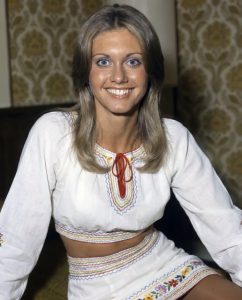
Olivia Newton-John in 1972: The Rising Star Before Grease Made Her a Legend
The singer and actress in this 1972 photograph is Olivia Newton-John, the British-born Australian performer whose extraordinary career would eventually take her from British television and country-pop success to worldwide superstardom as Sandy in Grease.
The image captures Newton-John at a fascinating moment in her career. She was already an established young performer, but the defining chapter of her international fame was still several years away. In 1972, there was no Sandy Olsson, no famous black leather outfit, and no carnival finale with Danny Zuko. Instead, Newton-John was steadily building the musical career that would eventually make her one of the most recognizable performers of her generation.
Born in Cambridge, England, in 1948 and raised largely in Melbourne, Australia, Newton-John had developed an interest in music from an early age. As a teenager, she began performing publicly and eventually returned to Britain, where she pursued opportunities as a professional singer. Her early career was anything but an overnight success. She worked through television appearances, live performances, recordings and collaborations before finding the combination of talent, opportunity and material that would transform her career.
By the early 1970s, however, things were beginning to move quickly.
A Young Performer Crossing the Atlantic
Newton-John’s early career was unusual because it developed across several countries and musical markets. She had Australian roots, an English birthplace and a growing professional life in Britain. That international background would become an important part of her eventual appeal.
Her breakthrough as a recording artist came with “If Not for You,” her 1971 cover of the Bob Dylan song. The recording became a significant success in Britain and Australia and also made an unexpected impact in the United States. According to the National Film and Sound Archive of Australia, the song became an international hit, giving Newton-John her first major taste of American success. (NFSA)
She was also becoming familiar to British television audiences. Her association with Cliff Richard was particularly important. Newton-John became a regular performer on his television program, giving her valuable exposure to a large audience and helping establish her as a recognizable personality as well as a singer. (The Guardian)
That television exposure is one reason the phrase “transatlantic career” fits this period so well. Newton-John was no longer simply an Australian-born singer trying to make it in Britain. She was developing an international audience.
What Was Happening in 1972?
The photograph belongs to a year when Newton-John’s career was progressing rapidly.
Her second studio album, Olivia, was released in August 1972. The record included songs that demonstrated the mixture of pop, folk and country influences that would become increasingly important to her sound. (Wikipedia)
She was also appearing regularly on British television and performing live. A detailed chronology of her career records that she became a resident guest performer on Cliff Richard’s BBC television variety show for 13 weeks beginning in January 1972. (Only Olivia)
In other words, the woman in this photograph was already working steadily toward international recognition.
She had not yet become the Olivia Newton-John known to millions of moviegoers, but the foundations were firmly in place.
Before Sandy Was Even a Possibility
One of the most fascinating things about looking at a photograph of Newton-John from 1972 is knowing what was still ahead.
Six years after this image, she would be cast opposite John Travolta in Grease, playing Sandy Olsson. The film, released in 1978, would transform her from a successful singer into a global pop-culture icon.
The transformation of Sandy at the end of Grease is particularly memorable. During the carnival finale, the previously innocent-looking Sandy appears in a striking black outfit, complete with a leather jacket-inspired look and high heels. The moment became one of the most famous costume transformations in movie history.
But the woman pictured in 1972 was already a successful performer long before Hollywood discovered the perfect role for her.
Newton-John’s official biography notes that Grease catapulted her into superstardom and earned her a Golden Globe nomination for Best Performance by an Actress in a Motion Picture – Musical or Comedy. (Olivia Newton-John)
The contrast is remarkable: the photograph shows a young singer still building her career, while audiences today often remember her first and foremost as Sandy.
The Country-Pop Breakthrough
Newton-John’s next major career stage came through country-pop music.
Her 1973 recording of “Let Me Be There” became a major breakthrough in the United States. The song reached the American pop Top 10 and also succeeded on the country chart. It earned Newton-John a Grammy Award for Best Country Vocal Performance, Female. The success helped establish her as a genuine American recording star. (The Guardian)
This was an important achievement because Newton-John was not initially an obvious candidate to dominate American country music. She was an Australian-raised singer working primarily from Britain, yet her gentle voice and country-pop material connected with American listeners.
Her success also created controversy among some traditional country figures who questioned whether a British-Australian pop singer belonged in the country genre. Instead of preventing her progress, however, the debate helped increase attention around her music. (The Guardian)
The success of “Let Me Be There” marked the beginning of an extraordinary American chapter.
The Hits That Followed
After “Let Me Be There,” Newton-John’s career accelerated.
Songs such as “If You Love Me (Let Me Know),” “Have You Never Been Mellow,” and “I Honestly Love You” established her as one of the major female recording artists of the 1970s.
“I Honestly Love You” became particularly important. The emotional ballad demonstrated that Newton-John could move beyond the country-pop style that had helped introduce her to American audiences. Her soft, intimate vocal style became one of her trademarks.
By the middle of the decade, she was no longer simply an emerging international performer. She was a major recording star.
And then came Hollywood.
Grease Changes Everything
When Grease arrived in 1978, Newton-John was already a successful singer. The film did not create her career from nothing; rather, it dramatically expanded the audience that already knew her music.
Her casting as Sandy was also a major gamble. She was an established recording artist, but she had never played a movie role on anything approaching this scale.
The result was historic.
Her chemistry with John Travolta became one of the central attractions of the movie. Their performances produced songs that became global hits, including “You’re the One That I Want” and “Summer Nights.” Newton-John also delivered the memorable solo “Hopelessly Devoted to You.” Her official biography notes that the film’s soundtrack became a huge international success and that Grease propelled her into superstardom. (Olivia Newton-John)
Suddenly, audiences who had discovered her through records knew her as Sandy.
The transformation was complete.
More Than a Movie Star
It would be easy to reduce Newton-John’s legacy to Grease, but doing so overlooks how substantial her career already was before the movie.
She had been recording and performing internationally for years. She had appeared on television, toured with major performers, built a successful recording career and crossed musical boundaries between pop and country.
After Grease, she continued expanding her career. She starred in Xanadu, recorded the enormously successful “Physical,” and remained a major figure in popular music.
Her career also extended into philanthropy and advocacy, particularly later in life.
That broader legacy makes early photographs like this one especially interesting. They show Newton-John before the image that ultimately became her most famous.
Looking Back at the Photograph
Seen today, the 1972 photograph has a fascinating sense of history.
Newton-John looks young, confident and unmistakably like a performer who already knew she was going somewhere. The clothing, hairstyle and photography style immediately place the image in the early 1970s, a period when fashion and popular music were changing rapidly.
There is also something striking about the fact that the photograph predates her greatest fame by several years.
At the time, she could not have known that a future movie role would turn her into one of cinema’s most recognizable musical characters. She could not have known that audiences would still be singing her songs decades later.
Yet the career was already underway.
The Legacy of Olivia Newton-John
Olivia Newton-John died in 2022, but her work remains deeply embedded in popular culture. She was a successful recording artist, a film star and a performer whose career crossed generations.
Her story is particularly remarkable because Grease was not the beginning of her success. It was the spectacular midpoint of an already developing international career.
That is what makes this 1972 photograph so compelling.
The young woman pictured here was already building the foundations of an extraordinary future. She had crossed continents, worked her way through television and live performance, established herself as a recording artist and was beginning to attract attention beyond Britain and Australia.
Six years later, the world would know her as Sandy.
But in 1972, Olivia Newton-John was simply a talented young singer and actress on the rise—and the biggest chapters of her story were still waiting to be written.