Mexican President States That Trump Is “Not Well-Informed” About Mexico
A sharp exchange between Mexican President Claudia Sheinbaum and U.S. President Donald Trump has once again placed the complicated relationship between the two neighboring countries in the international spotlight.
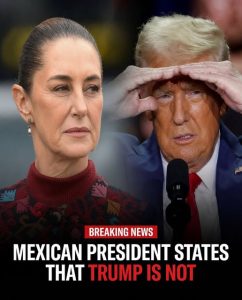
A viral graphic circulating online carries the dramatic headline, “Mexican President States That Trump Is Not…” The incomplete wording is clearly designed to encourage curiosity, but the underlying story is more specific. In June 2026, Sheinbaum responded to Trump’s claims that Mexico had lost control of its territory and that drug cartels effectively controlled the country by saying that the U.S. president was “not well-informed.” (Mexico News Daily)
The exchange was notable not simply because of the disagreement, but because of the way Sheinbaum chose to respond. Rather than escalating into a personal confrontation, she attempted to separate Trump’s comments from the broader relationship between the United States and Mexico.
Her response reflected a strategy that has become increasingly familiar during her presidency: defend Mexican sovereignty firmly while continuing to leave room for cooperation with Washington.
What Trump Said
The controversy began with remarks Trump made during the G7 summit in France.
Trump argued that Mexico had lost control of its country and claimed that drug cartels were effectively running Mexico. He also characterized Sheinbaum as a “very scared woman,” while simultaneously describing her as a good woman. (Mexico News Daily)
Those remarks touched one of the most sensitive issues in the U.S.-Mexico relationship.
Mexico has struggled for decades with powerful organized-crime groups, drug trafficking, corruption and violence. The United States, meanwhile, remains a major destination for illegal drugs and an important source of firearms that flow south across the border.
Trump has repeatedly used the cartel issue as an argument for stronger U.S. action, including increased pressure on Mexico.
For Sheinbaum, however, accepting the characterization that Mexico is effectively controlled by criminal organizations would undermine the authority of the Mexican government and the country’s claim to sovereignty.
Her response was therefore carefully calculated.
Sheinbaum’s Response
At her daily morning press conference, Sheinbaum indicated that Trump’s comments were not new.
She said that Trump has his own way of communicating and suggested that the Mexican government should not become consumed by every statement made by the U.S. president. She then directly challenged his understanding of the situation, saying that he was “not well-informed.” (Mexico News Daily)
The significance of the response was its balance.
Sheinbaum did not simply dismiss the existence of organized crime in Mexico. Instead, she defended the existence and functioning of the Mexican state, emphasizing that her government has institutions responsible for security, law enforcement and national defense.
She also pointed to government crime statistics as evidence that some measures of violence had been declining.
In other words, her argument was not that Mexico has no cartel problem. Her argument was that the cartel problem should not be confused with the idea that criminal organizations have replaced the Mexican state.
That distinction is at the heart of the disagreement.
A Question of Sovereignty
The dispute goes beyond statistics about crime.
For Mexico, sovereignty is a deeply sensitive political issue. Any suggestion that the United States should take unilateral military action inside Mexican territory immediately raises concerns about national independence and foreign intervention.
Sheinbaum has repeatedly rejected the idea that Mexico should accept U.S. military intervention against criminal organizations.
At the same time, her administration has continued cooperating with U.S. authorities on security issues, including efforts against drug trafficking and organized crime.
That combination can appear contradictory from the outside, but it reflects the practical reality of the relationship.
Mexico needs cooperation with the United States.
The United States needs cooperation with Mexico.
Neither country can easily separate itself from the other.
The Complicated Trump-Sheinbaum Relationship
Since Sheinbaum became president, her relationship with Trump has been characterized by a mixture of confrontation and cooperation.
The two leaders have disagreed over immigration, tariffs, drug trafficking, organized crime and the possibility of American involvement in Mexican security operations.
Yet they have also maintained direct communication and continued negotiations.
That is important because the United States and Mexico share one of the world’s most economically important bilateral relationships.
Millions of people cross the border legally each year. Supply chains stretch across both countries. American companies operate in Mexico, Mexican companies operate in the United States, and enormous quantities of goods move between the two nations.
The relationship therefore cannot be reduced to the personalities of two presidents.
Even when Trump and Sheinbaum exchange sharp statements, officials on both sides continue working on trade, border management and security.
Why the “Not Well-Informed” Comment Matters
Sheinbaum’s choice of words was significant.
Calling another country’s president “wrong” or “ignorant” could have produced a major diplomatic confrontation. Instead, saying that Trump was “not well-informed” allowed her to challenge his argument without completely closing the door to cooperation.
It was a diplomatic form of disagreement.
Sheinbaum also emphasized that her primary responsibility was to the Mexican people. Rather than allowing Trump’s comments to dictate her government’s agenda, she said that what mattered was that Mexicans understood that their government was working for them. (Mexico News Daily)
That approach has become an important part of her political style.
She often presents herself as calm in the face of pressure, particularly when dealing with Trump.
This does not mean that she avoids confrontation. Instead, she tends to frame disagreements around Mexico’s sovereignty and national interests.
The Cartel Question
At the center of the dispute is a difficult reality: organized crime remains a serious problem in Mexico.
Cartels have extensive networks involved in drug trafficking and other criminal activities. Some regions have experienced severe violence, and allegations of corruption and connections between criminals and officials have periodically created additional political challenges.
At the same time, describing Mexico as a country completely controlled by cartels is a much broader claim.
Sheinbaum rejects that characterization.
Her government has increased security operations and taken action against major criminal organizations. Analysts have also noted that her administration has pursued a more aggressive security strategy than some observers initially expected. (Los Angeles Times)
The result is a complicated picture: Mexico faces serious organized crime, but its government continues to function, its institutions remain active, and its leaders strongly resist the idea that foreign powers should dictate how Mexico handles its security problems.
The U.S. Perspective
From Washington’s perspective, the issue looks different.
The United States faces enormous consequences from drug trafficking across the southern border. Synthetic opioids and other illegal drugs have produced devastating public-health and security concerns.
American officials therefore have strong incentives to demand greater action from Mexico.
Trump’s administration has frequently argued that Mexico must do more to stop criminal organizations before drugs reach American communities.
That pressure is not likely to disappear.
But the question is how far the United States should go in attempting to influence Mexico’s domestic security policies.
That is where the disagreement with Sheinbaum becomes especially important.
Mexico Wants Cooperation, Not Subordination
One phrase that has repeatedly appeared in Sheinbaum’s approach to Washington is the idea of cooperation without surrendering sovereignty.
Recent reporting has described her position as “coordination, not subordination.” She has argued that Mexico can cooperate with the United States while maintaining control over its own territory and institutions. (Los Angeles Times)
That distinction is particularly relevant when discussing military operations.
Mexico can share intelligence, cooperate on arrests and extraditions, and coordinate efforts against organized crime without agreeing that American forces should operate independently inside Mexican territory.
For Sheinbaum, those are fundamentally different things.
Why the Viral Graphic Is Misleading
The wording in the viral image is deliberately incomplete: “Mexican President States That Trump Is Not…”
That type of headline is designed to make people click before they know what the statement actually was.
The documented statement was not simply that Trump was “not” something in a vague or mysterious sense. The key point was that Sheinbaum considered Trump not well-informed about the situation in Mexico, particularly his claims that cartels were running the country. (Mexico News Daily)
That context matters.
Without it, readers could easily interpret the graphic as announcing a completely different confrontation.
The broader lesson is important in an era when political images spread rapidly through social media. A dramatic graphic may contain real photographs and reference a genuine event while still presenting the event in a misleading or incomplete way.
What Happens Next?
The disagreement is unlikely to be the final chapter in U.S.-Mexico relations.
Security will remain one of the most important issues between the two governments. Trade is equally significant, particularly as North American economic agreements face continued negotiations and review. Mexico’s economy is deeply connected to the United States, while American manufacturers and consumers also depend heavily on Mexican production and supply chains.
That interdependence creates a powerful incentive for both governments to keep talking.
Trump may continue demanding stronger action against cartels.
Sheinbaum is likely to continue defending Mexico’s sovereignty.
The challenge for both leaders will be finding a way to pursue security cooperation without allowing political rhetoric to destroy the broader relationship.
Final Thoughts
The viral headline suggesting that the Mexican president declared Trump “not…” is based on a real political disagreement, but the full context is far more interesting than the sensational graphic suggests.
In June 2026, Claudia Sheinbaum pushed back against Donald Trump’s claims that Mexico had lost control of its country and that cartels were running the nation. Her response was that Trump was “not well-informed” and that Mexico’s government remained committed to addressing crime while defending the country’s sovereignty. (Mexico News Daily)
The exchange illustrates the delicate balancing act facing Sheinbaum.
Mexico must cooperate with its largest trading partner and neighbor, particularly on security and migration. At the same time, the Mexican president must demonstrate to her own citizens that national decisions remain under Mexican control.
For Trump, the cartel issue remains a central part of his pressure campaign toward Mexico.
For Sheinbaum, the message is equally clear: Mexico can cooperate with the United States, but cooperation does not mean surrendering sovereignty.
That tension will likely remain one of the defining features of the U.S.-Mexico relationship for years to come.
I can also create a cleaner news-style image explaining the Trump–Sheinbaum dispute.