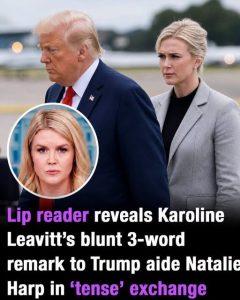
Lip Reader Reveals Karoline Leavitt’s Blunt 3-Word Remark to Trump Aide Natalie Harp in ‘Tense’ Exchange
A brief video involving Karoline Leavitt, Donald Trump and White House aide Natalie Harp has sparked intense speculation after viewers noticed what appeared to be a serious conversation aboard Marine One.
The footage itself contains no audible conversation, but a professional lip reader has offered an interpretation of what Leavitt may have said to Harp. According to reports, the three words were “Are you sure?” (Newsner English)
Those three words may sound ordinary in isolation. In the context of the video, however, they have become the focus of a much larger discussion about what was happening behind the scenes shortly before Leavitt announced her departure from her position as White House press secretary.
It is important to stress from the beginning that lip-reading interpretations are not the same as an authenticated transcript. The footage has no audio, and the interpretation has not been independently verified. There is also no confirmed evidence that the exchange caused or directly influenced Leavitt’s decision to leave.
Still, the video has generated enormous curiosity.
The moment aboard Marine One
The footage appears to show Leavitt seated near Trump while Harp is also present. At one point, Leavitt appears to address Harp directly.
Viewers noticed several gestures and expressions during the short exchange. Leavitt appears to lean forward, gesture toward Harp and later fold her arms. Harp is also seen using gestures while responding. Trump remains nearby as the two women appear to continue their conversation.
Because there is no sound, viewers are left attempting to interpret the interaction through body language.
Some observers described the exchange as tense or uncomfortable. Others cautioned that facial expressions and gestures can easily be misinterpreted, particularly when people are having a complicated conversation that viewers cannot hear.
That distinction matters.
A serious expression does not necessarily mean an argument, and a hand gesture does not automatically indicate anger. Without audio or an official account of the conversation, the precise meaning of the interaction cannot be established.
The three words that captured attention
Professional lip reader Nicola Hickling reportedly examined the footage and concluded that Leavitt appeared to ask Harp, “Are you sure?” (Newsner English)
Hickling’s interpretation reportedly goes beyond those three words. Harp allegedly responded with language along the lines of, “We don’t like it. There’s going to be an announcement as soon as possible, okay?”
Later in the exchange, Harp was reportedly interpreted as saying, “This has now happened twice,” before apparently emphasizing the number two with her fingers.
Again, these words should be treated as a lip reader’s interpretation rather than a confirmed recording of the conversation.
The distinction is especially important because the conversation concerns senior political figures and a major personnel change. A small misunderstanding could easily become a much larger story once it spreads across social media.
Why the video became controversial
The timing is what made the footage especially intriguing.
Leavitt announced that she was leaving her role as White House press secretary in August. She said her decision was motivated by a desire to spend more time with her young family. Reports have noted that she was expected to leave the administration by the end of the month. (AOL)
After video of the Marine One exchange circulated, some people began wondering whether there might have been another explanation.
Social-media posts suggested that the conversation could have been connected to her departure. Some went further, claiming that Leavitt had been fired or that the administration was hiding the real reason for her exit.
There is, however, no established evidence supporting those claims.
The fact that the footage appeared close to the announcement is not proof that the two events were connected.
Leavitt herself has publicly cited family considerations, and reporting about the exchange has acknowledged that the relationship between the video and her departure remains unknown. (The Mirror)
Who is Natalie Harp?
The attention surrounding the exchange has also placed Natalie Harp under an unusually bright spotlight.
Harp is a close Trump aide who has become known for her extraordinary proximity to the president. She previously worked in conservative media and became particularly recognizable during Trump’s 2024 campaign.
She gained the nickname “human printer” because she was known for carrying a portable printer and providing Trump with physical copies of news articles and other information. (CBS News)
According to recent reporting, Harp has remained one of Trump’s most trusted aides. Her responsibilities reportedly include helping with his social-media activity and handling information for the president.
Her close relationship with Trump has attracted increasing public attention in recent weeks. Major news organizations have reported on her influence and her unusual level of access to the president. (The Guardian)
That background helps explain why a short conversation between Harp and Leavitt would attract so much interest.
A powerful setting for a mysterious moment
Marine One is not an ordinary workplace.
It is one of the most recognizable symbols of the U.S. presidency, and footage showing what happens around the president while aboard or departing the aircraft naturally receives intense scrutiny.
Yet even when cameras are nearby, viewers generally do not have access to every private conversation.
That makes silent footage particularly tempting to interpret.
People look at facial expressions, gestures, posture and apparent reactions. They then attempt to reconstruct what was said. In some cases, professional lip readers can provide useful interpretations. But even experts can face significant limitations when someone’s mouth is partially obscured, when the camera is distant, or when a speaker turns away.
The Marine One footage therefore provides an intriguing clue—but not definitive proof of what happened.
“Are you sure?” can mean many things
Perhaps the most interesting part of the alleged exchange is how little we actually know about the subject being discussed.
If Leavitt really did say “Are you sure?”, what was she asking about?
It could have referred to an announcement.
It could have concerned scheduling.
It could have involved a political decision.
It could have been about something entirely unrelated to her eventual departure.
Without additional context, the words cannot answer that question.
Likewise, if Harp really said that something had happened twice, there are numerous possible explanations. The statement could have concerned an administrative problem, a communication issue, a scheduling matter or another event that had nothing to do with Leavitt’s resignation.
This is why speculation should not be confused with evidence.
The internet fills in the blanks
The controversy illustrates a familiar pattern in modern political news.
A short video appears online.
People notice unusual body language.
A lip reader provides an interpretation.
Social-media accounts add their own theories.
Within hours, a brief conversation can become a major story.
The danger is that each step can add another layer of interpretation. Eventually, viewers may forget which details were actually observed and which were assumptions added afterward.
In this case, the observed facts are relatively limited: Leavitt, Harp and Trump were together; Leavitt and Harp appeared to have a conversation; the interaction looked serious to some viewers; and a lip reader offered an interpretation of portions of the exchange.
Everything beyond those points requires caution.
Leavitt’s departure
Leavitt’s departure itself represents a significant change for the Trump administration.
She became one of the most recognizable public faces of the White House and was known for her combative exchanges with reporters. Her role placed her at the center of the administration’s daily communications strategy.
Reporting has described her press operation as unusually aggressive and closely aligned with Trump’s political messaging. Her departure therefore generated considerable discussion about who would take over and how the White House communications operation might evolve. (Vanity Fair)
But the existence of a tense-looking conversation does not establish that internal conflict caused her departure.
Political organizations are full of difficult conversations. Senior officials routinely discuss announcements, disagreements, personnel matters and sensitive decisions behind closed doors.
Sometimes a serious-looking exchange is simply a serious conversation.
What remains unanswered
The biggest unanswered question is straightforward: What exactly were Leavitt and Harp discussing?
The available footage does not provide a definitive answer.
The alleged lip-reading interpretation gives viewers one possible version, but it does not provide enough information to establish the full context.
Nor does the video prove that Leavitt’s departure was connected to the conversation.
For now, the most responsible conclusion is that the footage is interesting because of its timing and because it offers a rare glimpse of senior figures in a private-looking moment—but the dramatic theories surrounding it remain unconfirmed.
A three-word mystery
“Are you sure?” may be only three words, but those words have become the centerpiece of a much larger political mystery.
Did Leavitt genuinely say them?
Was Harp discussing an upcoming announcement?
What had supposedly happened twice?
And was any of it connected to Leavitt’s decision to leave?
At present, those questions do not have definitive public answers.
What is certain is that the footage has generated another wave of interest in the people surrounding Trump and the internal dynamics of his administration. Natalie Harp’s unusually close access to the president has already made her a subject of growing media scrutiny, while Leavitt’s departure has naturally prompted questions about the future of the White House communications operation. (The Guardian)
For viewers, the temptation is to watch the clip and believe that every expression reveals a hidden story.
But sometimes the most responsible conclusion is to acknowledge what remains unknown.
The three words “Are you sure?” may indeed have been spoken. Until the people involved confirm the conversation—or authenticated audio emerges—the rest is interpretation.
And that uncertainty is precisely what has made this brief Marine One exchange so fascinating to millions of people watching from the outside.