My Husband Found These Strange Keys at His Grandparents’ House — But None Fit the Doors
There is something strangely captivating about finding an old key in a relative’s house.
A key is an object with an obvious purpose. It is supposed to open something. A door, a cabinet, a trunk, a desk, a chest—somewhere there should be a lock waiting for it.
That is why the discovery of unusual old keys can create an immediate mystery.
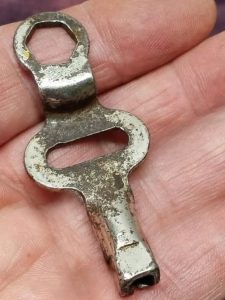
The photograph accompanying this story shows a particularly intriguing metal object. It certainly resembles a vintage key at first glance, but its unusual openings, broad body and strangely shaped end make it difficult to identify as an ordinary door key.
And if none of the doors at the grandparents’ house accepted it, there may be a surprisingly simple explanation.
It May Not Be a Door Key at All
The first thing to remember when examining old hardware is that not every object shaped like a key was intended to operate a door lock.
For generations, manufacturers produced keys for furniture, cabinets, trunks, desks, padlocks, clocks and other household mechanisms. There were also key-shaped tools and novelty objects whose primary purpose had nothing to do with unlocking anything.
The object shown in the photograph is particularly unusual because the working end does not resemble the conventional toothed bit of a traditional door key.
That is an important clue.
Traditional antique keys generally have a recognizable bow—the part held by the user—attached to a shaft and a bit at the opposite end. The shape of that bit is critical because it interacts with the internal mechanism of the lock.
This object has a very different appearance.
Its broad metal body contains openings that look more like functional slots than conventional key cuts. The end is also unlike the sharply defined bit of a typical warded door key.
So the mystery may not be “Which door does this key open?”
It may instead be:
“What tool was this designed to be?”
The Famous “Skeleton Key” Isn’t Always What People Think
Whenever someone discovers an old-fashioned metal key, the phrase skeleton key usually comes up.
The term is widely used today for almost any antique-looking key, but technically it refers to a particular type of key associated with warded locks.
A true skeleton key has been reduced to its essential working parts so that it can bypass wards inside certain locks. The name comes from the idea that unnecessary material has been removed, leaving the “skeleton” of the original key. (Wikipedia)
Warded locks work differently from the pin-tumbler locks commonly found on modern residential doors.
Inside a warded lock are fixed metal obstructions called wards. A properly shaped key has to navigate around those obstructions before it can rotate the locking mechanism.
Because many older locks shared similar designs, simplified keys could sometimes operate multiple locks of the same general type. (Antique Identifier)
That is where much of the mythology surrounding skeleton keys comes from.
However, the object shown here does not immediately look like a conventional skeleton key.
The Shape Provides Important Clues
Look closely at the photograph.
At one end is a large circular opening.
Below it is a wider metal section containing another elongated opening.
The object then narrows toward a short, squared-off end.
There is no obvious set of traditional teeth.
That unusual construction is why it would be risky to identify it simply as an antique door key.
The metal also has substantial wear and discoloration. That suggests it may have been handled or used for many years, although surface patina alone cannot establish an exact age.
Without measurements, markings, a view of the reverse side and photographs of the end, identifying the object with complete certainty would be difficult.
But there is another possibility worth considering.
Could It Be a Key-Shaped Bottle Opener?
One plausible explanation is that the object is a key-shaped bottle opener or similar utility tool.
Key-shaped bottle openers have existed as novelty and functional objects, and modern reproductions deliberately imitate antique skeleton keys. The Museum of the American Revolution, for example, sells an antiqued brass bottle opener designed in the style of an old skeleton key. (Museum of the American Revolution)
That doesn’t prove that the pictured object is specifically a bottle opener, but it demonstrates why an object can look exactly like an old key while actually serving another purpose.
There is also anecdotal evidence from collectors of similarly shaped objects being identified as bottle openers rather than keys. (Reddit)
The unusual end of the photographed object is therefore significant.
If that portion was designed to catch beneath a bottle cap, the mystery would immediately make more sense.
Grandparents’ Houses Are Full of Forgotten Objects
The setting of the story is just as interesting as the object itself.
Older houses often contain decades of accumulated hardware.
A drawer that hasn’t been emptied for generations may contain keys belonging to furniture that disappeared years ago, locks that were replaced, old tools, sewing accessories, hardware from renovations and miscellaneous objects whose original purpose has been forgotten.
That means finding a key that doesn’t fit any existing door isn’t unusual at all.
The original lock may have been removed decades earlier.
The key could have belonged to a cabinet that was thrown away.
It might have opened a trunk that no longer exists.
Or, as in this case, it might never have been intended for a door in the first place.
Antique Keys Came in Many Forms
Older households used an astonishing variety of locking mechanisms.
There were keys for interior doors, exterior doors, wardrobes, desks, cabinets, trunks and boxes.
Small furniture keys were particularly common.
Antique keys could be made from iron, brass, steel and other metals. Their shapes varied according to the mechanism, manufacturer and period.
Collectors today often classify them according to features such as the bow, shank and bit. The bit—the working portion that enters the lock—is especially useful when trying to determine what type of lock a key belonged to. (CallOrange Locksmith)
That is why experienced collectors don’t normally identify an old key simply because it looks “old.”
They study its construction.
Why Some Keys Look So Strange
The technology of locks changed dramatically over the centuries.
Older warded locks were comparatively simple mechanical systems. Their keys could therefore have substantial decorative bows and relatively uncomplicated shafts.
Furniture manufacturers also had their own locking systems.
A cabinet key could be dramatically smaller than a door key.
A trunk key could have a hollow shaft.
A clock key might have a square socket designed to engage a winding arbor rather than a lock.
And utility objects could deliberately borrow the visual language of keys because the shape was familiar and convenient.
The result is a huge variety of objects that modern observers might simply call “keys.”
The Patina Doesn’t Tell the Whole Story
The worn appearance of the metal is another reason the object looks mysterious.
It has a dark, mottled surface with areas of brighter metal where the surface appears to have been rubbed or worn.
That can happen through age and handling, but it doesn’t automatically mean the object is extremely old.
Vintage and antique-looking objects can acquire surface wear through ordinary use.
Modern reproductions can also be artificially aged.
Consequently, determining age from a photograph alone is unreliable.
A collector would want to examine the manufacturing method, metal composition, dimensions, markings and construction details before making a serious dating claim.
Don’t Clean It Too Quickly
If someone really does find an old metal object in a family home, there is another important lesson here: don’t immediately polish it until it shines.
Collectors often value original surface condition and patina.
Aggressive cleaning can remove evidence of age, manufacturing marks or previous use. It can also permanently change the appearance of an object.
Before cleaning something that might be historically significant, it is better to photograph it from several angles and investigate its identity first.
That is particularly true when an object has been preserved in a family for generations.
The scratches and discoloration may be part of its history.
Could It Have Been a Master Key?
The idea of an old master key is another possibility that naturally comes to mind.
Historically, skeleton and master keys could allow authorized users to operate multiple locks within a particular system. Such keys were useful to people who needed access to several rooms, including certain tradespeople and building staff. (Antique Hardware Supply)
But a true master key still needs to be compatible with the locks it was designed to operate.
It would not simply open every antique door.
That is another misconception created by movies and popular culture.
A skeleton key isn’t magical.
Its usefulness depends on the design of the locks involved.
The Most Interesting Possibility
Perhaps the most fascinating explanation is that the object doesn’t belong to a lock at all.
If the pictured item is a key-shaped utility tool, its strange appearance suddenly becomes logical.
The large openings could reduce weight or provide convenient gripping points. The shaped end could perform a mechanical function. Its resemblance to a key could simply be part of the design.
And that would explain perfectly why it never fit any door.
The family wasn’t necessarily missing a mysterious lock.
They may simply have inherited an old tool.
How to Investigate the Mystery
Anyone who discovers a similar object can perform a few simple checks.
First, examine both sides.
Look for stamps, numbers, letters, logos or manufacturer’s marks.
Second, measure it.
Length, width and thickness can help distinguish a door key from a furniture key or utility object.
Third, inspect the working end.
Does it have teeth? A square socket? A hook? A notch? A bottle-cap-catching edge?
Fourth, search the family’s history.
Was there once an old trunk, cabinet, workshop, bar, farmhouse or piece of machinery that might explain the object?
Finally, compare it with historical examples.
A good photograph can often reveal far more when viewed alongside collections of antique hardware.
The Mystery Is What Makes It Valuable
Even if the object turns out to be an ordinary vintage tool worth only a modest amount, that doesn’t make the discovery meaningless.
Objects like this are physical reminders of everyday life in another era.
A key that once opened a cabinet may have been held by someone’s great-grandparents.
A bottle opener may have been used at family gatherings.
A small utility tool may have spent decades in a kitchen drawer.
Its monetary value and its historical value are two completely different things.
In many families, the story attached to an object is more valuable than the object itself.
Final Thoughts
The strange metal object shown in the photograph certainly looks like a key at first glance, but its unusual construction makes a conventional door key identification questionable.
It may be related to antique locking hardware, but the absence of conventional teeth and the unusual openings suggest that it could instead be a specialized tool or a key-shaped bottle opener.
True skeleton keys were designed around warded locks and have a specific mechanical purpose; the term is often used much more loosely today. (Antique Identifier)
The biggest lesson from this mystery is simple: an old key doesn’t necessarily open a door.
It might open a cabinet.
It might belong to a forgotten trunk.
It might operate an old mechanism.
Or it might not be a key at all.
And that is exactly what makes forgotten objects found in grandparents’ homes so fascinating. They can look completely ordinary at first, yet a closer examination can reveal a small piece of technology, craftsmanship and family history that has survived long after the original purpose was forgotten.
Sometimes the real mystery isn’t discovering what door an old key opens.
It’s discovering what part of the past the object came from.