Ivanka Trump Brutally Slammed Over Words About Dolly Parton After Death
The death of Dolly Parton has prompted an extraordinary wave of grief from fans, musicians, actors, public figures, and political leaders around the world. The country music legend died on August 25, 2026, at the age of 80, following a brief battle with cancer. Her family and representatives confirmed the news, and tributes quickly poured in celebrating not only her extraordinary musical career but also her philanthropy and reputation for kindness. (People.com)
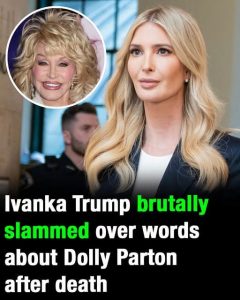
Among those paying tribute was Ivanka Trump, who attempted to honor Parton’s memory with a message centered on the singer’s philosophy of compassion and acceptance.
Instead of receiving universal praise, however, Ivanka’s tribute quickly became the subject of criticism online.
The controversy was not primarily about whether Ivanka admired Dolly Parton. Rather, it centered on the particular message she chose to highlight—and the political associations that readers brought to it.
Ivanka’s Tribute
In her tribute, Ivanka described Parton as a “bright light” and reflected on a conversation she had previously had with podcaster Lex Fridman. According to reports about her post, Ivanka recalled a Dolly Parton quotation that had resonated with her: “I don’t criticize and condemn; I love and accept.”
Ivanka presented the philosophy as an example of what made Parton so extraordinary. She described the sentiment as seemingly simple but ultimately profound, emphasizing the idea that Parton’s approach to life was based on generosity, acceptance, and refusing to condemn others. (AOL)
On its face, the message was a respectful tribute to a beloved entertainer.
But social media quickly transformed it into something much more politically charged.
Critics began arguing that Ivanka’s decision to highlight Parton’s words about acceptance created an uncomfortable contrast with the political world surrounding her family.
That contrast became the central issue in the backlash.
Why Did People Object?
Dolly Parton’s public image has long been associated with kindness, humor, generosity, and an ability to connect with people who hold very different beliefs.
Throughout her career, she managed to appeal to audiences across political and cultural divides. Her music reached country fans, pop audiences, rock listeners, older generations, and younger listeners alike.
Her charitable work expanded that influence even further.
One of her best-known initiatives, the Imagination Library, has provided free books to children around the world. Parton’s humanitarian work also included support for medical research and other charitable causes. Her death therefore represented the loss of an entertainer whose influence extended far beyond music. (Reuters)
Because of that broad legacy, some people felt that Parton’s message of acceptance should not be used as part of a political argument.
Others, however, immediately saw Ivanka’s post through the lens of American politics.
Critics argued that the language about not criticizing or condemning others did not fit comfortably with the public political environment associated with Donald Trump.
Some commenters accused Ivanka of hypocrisy, arguing that the Trump political movement has frequently been marked by sharp personal attacks against opponents and critics.
Those reactions were widely reported after Ivanka’s tribute appeared online. (The Daily Beast)
A Tribute Becomes a Political Argument
The irony is that Ivanka’s message appears to have been intended to do almost the opposite.
Rather than turning Parton’s death into a political statement, she seemed to be focusing on one of the qualities she admired most about the singer.
But because the quotation involved acceptance and refusing to condemn others, readers immediately connected it to current political divisions.
That demonstrates just how difficult it can be for public figures from political families to comment on major cultural moments without their words becoming political.
Even a message about music, kindness, or personal inspiration can be interpreted through a political lens.
And Dolly Parton’s death occurred at a moment when the public conversation was already deeply divided.
Dolly Parton’s Unique Legacy
Parton’s enormous popularity helps explain why reactions to her death have been so emotional.
She was more than a country singer.
She was a songwriter, actress, businesswoman, philanthropist, and cultural institution.
Songs such as “Jolene,” “9 to 5,” and “I Will Always Love You” became part of the American musical landscape. Her career lasted for decades, and she continued to attract new generations of fans long after many of her original hits were released. (The Guardian)
Her story was also central to her appeal.
Parton grew up in rural Tennessee in a large family with very limited financial resources. She transformed that humble beginning into an international career without abandoning the personality and humor that made her relatable.
Her success also allowed her to give back on an enormous scale.
The Imagination Library became one of the most visible examples of that philosophy, helping put books into the hands of children regardless of their family’s financial circumstances. (Reuters)
That combination of entertainment and generosity is why tributes have come from people across political parties and cultural backgrounds.
The Bigger Question Behind the Backlash
The controversy surrounding Ivanka’s tribute raises a larger question: Can a celebrity’s words about another celebrity ever remain completely separate from politics?
For ordinary people, a tribute might simply mean saying, “She was kind, talented, and inspiring.”
For someone as recognizable as Ivanka Trump, however, every public statement receives additional scrutiny.
People don’t just read the words.
They consider who said them, what family that person belongs to, what political movement surrounds them, and what that person’s previous public statements have meant.
That can make even a sincere tribute vulnerable to criticism.
Ivanka has not been the only public figure whose comments about Parton’s death have generated controversy. Other tributes have also become politically charged, demonstrating how difficult it has been for public figures to discuss Parton’s legacy without political arguments entering the conversation. (Irish Star)
Critics Focused on the Message, Not Parton’s Music
Importantly, the backlash directed at Ivanka was not necessarily criticism of Dolly Parton herself.
In fact, many of the people criticizing Ivanka appeared to agree with the sentiment that Parton represented kindness and acceptance.
Their objection was to the perceived contrast between that philosophy and the political environment associated with the Trump family.
That distinction matters.
The online argument was essentially about whether Ivanka was the right person to invoke Parton’s message of unconditional acceptance.
Some critics felt that she was highlighting a principle that they believed was absent from the politics surrounding her family.
Others viewed the reaction as unfair, arguing that Ivanka should be allowed to admire an artist without being held responsible for every political disagreement involving her father.
The Danger of Social Media Tributes
The episode also illustrates the complicated nature of social media.
A traditional condolence message might disappear into a newspaper’s obituary section or a television broadcast.
An online post is different.
It can be shared thousands of times within minutes.
People can isolate one sentence, respond to it, criticize it, and turn it into a completely separate conversation.
That is what appears to have happened here.
Instead of remaining solely a tribute to Dolly Parton, Ivanka’s words became another flashpoint in America’s continuing political arguments.
The original intention may have been sincere.
The reaction, however, was largely outside her control.
Dolly’s Message May Ultimately Outlast the Controversy
Perhaps the most important point is that the controversy surrounding one tribute is unlikely to define Dolly Parton’s legacy.
Parton’s influence is much larger than any single social media post.
Her songs will continue to be performed.
Her films will continue to be watched.
Her charitable programs will continue helping children.
And her story will continue inspiring people who grew up with very little but dreamed of building something meaningful.
Following her death, tributes came from musicians, actors, politicians, international figures, and ordinary fans. Reuters reported that tributes crossed cultural and political boundaries, with people emphasizing her generosity and extraordinary ability to connect with audiences. (Reuters)
That may ultimately be the most fitting tribute of all.
Dolly Parton spent her life creating things that brought people together.
Her music crossed genres.
Her humor crossed generations.
Her charitable work crossed political boundaries.
And her public personality made room for people with very different backgrounds.
The Final Takeaway
Ivanka Trump’s tribute to Dolly Parton was intended to honor a woman she described as a remarkable light and an American icon.
But the words she chose—particularly Parton’s philosophy about love, acceptance, and refusing to condemn—triggered a strong political reaction online.
Critics saw an apparent contradiction between the message and the political world associated with Ivanka’s family. Supporters could reasonably argue that Ivanka was simply sharing a lesson she personally found meaningful.
Both interpretations reveal something about the extraordinary power of Dolly Parton’s public image.
Even after her death, her words continue to provoke discussion about kindness, acceptance, disagreement, and the way people treat one another.
Dolly Parton’s passing has left a tremendous hole in American popular culture. But it has also reminded millions of people why she mattered in the first place.
She wasn’t simply famous.
She built a career around storytelling, resilience, humor, generosity, and connection.
And while the internet may continue debating Ivanka Trump’s tribute, the larger story remains Dolly’s.
A girl who grew up with very little became one of the most recognizable entertainers in the world—and used much of her success to help others.
That is a legacy far bigger than any political controversy surrounding a single post.
And perhaps the most fitting way to remember Dolly Parton is not by arguing over who said what after her death, but by remembering the qualities she spent decades encouraging in others: generosity, compassion, courage, and the willingness to make the world a little brighter for someone else.