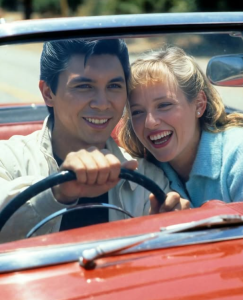
The film is La Bamba (1987), the unforgettable rock-and-roll biopic about Ritchie Valens. The two actors pictured are Lou Diamond Phillips, who portrayed Valens, and Danielle von Zerneck, who played his girlfriend, Donna Ludwig.
Released on July 24, 1987, La Bamba arrived in cinemas as far more than a conventional music biography. It was a heartfelt coming-of-age story, a family drama, a celebration of Latino culture, and a poignant reminder of just how much one extraordinary young man accomplished before his life was tragically cut short.
At its heart was the remarkable story of Ritchie Valens, one of rock and roll’s brightest early stars. In little more than a year, the California teenager helped change American popular music forever, proving that talent could overcome barriers of language, culture and circumstance. His life ended at just seventeen, but his influence has echoed through generations of musicians ever since.
For many audiences, however, it was La Bamba that introduced them to his story.
The film begins in the farming communities of Southern California during the late 1950s, where Richard Steven Valenzuela—known to the world as Ritchie Valens—dreams of something bigger than the fields and neighborhoods where he grew up.
Raised in a close-knit Mexican American family, Ritchie possesses an extraordinary singing voice and a natural gift for playing the guitar. His ambition is matched only by his devotion to his mother and siblings, even as family tensions simmer beneath the surface.
One of those tensions comes from his older half-brother, Bob Morales.
Bob loves Ritchie deeply, but his own struggles with anger, insecurity and disappointment often place the brothers at odds. Their relationship becomes the emotional backbone of the film, illustrating both fierce loyalty and heartbreaking conflict.
Rather than presenting Ritchie’s rise as an effortless fairy tale, La Bamba shows the sacrifices, misunderstandings and emotional complexities that accompanied sudden fame.
Stepping into the lead role was Lou Diamond Phillips, then a relative newcomer whose performance would make him an international star.
Phillips faced an enormous challenge.
Not only did he need to capture Ritchie Valens’ youthful optimism and musical charisma, but he also had to portray a teenager carrying the hopes of an entire family while navigating the pressures of unexpected celebrity.
He succeeds brilliantly.
Phillips gives Ritchie warmth, humility and infectious enthusiasm. His performance avoids turning Valens into an untouchable legend, instead presenting him as an ordinary young man blessed with extraordinary talent.
Audiences immediately connected with him.
The role earned widespread critical acclaim and launched Phillips into one of Hollywood’s busiest careers. Over the following years he would star in films such as Stand and Deliver, Young Guns, Courage Under Fire, and numerous television productions, establishing himself as one of the most recognizable actors of his generation.
Equally memorable is Danielle von Zerneck as Donna Ludwig, Ritchie’s girlfriend.
Donna represents stability and innocence amid the whirlwind of touring, recording sessions and growing fame. Their romance is portrayed with tenderness rather than melodrama, capturing the excitement and uncertainty of first love.
One of the film’s most touching moments comes with Ritchie’s performance of “Donna,” the gentle ballad inspired by their relationship.
The song remains one of Valens’ most enduring recordings.
Although Donna and Ritchie came from different cultural backgrounds during a period when interracial relationships often faced prejudice, the film treats their love story with sensitivity and authenticity.
Danielle von Zerneck brings grace and sincerity to the role, ensuring Donna becomes far more than simply “the girlfriend” in a musician’s biography.
Of course, no discussion of La Bamba is complete without its extraordinary music.
Ritchie Valens burst onto the rock-and-roll scene during the late 1950s, when the genre was still in its infancy. Influenced by artists such as Little Richard and Chuck Berry, he blended energetic rhythms with his own Mexican American heritage.
His version of the traditional Mexican folk song “La Bamba” became revolutionary.
Rather than abandoning his cultural roots in pursuit of mainstream success, Valens proudly incorporated them into rock and roll. Sung largely in Spanish, “La Bamba” became one of the first Spanish-language songs to achieve major success in the American pop charts.
It remains one of the most recognizable rock songs ever recorded.
The film’s soundtrack introduced Valens’ music to an entirely new generation.
Interestingly, the songs were not performed by the actors themselves.
Instead, they were recorded by the Los Angeles band Los Lobos, whose energetic reinterpretations became major hits in their own right. Their version of “La Bamba” reached number one in numerous countries, becoming one of the defining songs of 1987.
The soundtrack itself became a bestseller, ensuring that Valens’ music once again filled radios nearly three decades after his death.
Director Luis Valdez approached the material with deep personal understanding.
Already celebrated for his work in Chicano theatre and film, Valdez emphasized authenticity, family relationships and cultural identity rather than simply recreating famous concerts.
The result was a biography that resonated strongly with Latino audiences while appealing to viewers everywhere.
Its themes of family, ambition, love and loss are universal.
As Ritchie’s popularity grows, the film also explores one of the most haunting aspects of his life.
Since childhood, he had been terrified of flying.
This fear stemmed from traumatic experiences and recurring nightmares, creating an unsettling sense of destiny as his music career increasingly required air travel.
The audience knows where history is leading.
On February 3, 1959, after performing on the Winter Dance Party tour alongside Buddy Holly, J.P. “The Big Bopper” Richardson, and others, Ritchie boarded a small charter plane in Iowa.
Shortly after takeoff, the aircraft crashed.
There were no survivors.
Valens was only seventeen years old.
The tragedy became immortalized as “The Day the Music Died,” a phrase later popularized by Don McLean in the classic song “American Pie.”
Despite his incredibly short career, Ritchie Valens left behind a musical legacy that continues to inspire artists across genres.
He demonstrated that rock and roll belonged to everyone.
His willingness to embrace both American rock influences and Mexican musical traditions paved the way for countless Latino performers who followed, from Carlos Santana to Los Lobos and beyond.
La Bamba itself became a critical and commercial success.
Produced on a relatively modest budget, it earned many times its production cost at the worldwide box office. Critics praised its emotional honesty, outstanding performances and respectful portrayal of Valens’ life.
More importantly, audiences embraced it.
For many young viewers during the late 1980s, La Bamba served as their introduction not only to Ritchie Valens but also to an important chapter in American musical history.
The film also helped broaden Hollywood’s representation of Latino stories at a time when such productions were relatively uncommon.
Rather than presenting stereotypes, it offered complex, believable characters grounded in family, culture and community.
That achievement has only become more appreciated with time.
Looking back today, La Bamba remains one of the finest music biopics ever made.
It succeeds because it remembers that behind every famous song stands a human story. Ritchie Valens wasn’t merely a chart-topping singer. He was a devoted son, a loving brother, a young man experiencing first love, and a teenager whose dreams were larger than the circumstances into which he was born.
Lou Diamond Phillips captured all of those qualities with remarkable sensitivity, while Danielle von Zerneck brought warmth and authenticity to one of the film’s sweetest relationships.
Nearly forty years after its release, La Bamba continues to move audiences because it celebrates not only a remarkable musician but also the enduring power of hope, family and music. Every time the opening chords of “La Bamba” ring out, they remind us of a gifted young artist whose voice changed rock and roll forever—and whose story remains as inspiring today as it was in 1987.