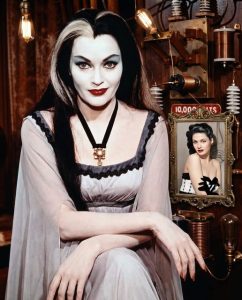
Born in 1922, She Went From Hollywood Screen Siren to TV’s Beloved Spooky Mum
The answer is Yvonne De Carlo, the Canadian-born actress who enjoyed major stardom in the 1940s and 1950s before reinventing herself as Lily Munster, the glamorous and wonderfully deadpan matriarch of The Munsters. Born September 1, 1922, in Vancouver, British Columbia, De Carlo built a career that stretched across film, television, theater, music and more than five decades of entertainment. (Turner Classic Movies)
And that is precisely what makes her story so fascinating. Long before television audiences knew her as the elegant vampire wife of Herman Munster, De Carlo had already been one of Hollywood’s most recognizable glamour stars.


From Vancouver to Hollywood
Yvonne De Carlo was born Margaret Yvonne Middleton, and her path toward Hollywood began long before she became a familiar face on the silver screen.
Her mother encouraged her interest in performance, and De Carlo studied dance and acting while still young. After moving to Los Angeles, she worked as a dancer while attempting to establish herself in movies. Her early film career consisted largely of small and uncredited appearances, including films such as This Gun for Hire, The Road to Morocco, So Proudly We Hail! and For Whom the Bell Tolls. (Turner Classic Movies)
Those early years were hardly an overnight success story. De Carlo had to work her way through Hollywood’s enormous system of studios, casting offices and supporting roles.
Eventually, however, her distinctive beauty and screen presence began attracting serious attention.
The breakthrough: Salome, Where She Danced
The turning point came in 1945, when De Carlo starred in Salome, Where She Danced.
The movie helped establish her as an exotic, glamorous leading lady. Although the film itself was not universally admired by critics, it performed strongly enough commercially to elevate De Carlo’s profile considerably. The role essentially introduced audiences to the persona that would define much of her early career: beautiful, confident, mysterious and perfectly suited to Technicolor spectacle. (Los Angeles Times)
During the late 1940s, she appeared in a succession of films that emphasized her glamour while also allowing her to work in different genres.
She appeared opposite major stars including Burt Lancaster in Brute Force and Criss Cross, and she took roles in westerns, adventure pictures, romances and crime dramas. The Television Academy notes that she eventually appeared in more than 100 movies during her career. (Television Academy)
In other words, describing her simply as a “screen siren” does not tell the whole story.
She certainly had the beauty associated with that label, but she was also an experienced performer who worked steadily across several genres.
A queen of Technicolor
De Carlo became particularly associated with colorful adventure films and westerns.
Movies such as Frontier Gal, Song of Scheherazade, Slave Girl, River Lady and Tomahawk helped establish her as a major postwar Hollywood attraction. Her appearance was perfectly suited to the Technicolor productions of the era, where elaborate costumes, dramatic landscapes and vivid lighting were central attractions.
But De Carlo eventually became frustrated with being defined primarily by her appearance.
She wanted opportunities to demonstrate that there was more to her than glamour.
That ambition became increasingly evident as she moved into more substantial dramatic roles.
The Ten Commandments
One of the most important moments of her film career arrived in 1956, when Cecil B. DeMille cast De Carlo as Sephora, the wife of Moses, in The Ten Commandments.
The epic starred Charlton Heston as Moses and became one of the most famous biblical spectacles in Hollywood history.
For De Carlo, the role represented something important: she was no longer simply being presented as an exotic beauty in a Technicolor adventure. She was part of an enormous prestige production and was given a role with dramatic significance.
The performance became one of her most enduring film appearances. The Television Academy specifically highlights her work as Sephora among her notable achievements. (Television Academy)
The success of The Ten Commandments also demonstrated why De Carlo’s career should not be reduced to her later television fame.
She had already built a substantial filmography before Lily Munster ever entered the picture.
Working alongside Clark Gable and other stars
De Carlo continued appearing with major Hollywood names.
In Band of Angels (1957), she starred opposite Clark Gable, while her earlier career included collaborations with Burt Lancaster, Rock Hudson, Joel McCrea, Alec Guinness and other prominent performers. (Los Angeles Times)
She also demonstrated a flair for comedy.
Her performance opposite Alec Guinness in The Captain’s Paradise showed another side of her abilities, while British-made productions gave her opportunities beyond the standard Hollywood studio system. (The Guardian)
By the end of the 1950s, however, Hollywood was changing.
The old studio system was weakening, television was becoming increasingly important and the kinds of roles available to established actresses were shifting.
De Carlo responded by doing something that would ultimately define the second half of her career:
She reinvented herself.
Enter Lily Munster
In 1964, De Carlo took on the role that would introduce her to an entirely new generation: Lily Munster in The Munsters.
The CBS sitcom ran from 1964 to 1966 and centered on a bizarre but surprisingly wholesome family of monsters living at 1313 Mockingbird Lane.
Fred Gwynne played Herman Munster, Al Lewis played Grandpa, Butch Patrick played Eddie, and De Carlo played Lily—the elegant, composed mother of the household. (Los Angeles Times)
The transformation was remarkable.
The woman who had once been promoted as one of Hollywood’s glamorous leading ladies was suddenly appearing on television in elaborate gothic makeup, dark clothing and a distinctive streak of white in her hair.
Yet the role was not a complete rejection of her earlier image.
In many ways, Lily Munster allowed De Carlo to combine her glamour with comedy.
She could still look elegant and sophisticated, but now that sophistication became part of the joke.
The secret of Lily’s appeal
Lily was surrounded by characters who looked frightening, yet she was often the calmest person in the room.
That contrast became central to the character.
The Munsters might look like a family from a horror movie, but their problems were frequently ordinary domestic problems. Herman could be foolish, Grandpa could be eccentric, and Eddie could cause trouble, but Lily often provided the steady center of the household.
De Carlo reportedly based aspects of her performance on silent-film comedian ZaSu Pitts, helping her create a comic style that was more understated than broad. (Los Angeles Times)
That deadpan quality was essential.
Rather than constantly reminding the audience that Lily was a vampire, De Carlo played her as though being married to a Frankenstein-like husband and living with a werewolf child were completely normal.
That made the character funny.
From vamp to vampire
The transformation has been described as a move from Hollywood “vamp” to television vampire, and it perfectly captures the unusual arc of De Carlo’s career. (The Guardian)
The woman who had once played glamorous saloon girls, dancers and exotic heroines was now playing a fictional monster—but somehow the role suited her.
Her natural elegance made Lily believable as a glamorous member of the Munster family.
And her years of professional experience meant she knew how to land a joke without overplaying it.
Although The Munsters lasted only two seasons, its cultural impact proved enormous. Syndication kept the series alive for generations, turning Lily Munster into one of classic television’s most recognizable female characters. (Television Academy)
She was much more than Lily
It is easy for an iconic television role to overshadow everything that came before it.
For De Carlo, that is particularly ironic because she had already spent decades working in Hollywood.
Her film credits included Criss Cross, The Ten Commandments, Band of Angels, The Captain’s Paradise and McLintock!, among many others. She also continued working after The Munsters, appearing in movies and television while pursuing theater opportunities. (Rotten Tomatoes)
She even made her mark on Broadway.
In 1971, De Carlo appeared in Stephen Sondheim’s Follies, where she performed the celebrated number “I’m Still Here.” The song, with its theme of surviving changing fashions and decades of show business, proved particularly appropriate for an actress whose own career had undergone so many transformations. (Los Angeles Times)
A Hollywood survivor
Perhaps the most impressive part of De Carlo’s story is her ability to remain relevant while the entertainment industry repeatedly changed around her.
She began as a young dancer hoping to find movie work.
She became a 1940s screen attraction.
She established herself in westerns and adventure films.
She graduated to major dramatic productions such as The Ten Commandments.
Then, when television became increasingly dominant, she reinvented herself as Lily Munster.
And when The Munsters ended, she continued working in film, television and theater.
The Hollywood Walk of Fame recognized her achievements with stars for both motion pictures and television, awarded in 1960. (Hollywood Walk of Fame)
The enduring legacy of Yvonne De Carlo
Yvonne De Carlo died in January 2007 at the age of 84, but her legacy remains unusually diverse. (Los Angeles Times)
Classic-film audiences remember the glamorous actress of the 1940s and 1950s.
Fans of biblical epics remember Sephora in The Ten Commandments.
Western enthusiasts remember her appearances alongside some of the biggest stars of the era.
Broadway fans remember her work in Follies.
And television viewers remember her most affectionately as Lily Munster.
That last role may have become her most famous, but it should not erase the remarkable career that preceded it.
So, if the clue asks for the classic Hollywood screen siren born in 1922 who later became television’s wonderfully spooky mother Lily Munster, the answer is unmistakably Yvonne De Carlo.
She was glamorous enough for Old Hollywood, versatile enough for major dramatic productions, funny enough for a beloved sitcom and resilient enough to keep reinventing herself for more than five decades.
And perhaps that is why Lily Munster remains so memorable.
Behind the gothic makeup, the black-and-white hair and the deadpan delivery was a veteran Hollywood performer who had already lived several careers before she ever walked through the doors of 1313 Mockingbird Lane.