🚨 BREAKING NEWS: Devastating Floods Leave Homes Destroyed and Communities in Ruins
A catastrophic flooding disaster is leaving communities facing destruction, displacement and an uncertain road to recovery, as rescue teams race to reach people cut off by torrents of water, mud, rock and debris.
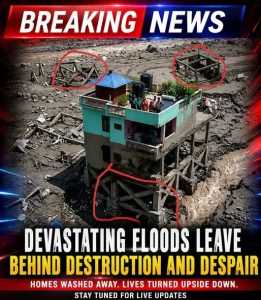
The dramatic image accompanying this story captures the kind of devastation that floods can leave behind: a building standing precariously above a landscape stripped of roads, structures and vegetation. The supplied image should be treated as illustrative; its exact location and date cannot be independently confirmed from the photograph alone. However, the destruction shown reflects the scale of the humanitarian emergency unfolding in parts of the Himalayan region.
Recent flooding along the Nepal–China border has become one of the most serious disasters reported in the region this year. The United Nations has described widespread destruction in Nepal and China’s Tibet Autonomous Region, while rescue and humanitarian operations continue. (United Nations)
A disaster that changed lives in minutes
Flood disasters are often described in terms of rainfall totals, river levels and damaged infrastructure. For families living through them, however, the reality is much more personal.
A home can represent decades of work.
A road can represent access to a school, hospital or workplace.
A bridge can connect an isolated community to the outside world.
When floodwaters sweep those things away, the damage is not simply physical. It can destroy livelihoods, separate families and leave survivors wondering where they will sleep, find food or obtain clean water.
In the Himalayan disaster, the danger has been particularly complicated because the flooding has involved powerful surges of water, debris and landslides in mountainous terrain. UN officials have warned that the emergency can continue evolving because landslides, blocked rivers and additional flooding may create new hazards. (UN Transcripts)
That means surviving the initial wave is only the beginning.
Rescue teams face enormous challenges
For rescuers, reaching devastated communities is one of the biggest challenges.
Mountain roads can disappear beneath mud and debris. Bridges can collapse. Communication networks can fail. Areas that were easily accessible before the disaster can suddenly become reachable only by helicopter.
A United Nations briefing on August 28 reported that more than 40 kilometers of roads had been completely destroyed and that helicopters were being used to reach some isolated areas. More than 30,000 military and security personnel were involved in Nepal’s search-and-rescue response at that stage. (UN Transcripts)
The conditions make every rescue operation more difficult.
Helicopters must contend with weather and mountainous terrain. Ground teams have to move carefully through unstable areas. Heavy machinery may be required to clear enormous quantities of mud, rock and debris.
And even after rescuers arrive, they may find that people need far more than immediate evacuation.
They may need drinking water.
They may need medical treatment.
They may need food and temporary shelter.
They may need help finding missing relatives.
And they may need psychological support after witnessing the destruction of their homes and communities.
The human toll continues to rise
The number of casualties in a rapidly developing disaster can change quickly as rescue teams reach previously inaccessible areas.
Earlier UN figures reported hundreds of deaths and hundreds of people missing in Nepal. By September 1, UN reporting indicated that the combined death toll from the Himalayan floods had passed 1,000, with thousands still missing. (United Nations)
Those numbers represent individual human beings—not statistics.
Behind every number is a family waiting for news.
There are parents searching for children, children waiting for parents, friends wondering whether loved ones survived and entire communities trying to determine who is still missing.
The scale of the tragedy is made even more painful by the number of people who were caught far from home.
Early reports indicated that hundreds of foreign nationals were among those missing, adding an international dimension to an already enormous rescue operation. (Reuters)
Homes washed away
One of the most visible consequences of a major flood is the destruction of housing.
A house can sometimes be repaired after water damage. But when floodwaters carry away walls, foundations, roofs and surrounding soil, rebuilding becomes an entirely different challenge.
Images from flood-affected areas have shown homes surrounded by enormous quantities of mud and debris. Some structures have been left standing while everything around them has disappeared.
That creates another danger.
Buildings that survived the initial flooding may no longer be structurally safe.
Foundations can become exposed.
Supporting ground can collapse.
Retaining walls can fail.
And additional rain can trigger landslides around already weakened structures.
The photograph accompanying this article illustrates that frightening reality. A building appears to be standing on supports above heavily damaged terrain, demonstrating how dramatically floodwaters can alter the landscape.
Again, however, the photograph itself does not establish where or when it was taken.
Thousands need assistance
The humanitarian needs are enormous.
The UN reported that at least 93,000 people were believed to have been affected in Nepal during the early response, with thousands of homes destroyed. Humanitarian organizations emphasized that the emergency would extend well beyond the first few days of rescue operations. (UN Transcripts)
Temporary shelter becomes an immediate priority.
People who have lost their homes need somewhere safe to sleep. They also need blankets, clothing, cooking supplies and hygiene materials.
Clean water is equally important.
Floodwater can contaminate drinking-water sources with sewage, chemicals, dead animals and other pollutants. When sanitation systems are damaged, the risk of disease increases.
The World Health Organization has warned about the health challenges created when displacement, overcrowding and disruption to water, sanitation and healthcare occur simultaneously. Several health facilities were damaged, according to the UN briefing. (UN Transcripts)
Children among the most vulnerable
Children can be particularly vulnerable after a disaster.
They may lose their homes, possessions and routines in a matter of hours.
Schools may be damaged or destroyed, meaning education stops at precisely the moment children need stability most.
UNICEF reported that 18 schools had been completely destroyed and another 20 damaged, with an estimated 10,000 school-aged children needing assistance to continue their education. (UN Transcripts)
Returning children to school is about more than textbooks.
A functioning classroom can provide safety, routine and a sense of normality.
After a traumatic event, that can be incredibly important.
Communities begin the long road back
The rescue phase will eventually give way to recovery.
But rebuilding a community after catastrophic flooding can take months or even years.
Roads must be reconstructed.
Bridges must be replaced.
Water systems must be restored.
Homes need to be rebuilt.
Businesses need to reopen.
Farmers may need assistance after losing crops, livestock or agricultural equipment.
And governments must determine how to rebuild in ways that reduce future risk.
This is particularly important in mountainous areas, where flooding can interact with landslides, glacial hazards and unstable slopes.
The UN has emphasized that Nepal’s disaster is not simply a conventional flood. In mountainous terrain, glaciers, landslides and temporary natural dams can create complicated chains of events, making early warning and emergency planning especially difficult. (UN Transcripts)
International aid begins moving
The scale of the emergency has prompted international assistance.
The United Nations and humanitarian partners have been working alongside Nepal’s government, which is leading the response. Emergency funding, supplies, assessment teams and medical assistance have been mobilized.
The UN said it released $2.5 million in emergency funding, while additional assistance was pledged by Switzerland, Australia and the United Kingdom. (UN Sustainable Development Goals)
International rescue cooperation has also become increasingly important as authorities attempt to reach isolated communities and search for missing people.
But money and equipment alone cannot instantly restore what has been lost.
The greatest challenge is time.
The danger may not be over
Perhaps the most frightening aspect of the disaster is that flood emergencies do not necessarily end when the water begins to recede.
Mountain slopes can remain unstable.
Rivers can rise again.
Temporary debris dams can fail.
Additional rainfall can trigger new landslides.
And damaged buildings can collapse without warning.
UN officials have specifically warned that the situation remained dynamic and that cascading hazards could continue in mountainous areas. (UN Transcripts)
For residents who have already survived one disaster, another warning can therefore be terrifying.
Some families may have no safe home to return to.
Others may be living in temporary shelters while waiting for authorities to determine whether their neighborhoods are safe.
More than destruction: a test of resilience
Yet disasters also reveal something powerful about communities: resilience.
Neighbors help neighbors.
Local volunteers search through debris.
Medical workers continue treating patients under extraordinary conditions.
Soldiers and emergency personnel work around the clock.
Humanitarian organizations deliver supplies.
And families who have lost almost everything begin helping one another rebuild.
The road ahead will be extraordinarily difficult, but recovery begins with those small acts of solidarity.
A heartbreaking reminder
The dramatic photograph accompanying this story is a powerful visual reminder of what flooding can do to a community. But the true story is not the picture itself.
It is the people.
It is the families whose houses disappeared.
It is the children whose schools were destroyed.
It is the rescuers climbing through dangerous terrain.
It is the survivors searching through ruins for possessions and loved ones.
And it is the communities confronting the enormous task of rebuilding.
The Himalayan floods have demonstrated once again that extreme flooding can transform a familiar landscape almost instantly. Current reporting from the United Nations and international news organizations shows that the crisis has involved widespread destruction, a huge humanitarian response and continuing uncertainty for thousands of missing people. (United Nations)
For those watching from afar, photographs can make the destruction visible.
But for the people living through it, this is not simply a dramatic news image.
It is home. It is family. It is livelihood. And it is a life that must now be rebuilt.
As rescue operations continue and humanitarian workers reach devastated communities, the immediate priority remains clear: save lives, find the missing, provide shelter and clean water, protect vulnerable people, and give survivors the support they need to begin again.
The floodwaters may eventually disappear.
The rebuilding, however, has only just begun.