People Have Just Found Out What ‘E’ on Car Gear Sticks Actually Stands For
If you have ever looked at the gear stick of an older manual car and wondered why there was an “E” sitting where you expected another numbered gear, you are definitely not alone.
For generations, drivers have become accustomed to seeing familiar markings such as 1, 2, 3, 4, 5, R and sometimes 6. But the unusual “E” found on certain older cars has puzzled plenty of motorists, particularly people who learned to drive on newer vehicles.
The answer is surprisingly simple: E was generally associated with Economy or Efficiency—a fuel-saving gear designed to let the engine run at lower revolutions during cruising. (Supercar Blondie)
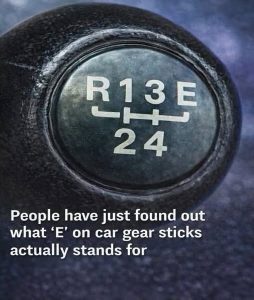
And the photograph above provides a great example of the old-fashioned gear pattern.
So, what exactly did “E” mean?
The most common explanation is “Economy.” However, there is an important little technical distinction: some manufacturers referred to the concept as Efficiency rather than Economy.
Either way, the basic idea was the same.
The E position represented a tall, fuel-saving ratio intended to keep engine speed relatively low when the vehicle was moving at higher road speeds. It was essentially an early approach to what modern drivers might recognize as an economy mode or fuel-saving overdrive. (SlashGear)
That explains why the letter appeared alongside conventional gears rather than replacing reverse or neutral.
It wasn’t an emergency gear.
It wasn’t “electric.”
And, despite some amusing guesses that have circulated online, it certainly wasn’t an ejector-seat button.
It was about saving fuel.
Look closely at the photograph
The gear knob shown in the image has R, 1, 3 and E across the upper portion, with 2 and 4 underneath.
That layout is a clue that this is not a conventional modern five-speed manual transmission.
Instead, the E position effectively takes the place of what drivers might expect to see as a higher cruising gear.
The concept became particularly associated with older European cars, including certain Volkswagen models. Contemporary discussions of the feature frequently point to Volkswagen’s 3+E and 4+E transmissions, where E represented the economy-oriented top ratio. (Supercar Blondie)
One notable example was the 1981 Volkswagen Rabbit, marketed with a 4+E transmission in some configurations. The E gear was designed to provide a taller ratio suitable for economical cruising. (SlashGear)
So that strange-looking gear pattern wasn’t a mistake.
It was automotive engineering from another era.
Why did cars need an economy gear?
To understand why manufacturers introduced systems like this, it helps to remember how different older cars were.
Fuel economy became an increasingly important concern following the oil crises of the 1970s. Drivers became much more conscious of gasoline consumption, while manufacturers looked for ways to squeeze greater efficiency from existing engines and transmissions.
One relatively straightforward solution was to give the car a taller cruising ratio.
At highway speed, an engine doesn’t necessarily need to spin extremely fast to maintain momentum. If the gearing allows the wheels to turn sufficiently quickly while the engine turns more slowly, fuel consumption can be reduced.
That’s essentially the principle behind overdrive.
The E gear therefore allowed the driver to cruise without keeping the engine spinning as rapidly as it would in a conventional lower gear.
Lower RPM was the secret
Imagine driving an older manual car at highway speed.
In a conventional lower gear, the engine may be turning relatively quickly even though the vehicle isn’t accelerating.
Select a taller gear, however, and the engine can settle into a lower RPM range.
Lower engine speed can mean less fuel being consumed during steady cruising, although the exact benefit depends on the vehicle, gearing, engine load, road conditions and driving style.
The E gear was therefore particularly useful on open roads and highways, rather than when accelerating from a standstill or climbing a steep hill.
It was essentially telling the driver:
You’re cruising now. Let the engine relax.
That philosophy still exists in modern vehicles.
The technology simply became much more sophisticated.
Why didn’t every car have an “E”?
This is one of the reasons the letter is so unfamiliar today.
The E designation was never a universal standard appearing on every manual transmission.
Different manufacturers used different approaches to improving fuel economy. Some used five-speed transmissions with an overdrive fifth gear. Others experimented with economy-oriented ratios or separate economy settings.
As automotive engineering improved, the need for a dedicated E position diminished.
Manufacturers could build transmissions with several closely spaced gears and a tall top gear, giving drivers both acceleration and efficient cruising without requiring a strange letter on the gear knob.
Modern electronic engine management also made fuel-saving strategies considerably more sophisticated.
Instead of relying on a dedicated mechanical E position, today’s vehicles can continuously adjust engine and transmission behavior.
E wasn’t necessarily a “normal” extra gear
One misconception is that E simply meant “extra.”
It is easy to understand why someone might think that. If a car has gears 1 through 4 and then E, wouldn’t E simply be “extra gear”?
Not quite.
While the E ratio did effectively function like an additional high gear in some transmissions, manufacturers used the letter specifically to emphasize its economy/efficiency purpose. (AOL.com)
In other words, the important characteristic wasn’t simply that it was another gear.
It was that it was a tall, fuel-conscious ratio.
That’s also why calling it an early form of overdrive isn’t entirely unreasonable.
What did the car feel like in E?
There was a trade-off.
A taller gear is excellent for steady cruising, but it isn’t necessarily what you want when you need strong acceleration.
If you’re traveling at a steady speed on a relatively flat road, keeping engine RPM down can be ideal.
But if you suddenly need to accelerate hard, climb a hill or carry a heavy load, the engine may not have the same immediate response.
The driver could therefore shift back into a lower gear when additional power was needed.
This is exactly the logic behind modern manual driving.
You don’t use the highest gear for every situation.
You choose the ratio that matches the engine’s workload.
The idea didn’t disappear—it evolved
Here’s the really interesting part.
Although the letter E largely disappeared from manual gear knobs, the idea behind it certainly didn’t.
Modern cars are packed with technology designed to accomplish essentially the same goal.
Many vehicles have Eco or Economy driving modes.
Automatic transmissions can select higher gears earlier.
Engine computers can adjust fuel delivery.
Hybrid vehicles use sophisticated power-management strategies.
Modern transmissions may have six, seven, eight, nine or even ten forward ratios, allowing the vehicle to combine strong acceleration with extremely low engine speeds during highway cruising.
So while today’s driver might press an ECO button rather than select an E gear, the basic philosophy is remarkably similar:
Use less fuel when maximum power isn’t necessary.
Why younger drivers rarely recognize it
There’s another reason this little symbol has suddenly become an Internet curiosity.
Many younger drivers simply haven’t encountered it.
Modern manual transmissions overwhelmingly use familiar numbered layouts. Automatic drivers may go years without operating a conventional clutch and manual gear lever at all.
And today’s gear selectors often use letters such as P, R, N and D, sometimes accompanied by S, M, L or B, depending on the vehicle.
A strange E sitting beside numbers therefore looks almost mysterious.
That unfamiliarity is exactly what makes photographs like the one above so shareable.
Someone discovers an old gear knob, asks what the E means, and suddenly thousands of people realize they never knew the answer either.
Don’t confuse every “E” with the same thing
There’s an important caveat, though.
Not every E appearing somewhere in a modern vehicle means Economy.
Automakers use letters for different purposes depending on the transmission and model.
For example, some modern cars use E-related terminology for electronic controls, electric propulsion or efficiency-related drive programs.
The meaning must therefore be determined from the specific vehicle.
But for the older manual-style gear pattern shown in the photograph, the economy/efficiency explanation is the relevant one. (Supercar Blondie)
A forgotten chapter of automotive history
The E gear is interesting because it represents a period when automakers were finding increasingly clever mechanical solutions to fuel consumption.
Today, saving fuel is often discussed in terms of hybrid batteries, regenerative braking, sophisticated computer controls and aerodynamic design.
Decades ago, engineers were working with comparatively simple mechanical systems.
A taller transmission ratio could make a meaningful difference.
The driver could select it during steady cruising and allow the engine to operate at a lower speed.
Simple idea.
Clever result.
And eventually, the technology became so commonplace that the special letter was no longer necessary.
So, the mystery is solved
The next time you see an old gear stick with an E on it, don’t assume it means electric, emergency or extra.
In the kind of older transmission shown in the viral photograph, E refers to Economy or Efficiency.
It was designed as a fuel-saving, high-ratio gear that allowed the engine to operate at lower RPM during cruising. In some vehicles, it effectively served a role similar to an overdrive gear. (Supercar Blondie)
And that explains why the feature seems so strange to modern drivers.
The automotive world moved on.
Five- and six-speed manuals became familiar. Automatic transmissions became increasingly sophisticated. Electronic engine management transformed fuel-saving technology. Hybrid and electric vehicles introduced completely different approaches to efficiency.
Yet that little E remains a fascinating reminder of an earlier era of motoring.
It wasn’t just a mysterious letter printed on an old gear knob.
It was a small piece of engineering designed around a very modern concern:
How can we make the car use less fuel while still getting where we’re going?
The answer, decades ago, was sometimes as simple as moving the stick into E.