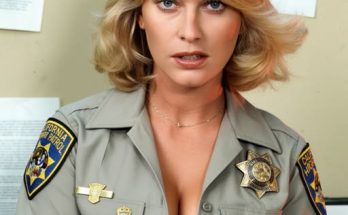
The actress is Susan Dey. Susan Dey
When television audiences first met Susan Dey in 1970, few could have predicted that the shy 17-year-old newcomer would become one of the biggest teen idols of the decade. With her long blonde hair, natural beauty and quietly confident screen presence, she quickly became a household name as Laurie Partridge in The Partridge Family. By 1971—the year this photograph was taken—her face adorned countless magazine covers, bedroom walls and fan scrapbooks across America.
Yet unlike many teen sensations whose fame faded with changing fashions, Susan Dey accomplished something far more difficult. She successfully reinvented herself as a respected dramatic actress, culminating in an Emmy Award-winning performance on one of television’s finest legal dramas, L.A. Law.
Her career remains one of television’s most impressive transformations.
Born December 10, 1952, in Pekin, Illinois, Susan Hallock Dey was raised primarily in New York after her family relocated there during her childhood. Life was not without hardship. Her mother died when Susan was only eight years old, a loss that deeply affected her and helped shape the quiet reserve for which she later became known.
As a teenager, Dey never planned to become an actress.
Instead, she found early success as a fashion model.
Her striking features, elegant appearance and photogenic quality quickly attracted the attention of photographers and advertising agencies. While still attending school, she appeared in catalogs and magazine advertisements, gaining valuable experience in front of the camera even though she had never acted professionally.
That unexpected opportunity arrived in 1970.
Television producer Bernard Slade was casting a new musical sitcom inspired loosely by the real-life success of the Cowsills, a family pop group that had enjoyed considerable chart success during the late 1960s.
The series became The Partridge Family.
Producers searched extensively for someone to play Laurie Partridge, the eldest daughter in the singing family.
Although Susan Dey had virtually no acting experience, she possessed exactly the natural charm they wanted.
She won the role.
It changed her life forever.
Premiering in September 1970, The Partridge Family quickly became one of American television’s biggest successes.
The story followed widowed mother Shirley Partridge, played by Shirley Jones, who formed a touring pop band with her five children.
Each episode mixed family comedy with musical performances, creating a formula that appealed to audiences of all ages.
David Cassidy starred as Keith Partridge, the group’s charismatic lead singer.
Almost overnight, Cassidy became one of the world’s biggest teen idols.
Yet Susan Dey proved equally popular.
As Laurie Partridge, she projected intelligence, kindness and effortless cool. She wasn’t loud or overly glamorous. Instead, she seemed approachable—the girl next door with movie-star looks.
Teen magazines couldn’t get enough of her.
Throughout the early 1970s, Dey regularly appeared on the covers of publications such as Tiger Beat, 16 Magazine and Teen Beat. Fans eagerly collected posters, interviews and photographs, decorating bedroom walls with images of both Susan Dey and David Cassidy.
For countless young viewers, Laurie Partridge represented the ideal older sister.
Behind the scenes, however, Susan Dey was still learning the craft of acting.
Unlike many of her co-stars, she had received no formal dramatic training. She often admitted feeling uncertain during the show’s early seasons, carefully observing experienced performers such as Shirley Jones to improve her skills.
Her dedication paid off.
With each season, Dey became increasingly confident and natural before the cameras.
One aspect of The Partridge Family that generated endless media attention involved her relationship with David Cassidy.
Because Laurie and Keith were siblings on-screen, audiences naturally viewed them as family. Off-screen, however, Dey developed a genuine romantic interest in Cassidy.
Years later, both actors spoke openly about the situation.
Cassidy admitted he cared deeply for Dey but did not share the same romantic feelings, creating an awkward emotional period during the series’ production.
Despite the personal disappointment, Dey handled the situation with remarkable maturity, and their professional relationship remained strong throughout the show’s four-season run.
When The Partridge Family ended in 1974, many assumed Susan Dey would struggle to escape her teen-idol image.
Television history was filled with young stars who found themselves permanently associated with one successful series.
Dey refused to accept that fate.
Rather than immediately chasing more glamorous sitcom roles, she deliberately sought projects that challenged audience expectations.
Throughout the late 1970s and early 1980s she appeared in television movies tackling serious themes, including abuse, addiction and emotional trauma.
These performances gradually changed industry perceptions.
Critics who had once viewed her simply as a pretty television personality began recognizing genuine dramatic ability.
Film roles followed, including appearances in Looker (1981), directed by Michael Crichton, and several other features that further expanded her résumé.
Yet the defining second act of her career arrived in 1986.
Steven Bochco’s groundbreaking legal drama L.A. Law assembled one of television’s strongest ensemble casts.
Susan Dey joined the series as Grace Van Owen, an intelligent, principled deputy district attorney.
The role bore little resemblance to Laurie Partridge.
Grace was ambitious, emotionally complex and professionally driven.
Her relationship with attorney Michael Kuzak, played by Harry Hamlin, became one of the show’s central storylines, blending romance with the ethical dilemmas of legal practice.
Dey’s performance surprised many viewers.
The former teen idol demonstrated extraordinary dramatic depth, handling courtroom confrontations, personal conflicts and emotional storylines with confidence and subtlety.
Critics praised her transformation.
In 1988, she received television’s highest honor when she won the Primetime Emmy Award for Outstanding Lead Actress in a Drama Series.
The victory represented far more than individual recognition.
It confirmed that Susan Dey had completely reinvented herself.
Very few former teen idols have successfully crossed into acclaimed adult dramatic acting.
Dey accomplished exactly that.
During L.A. Law‘s celebrated run, she also received multiple Golden Globe nominations and earned widespread respect within the television industry.
The series itself became one of the defining dramas of the late 1980s, influencing countless legal shows that followed.
Away from the cameras, Susan Dey has always maintained an unusually private personal life.
Unlike many celebrities, she rarely sought publicity beyond promoting her professional work.
She married television producer Bernard Sofronski in 1988, and the couple have enjoyed one of Hollywood’s quieter long-term marriages.
Dey has also devoted considerable energy to charitable causes.
Following her own struggles with eating disorders during her younger years, she became an advocate for organizations supporting individuals dealing with anorexia and bulimia, helping raise awareness about conditions that were rarely discussed openly during earlier decades.
As the years passed, Dey gradually stepped away from acting.
Her final screen appearances came during the early 2000s before she retired from the profession, choosing instead to enjoy a more private life away from Hollywood.
Despite her absence from the screen, her legacy has remained remarkably strong.
Fans continue discovering The Partridge Family through reruns and streaming platforms, appreciating its wholesome humor, catchy music and enduring optimism.
Meanwhile, television historians frequently cite L.A. Law as one of the greatest legal dramas ever produced, introducing new audiences to Dey’s outstanding dramatic work.
Looking back, Susan Dey’s career tells an inspiring story about growth and perseverance.
She began as an inexperienced teenager unexpectedly thrust into international fame.
She endured the pressures of celebrity, the challenges of being labeled a teen idol and the difficult transition into adult acting.
Rather than fading into nostalgia, she patiently rebuilt her career until critics recognized her among television’s finest dramatic performers.
Very few actors successfully define two entirely different eras of television.
Susan Dey managed exactly that.
For one generation, she will always be Laurie Partridge, the stylish eldest daughter whose smile lit up television screens every Friday night.
For another, she is Grace Van Owen, the determined attorney whose intelligence and integrity helped make L.A. Law one of television’s greatest dramas.
Both performances remain lasting reminders of an actress whose quiet talent ultimately proved every bit as memorable as her early teen-idol fame.