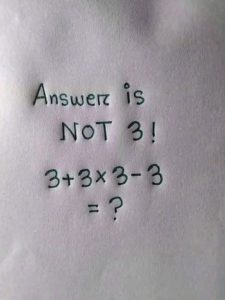
The Answer Is NOT 3! Can You Solve This Simple-Looking Math Puzzle?
At first glance, the equation in the image looks almost too easy to deserve a second thought:
3 + 3 × 3 − 3 = ?
Yet the message above it deliberately challenges the reader:
“Answer is NOT 3!”
That little warning changes the entire feel of the puzzle. Instead of quickly adding and subtracting the numbers from left to right, you have to stop and ask an important question: Which operation should be performed first?
The correct answer, using the standard mathematical order of operations, is 9.
But why? And why might someone initially arrive at 3?
Let’s break the puzzle down carefully.
The equation that causes the confusion
We have:
3 + 3 × 3 − 3
There are three different types of operations involved:
- Addition: +
- Multiplication: ×
- Subtraction: −
The crucial point is that mathematics does not normally tell us to calculate every operation from left to right when different operations are mixed together.
Instead, there is a conventional hierarchy known as the order of operations.
Multiplication has priority over addition and subtraction.
So the multiplication in the middle — 3 × 3 — needs to be calculated before the addition and subtraction.
Start there:
3 × 3 = 9
Now substitute that result into the original expression:
3 + 9 − 3
At this point, only addition and subtraction remain. These have equal priority, so they are evaluated from left to right:
3 + 9 = 12
Then:
12 − 3 = 9
Therefore:
3 + 3 × 3 − 3 = 9
Final answer: 9.
Why do some people get 3?
The most common mistake is to read the expression strictly from left to right.
Someone might see:
3 + 3 = 6
Then:
6 × 3 = 18
And finally:
18 − 3 = 15
That produces 15, not 3.
Another possible approach is to group the expression mentally in a way that is not justified by the written equation, perhaps treating the first and last 3s as canceling each other:
3 − 3 = 0
Then imagining that the remaining part somehow produces another result.
But without parentheses, you cannot simply rearrange the expression according to whichever calculation looks convenient.
There is another reason people might expect 3: they may be thinking about the familiar “three 3s” style of puzzle, where different mathematical symbols can be inserted between 3s to create a particular number. But this expression is not asking you to invent symbols or rearrange anything. It already gives you the operations.
The rules of arithmetic decide the result.
The importance of order of operations
The order of operations exists because mathematical expressions need to have a consistent interpretation.
Imagine if there were no agreed-upon rules.
Take a simple expression:
2 + 3 × 4
One person could calculate from left to right:
2 + 3 = 5
5 × 4 = 20
Another person could perform multiplication first:
3 × 4 = 12
2 + 12 = 14
Which answer would be correct?
Without a convention, both could claim their method was reasonable.
Mathematics avoids this problem by establishing a standard hierarchy. Multiplication and division generally come before addition and subtraction.
Thus:
2 + 3 × 4 = 14
not 20.
The same principle applies to the puzzle in the image.
PEMDAS and the familiar shortcut
Many students learn the order of operations using the acronym PEMDAS:
P — Parentheses
E — Exponents
M — Multiplication
D — Division
A — Addition
S — Subtraction
Some countries and classrooms use variations such as BODMAS or BIDMAS, but the underlying idea is similar.
The important detail is that multiplication does not merely happen “somewhere before addition.” It has higher precedence.
So when we encounter:
3 + 3 × 3 − 3
we immediately identify:
3 × 3
as the first calculation.
That gives us:
3 + 9 − 3
Then we proceed from left to right:
12 − 3 = 9
Nothing mysterious is happening. The puzzle is testing whether the solver remembers the convention.
But what if we calculate from left to right?
This is where the puzzle becomes a useful lesson.
Addition, subtraction, multiplication, and division are not all simply performed in the order they appear.
For example, consider:
10 − 2 × 3
If you work from left to right, you get:
10 − 2 = 8
then:
8 × 3 = 24
But that is not the standard interpretation.
Multiplication comes first:
2 × 3 = 6
Then:
10 − 6 = 4
So the correct result is 4.
The same rule explains our original puzzle.
What happens if there are parentheses?
Parentheses can completely change the answer.
For example:
(3 + 3) × 3 − 3
Now the addition inside the parentheses comes first:
3 + 3 = 6
Then:
6 × 3 = 18
Then:
18 − 3 = 15
So this version equals 15.
Compare that with the original:
3 + 3 × 3 − 3 = 9
The only difference is the placement of parentheses, yet the answer changes dramatically.
This demonstrates why mathematical notation matters so much.
Why the wording “Answer is NOT 3!” is effective
The text above the equation is part of what makes this puzzle appealing.
If the image simply showed:
3 + 3 × 3 − 3 = ?
many people would immediately recognize it as an order-of-operations question.
But the statement “Answer is NOT 3!” creates a psychological challenge.
It encourages the reader to think:
“If it isn’t 3, then what is it?”
The obvious warning also suggests that there may be a trick hidden somewhere.
However, there does not need to be an elaborate trick. Sometimes the “trick” is simply remembering a basic mathematical rule.
That is a common feature of viral math puzzles. The numbers are intentionally small so that the arithmetic itself is effortless. The real challenge is following the correct procedure.
Is there any ambiguity?
Under standard arithmetic conventions, the answer is clearly 9.
There are occasional online debates about expressions involving multiplication and division, particularly when unusual notation or implicit multiplication is involved. But this particular expression is straightforward.
There is an explicit multiplication symbol:
3 × 3
and explicit addition and subtraction symbols.
There are no fractions, hidden multiplication signs, exponents, or unusual parentheses to create a serious interpretive problem.
Therefore, under conventional mathematical notation:
3 + 3 × 3 − 3 = 9
is the standard answer.
A simple way to remember the rule
If you regularly find yourself making mistakes on equations like this, remember one basic principle:
Multiplication and division come before addition and subtraction.
For this problem, you can even mark the multiplication visually:
3 + [3 × 3] − 3
Calculate the bracketed multiplication:
3 + 9 − 3
Then finish:
12 − 3
which gives:
9
This method makes the answer almost impossible to miss.
Try these similar puzzles
Once you’ve solved this one, consider a few expressions that use the same principle.
Example 1
4 + 2 × 3
Multiplication first:
2 × 3 = 6
Then:
4 + 6 = 10
Answer: 10
Example 2
12 − 3 × 2
Multiplication first:
3 × 2 = 6
Then:
12 − 6 = 6
Answer: 6
Example 3
5 + 4 × 2 − 3
First:
4 × 2 = 8
Then:
5 + 8 − 3
Next:
13 − 3 = 10
Answer: 10
Notice how the multiplication is always handled before the addition or subtraction.
The bigger lesson behind the puzzle
Although the equation is elementary, it illustrates a broader mathematical principle: rules matter as much as calculation.
You can know how to add, subtract, and multiply perfectly and still arrive at the wrong answer if you perform those operations in the wrong sequence.
That is why mathematics relies so heavily on notation and conventions. A mathematical expression is designed to communicate a precise instruction.
In this puzzle, the numbers themselves are almost irrelevant. The challenge is recognizing that 3 × 3 must be handled before the surrounding addition and subtraction.
Once that is understood, the problem becomes very simple.
Start with:
3 + 3 × 3 − 3
Perform multiplication:
3 + 9 − 3
Move from left to right:
12 − 3
And finally:
9
So the image’s warning is absolutely right: the answer is not 3.
It isn’t 15, either, and there is no need for a complicated hidden trick.
The answer is 9, thanks to the standard order of operations.
And that is precisely why these deceptively simple puzzles can be so effective: they don’t test whether you can perform difficult arithmetic. They test whether you can resist the temptation to rush, recognize the rule being applied, and follow it carefully.
Final solution:
3 + 3 × 3 − 3
= 3 + 9 − 3
= 12 − 3
= 9