King Charles Pays Moving Tribute After the Death of Norway’s King Harald V at 89
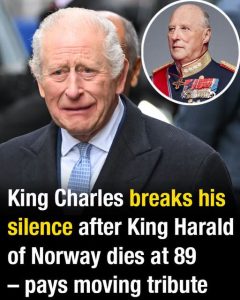
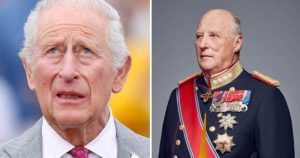
The death of King Harald V of Norway has brought a deeply personal message of mourning from King Charles III, who described the late Norwegian monarch as his “dear cousin” and remembered him as a much-loved relative and friend.
King Harald died peacefully at Rikshospitalet in Oslo on August 28, 2026, at the age of 89. He had reigned over Norway for 35 years, becoming a familiar and widely respected figure not only in his own country but across Europe. (Forsvaret)
For King Charles, however, Harald’s death represented more than the passing of another European sovereign. It was the loss of a member of his extended family and someone with whom the British royal family shared decades of personal and historical connections.
A deeply personal message from King Charles
Following the announcement of Harald’s death, King Charles and Queen Camilla issued a message expressing their profound sadness.
Charles referred to Harald as his “dear cousin” and reflected on the 35 years during which Harald served Norway. He praised the late king for guiding his country through periods of considerable change while maintaining a reputation for warmth and humility. (The Royal Family)
The message was notable for its personal tone.
Charles said that his entire family would remember Harald as a beloved relative and friend, emphasizing his kindness, compassion and strong sense of duty. He also extended condolences to Queen Sonja and the wider Norwegian royal family.
It was not simply a formal statement between two heads of state. The words reflected a relationship that had developed over generations.
The British and Norwegian royal families have long been connected through marriage, ancestry, friendship and shared history. Those connections became particularly important during the difficult years of the Second World War and continued throughout the reigns of both Harald and Queen Elizabeth II.
The end of a 35-year reign
Harald became King of Norway in 1991 following the death of his father, King Olav V.
Over the next three and a half decades, he became a symbol of continuity in a rapidly changing country.
His reign covered enormous social, technological and political transformations. Norway moved further into the modern era while retaining its constitutional monarchy, and Harald developed a public image that was markedly approachable for a king.
The Norwegian government described the country as being in mourning following his death, while Prime Minister Jonas Gahr Støre said that an era had ended and a new one had begun. (Regjeringen.no)
The Norwegian Armed Forces also paid tribute to Harald, describing him as a unifying presence, a compassionate man and a wise sovereign. A formal mourning gun salute was conducted following the announcement of his death. (Forsvaret)
For many Norwegians, Harald had been king for practically an entire generation.
He was not an abstract historical figure. He was the monarch many citizens had grown up seeing at national celebrations, sporting events, ceremonies and moments of national sorrow.
That familiarity helped make his death particularly emotional.
A royal family connection stretching across generations
King Charles’ description of Harald as his cousin highlights the complicated but very real family network connecting Europe’s monarchies.
The Norwegian royal family has longstanding links with the British royal family, and Harald himself was a second cousin of Queen Elizabeth II.
Those family relationships were reinforced by years of meetings and state occasions.
Harald and the British royals were frequently photographed together, including during significant diplomatic and ceremonial events. Their relationship was not limited to formal royal protocol.
Charles specifically highlighted the historical ties between Britain and Norway in his message of condolence.
He noted that Britain was among the first countries to recognize Norwegian independence and establish diplomatic relations with Norway in 1905. Those links became even stronger during the Second World War, when the relationship between the two countries took on extraordinary importance. (The Royal Family)
That shared history gives Harald’s passing significance beyond the Norwegian royal household.
His death represents the passing of one of the last direct links to an earlier generation of European monarchy.
Queen Sonja and a partnership that lasted decades
At the center of the Norwegian royal family’s grief is Queen Sonja, Harald’s wife of nearly six decades.
The couple married in 1968 after a long courtship, and their relationship was unusual for its time because Sonja was a commoner rather than a member of another royal family.
Their eventual marriage represented a significant change in the traditions surrounding European royalty.
Together, Harald and Sonja became one of Norway’s best-known couples.
They raised their family while carrying out the demanding responsibilities of public life, and Sonja became an important figure in her own right.
Harald’s death therefore marked not only the end of a reign but also the loss of a husband and lifelong companion.
The Norwegian royal household has described Harald’s final days and death with the solemnity expected during a national period of mourning. Norway’s government declared a national mourning period surrounding the funeral ceremonies. (Regjeringen.no)
A new chapter begins with King Haakon VIII
Harald’s death also immediately transformed Norway’s monarchy.
His son, Crown Prince Haakon, became King Haakon VIII.
Norway does not hold a traditional coronation, meaning the succession takes effect immediately when a monarch dies. Haakon subsequently took the constitutional oath before Norway’s parliament. (Reuters)
The transition from father to son carries both practical and emotional significance.
Haakon now inherits an institution his father led for 35 years. At the same time, he must establish his own identity as monarch while preserving the qualities Norwegians valued in Harald.
The new king has publicly remembered his father not merely as a monarch but as a devoted parent, husband and grandfather.
That personal dimension has been especially powerful during the transition.
Why Charles’ tribute matters
Royal condolence messages can sometimes sound carefully constructed and formal.
Charles’ message stood out because of the personal relationship behind it.
Calling Harald his “dear cousin” immediately placed the loss within a family context. Charles was not simply mourning another sovereign. He was mourning someone he had known across decades.
The reference to Harald’s warmth, humility, kindness and compassion also tells us how Charles viewed his fellow monarch.
Those qualities were central to Harald’s public image.
Unlike monarchs who cultivate an especially distant or ceremonial persona, Harald was often perceived as approachable. He and Queen Sonja were frequently seen engaging with ordinary citizens, supporting Norwegian sporting life and taking an active interest in the country’s natural environment.
That combination of tradition and accessibility helped define his reign.
The funeral and national mourning
Norway has entered a period of national mourning as preparations continue for Harald’s funeral.
The official program includes ceremonial events, public opportunities to pay respects and the funeral service itself. The Norwegian government has emphasized the importance of allowing the public to participate in the mourning process. (Regjeringen.no)
Large numbers of people have already gathered to pay their respects.
The late king’s coffin has been moved to the Royal Palace chapel, where members of the public have been given opportunities to say farewell. (AP News)
The funeral is scheduled for September 9, with the ceremonial procession carrying Harald’s coffin from the Royal Palace to Oslo Cathedral. (Regjeringen.no)
Such ceremonies are designed not merely to honor the monarch but to provide a moment for an entire country to acknowledge the end of an era.
A legacy built on duty
Perhaps the strongest theme running through Charles’ tribute is duty.
For 35 years, Harald served as Norway’s constitutional monarch.
He did not govern the country in the political sense, but he represented Norway at home and abroad, performed constitutional duties, supported charitable causes and served as a national figure during both celebrations and difficult moments.
Charles’ emphasis on Harald’s “deep sense of duty” therefore captures an important aspect of the late king’s legacy. (The Royal Family)
It also explains why his death has resonated so strongly across Europe.
Modern constitutional monarchies depend heavily on personal trust and continuity. A monarch who remains in the role for decades becomes part of the national landscape.
Harald was exactly that kind of figure.
An emotional farewell
King Charles’ tribute ultimately reflects something larger than royal protocol.
It is a farewell from one family member to another.
Harald’s death closes an important chapter in European royal history. A king who began his reign in 1991, when the world looked very different, remained on the throne through enormous changes in technology, society and international politics.
For Norway, his passing is the loss of a familiar national figure.
For Queen Sonja and the Norwegian royal family, it is the loss of a husband, father, grandfather and beloved family member.
And for King Charles and the British royal family, it is the loss of a cousin and friend.
The official Norwegian royal household now presents Harald’s life under the simple dates 1937–2026, marking the end of 35 years as king. (The Royal Family of Norway)
As Norway prepares to say its final farewell, Charles’ words provide a fitting reflection on the man behind the crown: a monarch remembered not simply for the position he held, but for the warmth, compassion and dedication with which he carried it.
The crown has now passed to a new generation, but King Harald’s legacy will remain closely woven into Norway’s modern history.
And for those who knew him personally—including King Charles—the mourning is not only for a king who has died, but for a cherished member of the family who will not be seen again. (The Royal Family)