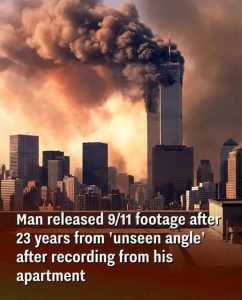
He Was Cleaning Out His Closet When He Came Across the Tapes: The Remarkable Story Behind the 9/11 Footage Found 23 Years Later
For more than two decades, the videotapes sat quietly in storage.
They were not in a museum. They were not preserved in a national archive. They were not carefully catalogued by historians.
They were simply old tapes in boxes.
Then, while cleaning out his closet years after September 11, 2001, Kei Sugimoto rediscovered them.
What he found was a remarkable personal record of one of the most consequential days in modern American history: footage of the World Trade Center towers collapsing, filmed from a perspective that had not previously been widely seen.
Sugimoto eventually digitized and released the recordings online in July 2024, nearly 23 years after he made them. The footage immediately attracted attention because it offered viewers another perspective on the destruction of the Twin Towers and demonstrated just how much historical material can remain hidden in private collections for decades. (LADbible)
A Morning That Changed Everything
On September 11, 2001, Sugimoto was a 24-year-old New Yorker.
The morning began like an ordinary day, but the atmosphere outside quickly became strange.
People were gathering in the streets and looking south toward Lower Manhattan. Sugimoto later explained that he initially saw the first tower burning and, like many people watching from a distance, did not immediately understand what had happened.
Then the second airplane struck the South Tower.
That moment changed his understanding of the situation completely.
He realized this was not an ordinary accident.
It was an intentional attack.
Sugimoto went to retrieve his camera equipment and began recording. According to accounts of his explanation, he filmed from the roof of 64 St. Marks Place in New York City, using a Sony VX2000 equipped with a teleconverter. (LADbible)
The resulting images are haunting.
Smoke rises over Lower Manhattan. The towers remain standing for a time, even as enormous clouds of smoke pour from them. Then the impossible happens: the buildings begin to collapse.
For someone watching the footage more than two decades later, the historical distance can almost make the scene feel unreal.
But the camera operator was there.
He was watching it happen in real time.
Why the Footage Stayed Hidden
The most remarkable part of the story may not actually be the recording itself.
It may be the fact that the recording disappeared into a closet.
Sugimoto did not upload the material immediately. In the years following the attacks, the tapes remained among his personal belongings.
Technology changed.
The equipment required to play older formats became harder to find.
And magnetic videotapes do not last forever.
When Sugimoto eventually came across boxes containing his old Hi-8, Digital-8 and DV tapes, he realized that time was working against him.
He later explained that when he attempted to examine the recordings, roughly a third of the tapes appeared to have suffered demagnetization or serious data corruption. That discovery prompted him to begin digitizing the material before more of it was lost. (LADbible)
It was an unexpected race against time.
The tragedy of 2001 had already become history, but the physical technology that preserved Sugimoto’s memories was itself beginning to disappear.
Had he waited another several years, some of the footage might have become unreadable.
A Different View of the Twin Towers
When the footage was finally uploaded, one feature immediately stood out.
The perspective was different.
For years, most people have encountered 9/11 through familiar images: television broadcasts from Lower Manhattan, footage from helicopters, photographs taken from across the river and recordings made by people standing on streets or rooftops.
Sugimoto’s footage offered another viewpoint.
Reports describe it as a perspective from the north that was not commonly represented in the existing public footage. (Balkanweb)
That doesn’t mean it changed what historians know happened that day.
Instead, its significance is more personal and archival.
It allows viewers to see the event through the eyes of an individual who happened to be in the right place with a camera.
And that’s what makes historical footage so powerful.
A textbook can explain an event.
A timeline can list the times.
A historian can describe the consequences.
But a personal recording can capture the atmosphere of a moment in a way that words sometimes cannot.
The Moment the Towers Came Down
The footage shows the towers surrounded by enormous clouds of smoke.
Then the buildings begin to collapse.
The reaction of people nearby can be heard as the recording continues. Voices and cries in the background provide a reminder that this wasn’t a movie or a historical reenactment.
These were real people watching their city change before their eyes.
The footage is difficult to watch because the viewer already knows what is about to happen.
That creates a strange psychological effect.
We know the towers will fall.
We know thousands of people will die.
We know the event will change American foreign policy, reshape airport security, influence wars and transform the lives of millions.
But the people standing there in the recording did not yet know all of that.
They were experiencing only the next few seconds.
That is part of what makes the footage so haunting.
He Tried to Give the Recording to Authorities
There is another remarkable detail in Sugimoto’s story.
According to accounts of his explanation, he made an effort to provide a copy of the footage to authorities shortly after the attacks.
Public transportation in New York was disrupted, so he reportedly traveled by rollerblades to a nearby police precinct with a copy of the recording. (Bored Panda)
The chaotic circumstances of September 11 made everything difficult.
The city was dealing with an unprecedented emergency.
Communications were disrupted.
Thousands of people were trying to locate friends and relatives.
Emergency responders were working in extraordinarily dangerous conditions.
In that environment, an individual arriving with a videotape was hardly likely to receive the attention that the material might have received under normal circumstances.
Eventually, the tapes remained with Sugimoto.
Years passed.
Then decades.
The Technology Nearly Destroyed the Memory
There is something especially fitting about the fact that the footage survived on obsolete formats.
People today live in an era of smartphones and cloud storage.
A person can record hours of high-definition video and immediately upload it to the internet.
In 2001, things were completely different.
Consumer video cameras commonly used physical tapes.
Digital footage still depended on physical media.
There was no guarantee that a recording made on one format would remain easy to access twenty years later.
Sugimoto’s discovery therefore illustrates a broader problem facing historians and archivists.
Millions of important photographs, recordings and home movies exist in people’s homes.
Some are in attics.
Others are in basements.
Some are sitting in boxes.
Many may never be digitized.
And some are slowly deteriorating.
His experience shows how easily pieces of history can disappear simply because nobody realizes how important they are.
Why the Story Went Viral
When the footage appeared online in July 2024, viewers were fascinated.
The timing was significant.
Nearly 23 years had passed since the attacks, yet here was footage that many people had never seen before.
One viewer described it as remarkable that new material from such a heavily documented event could still appear.
Another expressed the thought that there could be countless pieces of history sitting in people’s attics and basements, waiting to be discovered. (LADbible)
That reaction is understandable.
The September 11 attacks were among the most extensively recorded events in history.
Millions of photographs and hours of video exist.
Yet even with such an enormous archive, new personal recordings can still surface.
Every person who witnessed the event had a different perspective.
Someone standing on a bridge saw something different from someone in Lower Manhattan.
Someone looking from New Jersey saw something different from someone in Brooklyn.
And someone standing on a rooftop at St. Marks Place saw something different again.
Together, those perspectives form a far more complete historical record.
A Note About Online Claims
The footage has also generated speculation online, with some websites and commentators attempting to interpret individual visual details in ways that go beyond what the recording itself establishes.
Those claims should be treated cautiously.
The existence of previously unseen footage does not change the established historical record of the attacks.
Nor does a visual detail in a low-resolution archival recording, by itself, establish a particular explanation for how a building collapsed.
The important contribution of Sugimoto’s recording is simpler and more defensible: it preserves another firsthand visual perspective of an event that changed the world.
There is no need to add unsupported theories to make the footage historically significant.
Its value is already enormous.
Twenty-Three Years in a Closet
Perhaps the most striking part of this entire story is how ordinary the discovery was.
There was no dramatic archaeological excavation.
No government archive was opened.
No historian announced a major breakthrough.
Someone was simply cleaning a closet.
Inside were old boxes.
Inside those boxes were aging tapes.
And on those tapes was a record of September 11.
Sugimoto realized that the recordings were deteriorating and began digitizing them.
By July 2024, he was finally able to share them with the world. (LADbible)
The story is a reminder that history does not always live in official institutions.
Sometimes it lives in someone’s home.
Sometimes it is written in a notebook.
Sometimes it is printed in an old photograph.
And sometimes it is recorded onto a videotape that sits untouched for 23 years.
A Memory Preserved
September 11 remains one of the defining events of the 21st century.
The attacks killed thousands of people, devastated families and permanently altered the political and social landscape of the United States and the world.
For those who experienced that day, memories remain deeply personal.
Sugimoto’s recording is one of those memories.
It isn’t merely footage of buildings.
It is a record of a person witnessing history unfold.
The significance of finding it decades later is therefore not simply that the images are “new.”
It is that the footage survived.
The tapes survived technological obsolescence.
They survived years of storage.
They survived physical deterioration.
And, most importantly, they survived long enough for someone to recognize what they contained.
What began as an ordinary decision to clean out a closet ultimately reopened a window into one of the darkest mornings in modern history.
More than two decades after the Twin Towers disappeared from the New York skyline, Sugimoto’s old recordings offered viewers something unexpectedly powerful: another human perspective on a day the world will never forget.