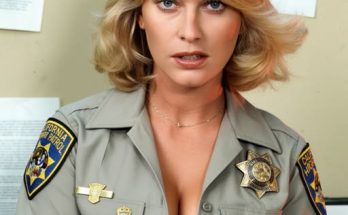
NAME THE YOUNG BRITISH ACTRESS WHO LATER MARRIED PETER SELLERS!
The actress is Lynne Frederick (25 July 1954 – 27 April 1994), a gifted English performer whose beauty, talent, and tragic personal story have ensured she remains one of the most fascinating figures of British cinema in the early 1970s. Although many people remember her primarily as the final wife of comedy legend Peter Sellers, Frederick had already established herself as a promising actress long before their paths crossed. Her career encompassed acclaimed fantasy films, horror classics, period dramas, and television appearances, revealing an actress capable of far more than the headlines that later surrounded her private life.
Born in London on 25 July 1954, Lynne Frederick entered the entertainment industry while still in her early teens. The photograph from May 1970, showing her at just fifteen years old, captures a young actress on the threshold of what seemed destined to become a remarkable career. With her striking blonde hair, expressive eyes, and unmistakably English charm, she possessed a screen presence that immediately attracted filmmakers.
Frederick was educated in London and developed an early interest in acting. Unlike many performers who entered the profession through theatre schools alone, she quickly found herself working in front of cameras, where her natural confidence and poise made a strong impression. The British film industry of the late 1960s and early 1970s was undergoing significant change, with established studios producing everything from family adventures to Gothic horror. Frederick proved versatile enough to move comfortably between these genres.
Her earliest screen appearances included supporting roles in British productions, allowing audiences and critics alike to notice a fresh young talent. Directors appreciated her professionalism despite her youth, while audiences found her refreshingly sincere and unaffected.
One of Frederick’s most memorable performances came in The Amazing Mr Blunden (1972), Lionel Jeffries’ enchanting fantasy film based on Antonia Barber’s novel The Ghosts. The story follows two modern children who encounter ghosts and travel through time in an effort to prevent a terrible crime.
Frederick played Rosalyn Allen, one of the ghostly children trapped in the past. Her performance was gentle, warm, and emotionally engaging. Rather than playing the role as an ethereal spirit, she gave Rosalyn genuine humanity, making audiences deeply invested in the children’s fate.
Although The Amazing Mr Blunden was only a moderate success upon release, it has since become one of Britain’s most beloved family fantasy films. Today it enjoys cult status, particularly during holiday television broadcasts, and Frederick’s performance remains one of its greatest strengths.
In the same remarkable period, Frederick appeared in Vampire Circus (1972), one of the finest productions from Hammer Films during its later years. Hammer had become world famous for reinventing Gothic horror with vivid color cinematography, memorable monsters, and lavish production design.
In Vampire Circus, Frederick demonstrated that she could succeed equally well in darker material. The film tells the story of a mysterious traveling circus whose performers are actually vampires seeking revenge upon a plague-stricken village.
Although horror cinema often relied on spectacle, Frederick brought sincerity and emotional credibility to her role. Her ability to react naturally amidst the film’s supernatural events helped ground the story, making its frightening moments all the more effective.
Today, Vampire Circus is frequently cited as one of Hammer’s last great classics, and Frederick’s contribution has been increasingly appreciated by horror enthusiasts.
Throughout the early 1970s Frederick became a familiar face on British television. She appeared in several dramas and anthology series, demonstrating considerable range.
Unlike many young actresses who became typecast because of their appearance, Frederick showed an ability to handle romance, suspense, fantasy, and historical settings with equal ease. Industry observers believed she possessed the qualities necessary for international success.
Hollywood also began to notice her. She appeared in larger productions and worked alongside respected actors, suggesting that her career might soon expand beyond Britain.
Unfortunately, events in her personal life would increasingly overshadow her professional achievements.
The defining chapter of Frederick’s life began when she met Peter Sellers, one of Britain’s greatest comic actors and the unforgettable star of the Pink Panther films and Dr. Strangelove. Sellers was nearly thirty years older than Frederick and had already experienced several marriages by the time they became involved.
Their romance fascinated the press almost immediately. The considerable age difference, Sellers’ eccentric personality, and Frederick’s youth made them irresistible subjects for British tabloids.
The couple married in 1977, making Frederick Sellers’ fourth and final wife.
Friends described the relationship as deeply complicated. Sellers could be charming, generous, and brilliantly funny, but he was also famously difficult, insecure, and emotionally unpredictable. Frederick often found herself trying to support a husband whose health and emotional state were increasingly fragile.
Despite the challenges, she remained devoted to him.
When Peter Sellers died suddenly from a heart attack in 1980 at the age of only 54, Frederick was just twenty-six years old. His death transformed her overnight from a rising actress into the young widow of one of Britain’s biggest stars.
Unfortunately, Sellers’ death also sparked years of legal disputes and intense media attention surrounding his estate. Newspaper coverage frequently portrayed Frederick as a controversial figure, sometimes unfairly reducing her identity to that of Sellers’ widow rather than recognizing her own achievements.
This relentless publicity made it difficult for her acting career to regain momentum.
Although she continued to appear occasionally on television and remained involved in the entertainment world, Frederick never fully escaped the shadow cast by her famous husband. Producers often viewed her through the lens of celebrity gossip rather than professional accomplishment.
She later remarried and sought a quieter life, but public fascination with the Sellers story continued to follow her.
Many film historians now argue that Frederick’s acting abilities were underestimated because media attention focused disproportionately on her personal circumstances. Looking back at films such as The Amazing Mr Blunden and Vampire Circus, it becomes clear that she possessed genuine talent and considerable screen charisma.
Tragically, Lynne Frederick’s life ended far too soon. She died on 27 April 1994 at the age of just 39 from complications related to alcoholism. Her death shocked those who remembered the bright, optimistic teenager who had entered British cinema with such enormous promise.
In the decades since her passing, appreciation for Frederick has steadily grown. Classic film enthusiasts continue to celebrate her performances, particularly in The Amazing Mr Blunden, which has become a cherished family favorite, and Vampire Circus, now regarded as one of Hammer’s finest later productions.
Modern audiences discovering these films often remark on Frederick’s natural warmth and understated acting style. Rather than relying on theatrical flourishes, she conveyed emotion through subtle expressions and quiet sincerity, qualities that have aged remarkably well.
Lynne Frederick’s story is ultimately one of remarkable promise mixed with undeniable tragedy. She entered British cinema as a gifted teenager with enormous potential, delivered memorable performances in films that have become enduring classics, and briefly stood at the threshold of international stardom. Yet circumstances beyond the screen—an intensely scrutinized marriage, personal struggles, and relentless tabloid attention—came to define public perceptions of her far more than her work ever should have.
Today, more than thirty years after her death, audiences are increasingly rediscovering Lynne Frederick not simply as Peter Sellers’ final wife, but as a talented actress in her own right. Her performances continue to captivate new generations, ensuring that her legacy rests not solely on the headlines of her life, but on the memorable characters she brought to the screen with grace, intelligence, and unmistakable charm.