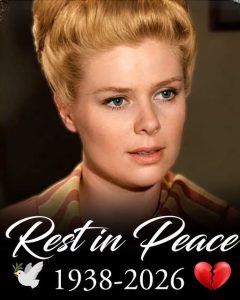
Golden Age Actress From a Hollywood Dynasty Dies at 88: Remembering Nina Shipman
The entertainment world is mourning the loss of actress Nina Shipman, a performer whose career connected her to Hollywood’s classic studio era, Alfred Hitchcock, Bing Crosby, Fred MacMurray and some of television’s most beloved shows.
Shipman died on September 6, 2026, at the age of 88, according to reports. Her stepdaughter, Lianne Bremer, said she died of natural causes at a hospital in Gardena, California. The Television Academy has also added Shipman to its official In Memoriam records. (Boston 25 News)
Although her name may not have the instant recognition of Hollywood’s biggest stars, Shipman’s career tells a fascinating story. She worked during an extraordinary period when the movie business was dominated by the major studios and television was rapidly becoming a fixture in American homes.
More remarkably, she was born into a family with a deep connection to show business.
A Hollywood family legacy
Nina Shipman was born in Los Angeles on August 15, 1938. Acting was hardly a distant concept in her family.
Her father, Barry Shipman, was a screenwriter whose work included Westerns and other film and television projects. Her mother, Gwynne Shipman, was a dancer and actress.
Her grandparents were also connected to the entertainment world. Her grandfather, Ernest Shipman, was associated with one of the early touring Shakespeare companies in the United States, while her grandmother, Nell Shipman, became known as a silent-film actress.
That meant Shipman belonged to a remarkable multigenerational entertainment family long before she began establishing her own career. (That Eric Alper)
Yet her original ambitions were not necessarily centered on becoming a movie star.
Shipman studied music and earned a degree in the subject from California State University, Los Angeles. She also developed her acting abilities at the Pasadena Playhouse and through studies with renowned acting teacher Sanford Meisner.
Eventually, the pull of Hollywood proved difficult to resist.
A brief encounter with Alfred Hitchcock
One of the most intriguing entries on Shipman’s résumé came very early in her professional career.
She appeared in Alfred Hitchcock’s 1958 classic Vertigo.
Her role was extremely small and uncredited, but the film itself became one of the most celebrated works in cinema history. Shipman portrayed a woman who is briefly mistaken for Kim Novak’s mysterious character.
For an aspiring young performer, appearing in a Hitchcock production—even in a tiny part—was an extraordinary introduction to the world of major filmmaking.
The American Film Institute’s catalog lists Shipman in Vertigo as well as several other films from the same period. (AFI Catalog)
Her career then moved into more substantial opportunities.
The Fox years
Shipman became a contract player at 20th Century Fox, one of Hollywood’s most powerful studios.
During this period, she appeared in a series of films that placed her alongside recognizable stars.
She was featured in Say One for Me in 1959, appearing with Bing Crosby. She later played Crosby’s daughter in Blake Edwards’ High Time, released in 1960.
She also appeared in Blue Denim and The Oregon Trail. In the latter, she played Prudence Cooper and shared the screen with Fred MacMurray.
The AFI Catalog records Shipman’s film work during this remarkable stretch, including Vertigo, Say One for Me, Blue Denim, The Oregon Trail, High Time and other productions. (AFI Catalog)
For a young actress working in Hollywood during the late 1950s, the opportunity to appear in films with stars such as Crosby and MacMurray represented an impressive achievement.
But television was about to become an equally important part of her career.
Becoming a familiar face on television
The television industry of the late 1950s and 1960s was exploding.
Shows such as Bonanza, Perry Mason, Rawhide, Daniel Boone, 77 Sunset Strip and The Andy Griffith Show were becoming household favorites.
Shipman appeared on many of them.
Her television résumé included appearances on 77 Sunset Strip, Bonanza, Rawhide, Perry Mason, The Munsters, The Andy Griffith Show, The Beverly Hillbillies, Daniel Boone and other popular programs. (That Eric Alper)
For performers like Shipman, television offered something that movies sometimes could not: the opportunity to return to American homes again and again.
A performer might appear for only one episode, but decades later viewers could still remember the character or recognize the face.
That became an important part of Shipman’s legacy.
Her memorable connection to The Munsters
Among Shipman’s television appearances, one of the most unusual came on The Munsters.
The famously eccentric comedy followed the Munster family, a group of lovable monsters living in suburban America.
Shipman appeared in a 1965 episode in which she played a youthful version of Grandpa Munster, portrayed by Al Lewis.
It was an unusual casting choice and one that helped make the episode particularly memorable. Reports note that Lewis dubbed Shipman’s dialogue because of the unusual setup. (TALi News)
For fans of classic television, appearances like this have helped keep Shipman’s work alive long after the original broadcasts.
More than an actress
Shipman’s life eventually expanded beyond traditional acting.
Her interests included education and writing, and she later became involved in projects outside the conventional Hollywood system.
She hosted an educational television program called Contemporary Health Issues in 1981. The series was designed to address subjects including addiction, sexuality, death and cardiovascular health, with the program structured so students could receive college credit.
She also wrote a book in 1975 titled How to Become an Actor in Television Commercials.
That detail is particularly revealing because it shows that Shipman understood the entertainment industry from more than one perspective. She was not simply someone who appeared in front of a camera; she also wanted to help others understand how the business worked.
Her career therefore evolved from performer to educator and writer, demonstrating a versatility that is sometimes overlooked when discussing actors from Hollywood’s classic era.
A career shaped by a changing Hollywood
Shipman’s career also reflects how dramatically the entertainment industry changed during her lifetime.
She entered show business during the final years of the traditional Hollywood studio system.
In those days, major studios maintained contract players and carefully managed their stars. Young performers could be signed to studios and receive opportunities across movies, television and publicity.
But by the 1960s and 1970s, that system was changing.
Television became increasingly dominant, independent filmmaking grew, and performers had to navigate a different industry.
Shipman adapted to those changes and continued working across television and film before eventually stepping away from acting.
Her screen career stretched across several decades, with credits continuing into the 1980s. (Wikipedia)
Remembering a quieter kind of Hollywood career
Not every Hollywood story is about an actor becoming an international superstar.
Some careers are built one role at a time.
Shipman belonged to that category.
She worked with major directors and stars, appeared in important films, became part of popular television series and accumulated a résumé that today provides a fascinating snapshot of American entertainment history.
Her appearance in Vertigo connected her to Hitchcock.
Her Fox contract connected her to the studio era.
Her work with Bing Crosby and Fred MacMurray connected her to major movie stars.
And her television appearances connected her to generations of viewers who grew up watching classic American programs.
That breadth makes her passing significant even for audiences who may not have immediately recognized her name.
A legacy spanning generations
Perhaps the most fitting part of Shipman’s story is the family legacy she carried.
Her grandmother, Nell Shipman, had been part of the silent-film era.
Her parents worked in entertainment.
Nina then entered Hollywood herself and became part of the movie and television world of the 1950s and 1960s.
Few families can trace such a direct line through multiple eras of American entertainment.
Shipman ultimately created her own place within that history rather than simply relying on her family name.
The Television Academy’s decision to recognize her passing is another reminder of how many performers contributed to television’s golden years. (Television Academy)
A farewell to Nina Shipman
Nina Shipman’s death marks the passing of another performer from an important chapter of Hollywood history.
She may not have been one of the era’s biggest box-office names, but she was part of the machinery that made classic Hollywood and television so memorable.
From a fleeting appearance in Hitchcock’s Vertigo to films with Bing Crosby and Fred MacMurray, and from Bonanza and Perry Mason to The Munsters and The Andy Griffith Show, Shipman left behind a body of work that continues to offer audiences a glimpse into another era.
She was 88 years old when she died on September 6, 2026.
For classic-film and television fans, her passing is a reminder that the people who helped create the entertainment memories of earlier generations are gradually leaving us.
Nina Shipman’s career was distinctive not because she sought the brightest spotlight, but because she consistently found her way into the frame.
And sometimes, that is how a Hollywood legacy lasts.
Rest in peace, Nina Shipman — 1938–2026. (Boston 25 News)