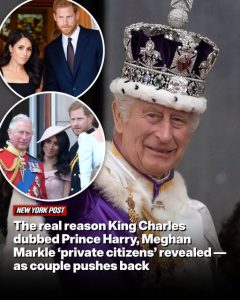
The Real Reason King Charles Dubbed Prince Harry, Meghan Markle “Private Citizens” Revealed — as Couple Pushes Back
A new royal dispute has erupted around a surprisingly simple phrase: “private citizens.”
King Charles III has formally reaffirmed that Prince Harry and Meghan Markle will remain outside the working Royal Family, even after their recent return to the United Kingdom. The clarification has prompted a strong reaction from people close to the Duke and Duchess of Sussex, who reportedly believe that the description does not accurately reflect their unusual position as internationally recognizable public figures. (ABC News)
The disagreement may sound like a matter of wording, but it carries much greater significance. Behind the language are questions about royal protocol, public appearances, charitable work, commercial interests, titles, security and, perhaps most importantly, the unresolved relationship between Harry and his family.
Why Charles Made the Clarification
Harry and Meghan stepped away from their senior royal duties in 2020 and eventually established their home in California. Their recent decision to return to Britain with their children has inevitably created new questions about what role they might play in British public life.
According to reports, that uncertainty was one of the reasons for the palace’s intervention.
A letter issued under the direction of King Charles and distributed by the Lord Chamberlain reminded government departments and other organizations that Harry and Meghan are not working royals. Their charitable and commercial activities are conducted independently rather than on behalf of the Crown. (Us)
The palace position is essentially about preventing confusion.
If Harry or Meghan were attending an event in Britain, would the public interpret their appearance as an official royal engagement? Would a government department treat them differently because they are members of the Royal Family by birth or marriage? Could their presence alongside working royals create uncertainty over whether they were representing the monarch?
Charles appears determined to eliminate those questions.
The clarification also reiterates that the couple will not publicly use their HRH styles and that their charitable activities remain personal rather than official royal duties. (Global News)
Why the Timing Matters
The timing is particularly interesting.
Harry and Meghan returned to the United Kingdom in late August after years of living in California. Their return immediately generated speculation about whether the move represented a significant change in their relationship with the Royal Family.
For royal watchers, the possibility of Harry spending more time in Britain naturally raised questions.
Would he become more involved with British charities?
Would Meghan attend public events?
Could the couple gradually rebuild relationships with senior members of the Royal Family?
And could they somehow develop a new version of their public role?
The palace response appears to be: whatever happens personally, their constitutional and working status has not changed.
They may live in Britain, attend events and continue their charitable work, but that does not make them working members of the Royal Family.
That distinction is at the heart of the controversy.
Harry and Meghan Reportedly Prefer “Public Figures”
The Sussexes’ reported objection is not necessarily that they want to become working royals again.
Instead, sources close to the couple have pushed back against the description of them as private citizens.
Their argument is relatively straightforward: Harry and Meghan may no longer perform official royal duties, but they remain among the most recognizable people in the world.
Sources close to them have reportedly argued that they are better described as public figures. (The Independent)
That distinction matters because “private citizen” can sound as though they are ordinary members of the public.
They clearly are not.
Harry is the son of the reigning British monarch and remains a prince and Duke of Sussex. Meghan is a globally recognized former actress and member of the Royal Family. Their lives are followed by international media, their charitable work receives worldwide attention, and their commercial activities have generated enormous interest.
So from the Sussexes’ perspective, the phrase may not capture reality.
The Security Question
There is also a practical issue behind the disagreement: security.
Harry has spent years challenging decisions concerning his security arrangements when he visits Britain. His argument has been that his public profile and the threats associated with it make appropriate protection necessary.
That is why the terminology surrounding his status is especially important.
If Harry is treated as a private citizen, what level of protection should he receive?
Who should pay for it?
What role should government agencies play?
And does his royal connection justify special treatment even though he no longer performs official duties?
The issue has been particularly sensitive since Harry’s return to Britain.
Reports indicate that security arrangements are being reassessed now that the family is again resident in the country. (Global News)
That makes the palace’s clarification more than a matter of royal etiquette.
It establishes a framework for how Harry and Meghan should be treated by government institutions.
The “Half-In, Half-Out” Problem
Another important element is the long-standing disagreement over whether Harry and Meghan could occupy a middle ground between royal and private life.
When they stepped away from royal duties, one of the central challenges was finding a workable arrangement.
Could they retain their royal status while earning commercial income?
Could they represent themselves publicly while occasionally representing the monarchy?
Could they live independently while still receiving the privileges associated with being working royals?
The palace ultimately rejected that kind of arrangement.
The current message from Charles is consistent with the principle that there cannot be a permanent “half-in, half-out” role. (The Irish Sun)
Harry and Meghan can be financially independent and pursue their own charitable interests, but those activities cannot be confused with official royal business.
That boundary is particularly important now that they are physically back in Britain.
A Difficult Family Dynamic
Beyond protocol, however, there is a deeply personal story.
Harry’s relationship with his father has been complicated for years.
The Duke has spoken publicly about family disagreements, his departure from royal duties and his concerns about how he and Meghan were treated. At the same time, there have been periodic indications that Charles wants to maintain a relationship with his son and grandchildren.
The latest dispute demonstrates how difficult that balance remains.
Charles can be a father who wants a relationship with Harry while simultaneously being the monarch responsible for protecting the institution of the Crown.
Those two roles do not always point in the same direction.
A father might want his son to feel welcome.
A king may need to establish clear institutional boundaries.
That tension is at the center of the current situation.
Harry’s Continued Public Role
Ironically, the “private citizen” label comes at a time when Harry’s public schedule remains substantial.
He continues to work with charitable organizations and causes connected to veterans and children. He is also expected to make several public appearances in the coming weeks, including events connected to the Invictus community and WellChild. (People.com)
He is also scheduled to appear at the Clinton Global Initiative meeting in New York later this month.
That makes the disagreement over terminology understandable.
Harry may be a private individual in the constitutional sense, but he is hardly invisible.
Millions of people continue to follow his activities.
Meghan’s Position
Meghan’s position is similarly complicated.
Although she is no longer a working member of the Royal Family, she remains a major public figure with her own commercial and philanthropic interests.
Her media projects, fashion appearances, charitable activities and public statements continue to attract substantial attention.
Therefore, calling the couple “private citizens” does not mean they have suddenly become anonymous.
Rather, it appears to describe their institutional relationship with the monarchy.
That distinction is important.
They can be private citizens in terms of royal duties while simultaneously being public figures in the cultural and media sense.
What Happens Next?
The immediate controversy is unlikely to end the family’s larger story.
Harry and Meghan have returned to Britain.
Charles remains monarch.
William remains heir to the throne.
And the Sussexes’ presence in Britain means their relationship with the Royal Family will continue to receive intense attention.
The biggest question may not be whether Harry and Meghan will become working royals again. Current indications strongly point in the opposite direction.
Instead, the question is whether they can develop a workable relationship with the institution while maintaining their independence.
The palace wants clarity.
The Sussexes appear to want recognition that their lives are far more complicated than those of ordinary private citizens.
Both positions can exist simultaneously.
A Royal Dispute About More Than Words
Ultimately, the latest controversy is not really about one phrase.
“Private citizens” has become a symbol of a much larger disagreement about what Harry and Meghan’s place in public life should be.
For King Charles, the priority appears to be preventing confusion between personal activities and official royal duties.
For Harry and Meghan, the concern is that their enormous public profile cannot simply be switched off because they no longer work for the Crown.
Both realities are true.
They are no longer working royals.
But they remain globally famous members of the wider Royal Family.
That contradiction is precisely what makes their position so unusual.
And with Harry and Meghan now spending more time in Britain, the question of where they fit into the royal story is unlikely to disappear anytime soon.