Can You Spell “Tomorrow” Correctly? 🤔📝 | Choose A, B, C, or D!
A fun English spelling challenge that will test your vocabulary, attention, and memory!Have you ever written a word that looks completely correct, only to discover that one small letter was missing or added? English spelling can be tricky, even for people who use the language every day. Some words sound exactly the way we expect them to look, while others contain silent letters, repeated letters, or unusual combinations that make them difficult to remember.
Today, we have a simple but exciting spelling challenge for you!
Look at the four options below and choose the correct spelling of a very common English word.
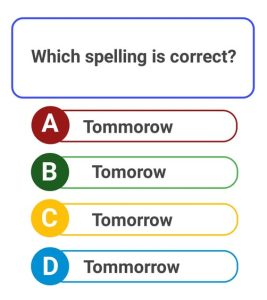
Which spelling is correct?
🔴 A. Tommorow
🟢 B. Tomorow
🟡 C. Tomorrow
🔵 D. Tommorrow
Take a moment to think carefully before choosing your answer. Don’t rush! Sometimes the easiest-looking words are the ones that can surprise us.
Have you made your choice?
Let’s discover the correct answer and learn why this word can be so confusing.
The Correct Answer Is C: Tomorrow! 🎉
Congratulations if you selected C. Tomorrow!
The correct spelling is:
T O M O R R O W
The word “tomorrow” contains two r’s and only one m after the first letter. This is the key detail that makes the spelling challenge interesting.
Let’s look at the correct word one more time:
Tomorrow
Not “Tommorow.”
Not “Tomorow.”
Not “Tommorrow.”
The correct spelling is Tomorrow, with one m and two r’s.
This small spelling difference can make a big difference when you are writing a message, completing a school assignment, preparing an email, or creating a social media post.
Why Is “Tomorrow” So Difficult to Spell?
The word “tomorrow” is one of those English words that many people recognize immediately but may still spell incorrectly.
Why does this happen?
One reason is that the word contains repeated letters. When we say “tomorrow,” the pronunciation flows quickly, and we may not notice exactly where each letter belongs.
Another reason is that people sometimes remember the word based on how it sounds rather than how it is written. This can lead to mistakes such as adding an extra m or leaving out one of the r’s.
Let’s examine the common mistakes.
Option A: Tommorow ❌
This spelling contains two m’s and only one r.
Tommorow
It may look familiar because many people accidentally repeat the m when writing the word. However, this is not the standard English spelling.
Remember:
The word starts with “tom,” not “tomm.”
Option B: Tomorow ❌
This spelling has only one r.
Tomorow
This is another common mistake. The word needs two r’s in the middle.
If you write “Tomorow,” you are missing one important letter.
Option C: Tomorrow ✅
This is the correct spelling.
Tomorrow
It contains:
- One m after the first “to.”
- Two r’s in the middle.
- One w at the end.
This is the spelling you should use in your writing.
Option D: Tommorrow ❌
This spelling contains two m’s and three r’s.
Tommorrow
It has too many repeated letters. Although it may look complicated and perhaps even correct at first glance, it is not the proper spelling.
The correct word is much simpler: Tomorrow.
What Does “Tomorrow” Mean?
“Tomorrow” refers to the day after today.
For example, if today is Monday, tomorrow is Tuesday.
If today is Friday, tomorrow is Saturday.
It is a word we use when talking about future plans, upcoming events, appointments, school, work, travel, and many other everyday activities.
Here are some examples:
Example 1:
“I will finish my homework tomorrow.”
This means the homework will be completed on the day after today.
Example 2:
“We are going to the beach tomorrow.”
This tells us that the beach trip is planned for the next day.
Example 3:
“Tomorrow is a new day.”
This sentence expresses the idea that each new day brings another opportunity.
Example 4:
“I have an important meeting tomorrow morning.”
This means the meeting is scheduled for the following day.
As you can see, “tomorrow” is a very useful word in everyday English.
A Simple Trick to Remember the Spelling
If you often forget how to spell “tomorrow,” try breaking it into smaller parts.
One useful way is:
TO + MOR + ROW
Put the parts together:
TO + MOR + ROW = TOMORROW
You can also remember the phrase:
One M, two R’s, one W.
This is a helpful spelling reminder.
Let’s count the letters:
T — 1
O — 2
M — 3
O — 4
R — 5
R — 6
O — 7
W — 8
The word “tomorrow” has eight letters.
It begins with T and ends with W.
The middle contains the important double R.
Try saying the spelling slowly:
T-O-M-O-R-R-O-W.
Repeat it a few times, and it may become easier to remember.
Can You Use “Tomorrow” in a Sentence?
Now that you know the correct spelling, let’s practice using it.
Complete the following sentences with the word “tomorrow.”
- I will visit my friend ________.
- We have an English test ________.
- She plans to start her new job ________.
- The weather may be better ________.
- I hope ________ brings good news.
The answer to each sentence is tomorrow.
Practice is one of the best ways to improve spelling. The more often you read and write a word correctly, the easier it becomes to remember.
Why Spelling Matters in Everyday Life
Spelling may seem like a small detail, but it plays an important role in communication.
When we write a message, we want other people to understand what we mean. Correct spelling helps make our writing clear, professional, and easy to read.
Imagine sending this message:
“I will see you tommorow.”
Most people will understand it, but the spelling is incorrect.
Now compare it with:
“I will see you tomorrow.”
The second sentence looks polished and correct.
Good spelling can be especially helpful when:
- Writing school assignments.
- Sending professional emails.
- Creating social media captions.
- Writing YouTube titles and descriptions.
- Applying for jobs.
- Communicating with friends and family.
- Learning English as a second language.
Even a small spelling improvement can make your writing look more confident.
Test Your Friends and Family!
Did you get the correct answer?
Why not share this spelling challenge with someone you know?
You can ask your friends, family members, classmates, or followers to choose between A, B, C, and D.
Don’t reveal the answer immediately. Give everyone a chance to think.
You might be surprised by how many people choose the wrong option!
This type of spelling quiz is a fun way to learn English while enjoying a friendly challenge.
You can even turn it into a competition.
Ask everyone to write down their answer before revealing the correct spelling.
Whoever chooses C gets one point!
If you want to make the game more interesting, ask participants to spell the word aloud without looking at the options.
Can they remember the double R?
Can they avoid adding an extra M?
Let’s find out!
More Commonly Misspelled English Words
“Tomorrow” is not the only English word that can cause spelling confusion.
Here are a few other words that people often practice.
1. Necessary
Correct: Necessary
A helpful reminder is that it has one c and two s’s.
2. Beautiful
Correct: Beautiful
Many learners remember this word using the phrase “beauty has a U.”
3. Wednesday
Correct: Wednesday
The pronunciation does not always make every letter obvious.
4. Because
Correct: Because
Some people remember it with the phrase “Big Elephants Can Always Understand Small Elephants.”
5. Definitely
Correct: Definitely
Be careful not to spell it “Definately.”
Learning these words one at a time can help improve your English spelling skills.
A Quick Spelling Challenge for You
Now let’s see if you can answer these questions.
Question 1: Which spelling is correct?
A. Tommorow
B. Tomorow
C. Tomorrow
D. Tommorrow
Correct answer: C. Tomorrow
Question 2: How many letters are in “tomorrow”?
A. 6
B. 7
C. 8
D. 9
Correct answer: C. 8
Question 3: How many r’s are in “tomorrow”?
A. 1
B. 2
C. 3
D. 4
Correct answer: B. 2
Question 4: What does “tomorrow” mean?
A. The day before today
B. Today
C. The day after today
D. Last week
Correct answer: C. The day after today
Question 5: Which sentence is spelled correctly?
A. I will see you tommorow.
B. I will see you tomorow.
C. I will see you tomorrow.
D. I will see you tommorrow.
Correct answer: C. I will see you tomorrow.
How many did you get right?
If you answered all five correctly, excellent work! You have a strong understanding of this word.
If you made a mistake, don’t worry. Every mistake is an opportunity to learn.
The Importance of Learning Every Day
Improving your English does not require studying for hours every day.
Sometimes, learning one word can make a difference.
A simple spelling quiz like this can help you notice details, improve your memory, and become more comfortable with English.
You can practice by:
- Reading English books.
- Writing short sentences.
- Keeping a vocabulary notebook.
- Playing spelling games.
- Watching educational videos.
- Taking daily quizzes.
- Reviewing words you often misspell.
The key is consistency.
A few minutes of practice each day can help you build stronger language skills over time.
And remember, learning should be fun!
You don’t need to be perfect from the beginning. The goal is to keep improving.
Final Reminder: One M, Two R’s!
Before we finish, let’s review the most important spelling rule from today’s challenge.
The correct word is:
TOMORROW
Remember:
One M. Two R’s. One W.
That’s the secret!
If you see “Tommorow,” “Tomorow,” or “Tommorrow,” you now know that those spellings are incorrect.
The correct spelling is always:
Tomorrow.
Did You Choose the Correct Answer?
Now it’s your turn to share your result!
Did you choose A, B, C, or D?
Were you confident in your answer, or did you have to think twice?
Tell us in the comments!
👇 Comment your answer below:
A, B, C, or D?
And if you got it right, challenge someone else to beat your score!
Don’t forget to like this post, share it with your friends, and follow for more fun English spelling quizzes, vocabulary challenges, and educational content.
You never know—tomorrow’s quiz might be even harder!
Final answer: C. Tomorrow ✅
Keep learning, keep practicing, and remember that every new day is another chance to improve.
See you tomorrow! 🌟