The Puzzle That Reveals How We See the World
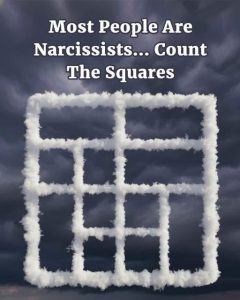
At first glance, the image looks almost too simple to be interesting: a collection of white, cloud-like lines arranged into a geometric pattern against a dark, stormy sky. Above it is a provocative challenge: “Most People Are Narcissists… Count the Squares.”
It sounds as though the puzzle is going to reveal something profound about your personality. Are you selfish if you see fewer squares? Are you more observant if you find more? Does the number you count somehow expose whether you are a narcissist?
The truth is much more interesting.
This puzzle is really an example of how easily the human brain can interpret the same visual information in different ways. Two people can look at exactly the same image, focus on different parts of it, and arrive at different answers before carefully checking the geometry.
And if you have been staring at the picture wondering how many squares are actually there, the answer is eight.
But getting to eight is where the fun begins.
Start With the Obvious Squares
The easiest place to begin is with the small squares.
Look at the lower portion of the diagram. There are three small squares arranged along the bottom:
- The square on the lower left.
- The square in the lower middle.
- The square on the lower right.
That gives us three.
There are also two smaller squares immediately above or alongside them on the left side of the design. When all of the complete boundaries are considered, the total number of individual one-unit squares is five.
This is where many people stop.
Five certainly seems like a reasonable answer when you first scan the image. The brain naturally identifies the smallest, most obvious shapes before considering larger shapes made from multiple sections.
But that’s exactly the trick.
The Larger Squares Are Easy to Miss
The puzzle isn’t asking you to count only the little squares.
It is asking you to count all complete squares, including squares that contain other sections inside them.
Once you begin looking at the larger boundaries, another three squares appear.
One large square occupies the upper-right portion of the design. Its interior contains a horizontal division, but that doesn’t prevent the outside boundary from forming a square.
Another large square appears in the lower-right/middle section. Again, internal lines don’t cancel out the larger square surrounding them.
Finally, the entire outside border forms one enormous square.
So the calculation becomes:
5 small squares + 2 medium-sized squares + 1 outer square = 8 squares.
That is the complete count.


Why Do People Get Different Answers?
The fascinating part isn’t really the number eight. It is why people can look at the same picture and see different answers.
Human vision isn’t a camera. Our brains don’t simply record everything in front of us and then present an objective picture.
Instead, the brain constantly organizes information.
It searches for patterns, identifies boundaries, groups similar shapes together, and decides which details deserve attention. This happens extremely quickly, often before we consciously realize that we are making those decisions.
When presented with a complicated geometric figure, your brain tends to simplify it.
You may initially see a collection of small rectangles. Someone else may immediately notice a large square hidden within the same arrangement.
Neither person is necessarily more intelligent.
They may simply be using different visual strategies.
One person might count from the smallest shapes upward. Another might start with the outer boundary and work inward. Someone else might mentally divide the image into sections.
The method matters.
The Psychology Behind Visual Puzzles
Puzzles like this are closely connected to principles studied in visual perception.
One important idea is figure-ground organization. Your brain separates an image into objects that seem important and a background that seems less important.
In this particular image, the white lines stand out dramatically against the dark background. Your brain immediately recognizes the white structure as the “figure.”
But there is another layer.
The brain also groups individual lines into recognizable forms. When several lines meet at right angles, we don’t necessarily perceive them as separate pieces. We automatically connect them into shapes.
That is useful in everyday life.
Imagine looking at a building. You don’t consciously analyze every brick, window frame, and wall segment. Instead, your brain quickly recognizes the overall structure.
The same process can make a puzzle more difficult.
Your brain may recognize the small squares and stop searching for larger ones because it has already decided what the important shapes are.
Why the Word “Narcissist” Is Part of the Trick
The claim that “most people are narcissists” makes the puzzle sound like a personality test.
But it isn’t a scientifically validated test for narcissism.
Narcissism is a psychological concept involving characteristics such as an inflated sense of self-importance, a strong need for admiration, and difficulties with empathy. A person’s performance on a simple visual puzzle cannot establish whether they have narcissistic personality traits or a personality disorder.
So don’t worry if you counted five, six, seven, eight, or another number before checking the answer.
It doesn’t mean you are selfish.
It doesn’t mean you lack intelligence.
And it certainly doesn’t provide a psychological diagnosis.
The provocative wording is better understood as part of the puzzle’s entertainment value. It encourages people to become emotionally invested in the answer.
And that makes people look harder.
The Power of Expectation
There’s another fascinating psychological trick happening here: expectation influences attention.
If someone tells you, “There are eight squares in this picture,” you will probably start searching for the missing shapes.
If someone tells you, “Only five squares are visible,” you might focus almost exclusively on the small ones.
The information you receive before solving a problem can influence what you notice.
This happens outside puzzles all the time.
For example, if you’re told that a particular object is hidden in a photograph, you suddenly notice details that you completely ignored the first time you looked at the picture.
The object was there all along.
Your attention simply wasn’t directed toward it.
A Better Way to Solve Count-the-Squares Puzzles
There is a simple technique that can make these puzzles much easier.
Instead of randomly looking around the image, organize the search by size.
Step One: Count the smallest squares
Look for every square that uses the shortest available side length.
Don’t worry about larger squares yet.
Step Two: Look for squares made from multiple sections
Now examine combinations of the smaller areas.
Ask yourself:
“Can this group of smaller sections form one larger square?”
Internal lines don’t matter. What matters is whether the four outside sides of the larger shape are complete.
Step Three: Check the entire boundary
Many puzzles hide an obvious large square in plain sight.
Trace the outside edge from corner to corner. If the four sides have equal length and form right angles, you’ve found another square.
Step Four: Check for overlapping shapes
A square can contain other squares.
Finding the smaller ones doesn’t mean the larger one should be ignored.
This is one of the most common mistakes people make.
The Final Answer: Eight
After carefully examining the structure, the image contains:
- 5 small squares
- 2 larger squares
- 1 large outer square
That gives a final total of:
8 SQUARES
The answer is surprisingly satisfying because the larger shapes aren’t necessarily obvious during the first glance.
And that is what makes the puzzle effective.
What the Puzzle Really Teaches Us
Perhaps the most valuable lesson isn’t about narcissism at all.
It’s about how we look at information.
When something appears simple, we often assume we’ve understood it immediately. We see the obvious answer and move on.
But sometimes the important details are hidden in the relationships between the obvious parts.
The same principle applies to photographs, news stories, conversations, statistics, and everyday decisions. Our first interpretation isn’t always the complete picture.
Taking a few extra moments to reconsider what we’re seeing can reveal something we initially missed.
That’s why visual puzzles remain so popular. They are small exercises in slowing down our automatic thinking.
So, the next time you encounter a puzzle claiming that your answer reveals your personality, don’t take the claim too seriously.
Instead, grab a pen—or simply use your finger—and trace every boundary.
Count the little squares.
Then count the larger ones.
Finally, count the square formed by the entire outside frame.
You may discover that the real challenge wasn’t determining whether you are a narcissist.
It was simply learning to look beyond the first answer that came to mind.