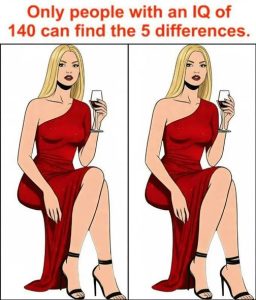
This Challenge Isn’t for Everyone — Only Truly Attentive Minds Will Spot All 5 Differences
At first glance, the two pictures appear almost identical. A woman in an elegant red dress sits gracefully while holding a wine glass, and both illustrations seem to show exactly the same pose, expression, hairstyle, and setting.
But look again.
Somewhere between the two images are five carefully hidden differences, and finding them requires more than simply glancing at the pictures. You have to slow down, compare small details, and resist the temptation to assume that two things that look similar are actually identical.
These “spot the difference” puzzles have become extremely popular online because they offer a simple challenge with an unexpectedly satisfying payoff. They encourage observation, concentration, visual memory, and patience. And while viral posts sometimes claim that only people with a particular IQ score can solve them, there is no scientific basis for saying that successfully finding five differences proves that someone has an IQ of 140.
What it can demonstrate is that you are paying close attention.
Why Do These Puzzles Feel So Difficult?
The human brain is remarkably good at recognizing overall patterns.
When we look at the two women in this puzzle, our brains immediately identify the major elements: blonde hair, red dress, wine glass, crossed legs, high heels, and a similar facial expression.
Once the brain decides that the pictures are essentially the same, it becomes surprisingly easy to overlook small changes.
This is known as a form of change blindness—our visual system does not necessarily notice every alteration in a scene, particularly when the overall image remains familiar.
That’s exactly what makes these puzzles effective.
The differences are usually not placed somewhere obvious. Instead, they are hidden among details that our brains normally process automatically.
A tiny change in a strand of hair can be overlooked.
A missing line on a shoe can disappear into the larger picture.
A small alteration in a glass or dress may seem insignificant.
The challenge is therefore not simply “looking.” It is comparing.
The First Rule: Don’t Look at Both Pictures as a Whole
If you want to solve a puzzle like this quickly, one of the biggest mistakes is staring at the entire image and hoping something suddenly jumps out.
Instead, divide the illustration into sections.
Start at the top.
Compare the woman’s hair, forehead, eyes, eyebrows, nose, mouth, and neckline. Then move toward the glass and hand.
Next, examine the dress from top to bottom.
Finally, study the legs, stockings, ankles, and shoes.
This method gives your brain a systematic checklist rather than allowing your attention to wander.
It also prevents one of the most common mistakes: repeatedly examining the same obvious area while completely ignoring another section.
Start With the Face and Hair
The woman’s face is one of the first areas worth examining.
At normal viewing size, her expression looks virtually identical in both pictures. Her eyes, lips, eyebrows, and general facial features appear unchanged.
But hair is another matter.
Illustrators can make extremely small modifications to hairlines, strands, partings, or shapes. Because hair already contains many lines, a missing or altered detail can be difficult to identify.
Try comparing the outline of the hair rather than simply looking at its color.
Look at the top of the head.
Then examine the sides.
Finally, follow the hair down toward the shoulders.
A useful technique is to look at one image for several seconds and then deliberately shift your attention to the corresponding area in the second image.
Your brain may suddenly recognize a detail that was invisible a moment earlier.
The Wine Glass Is Another Trap
The woman’s raised hand and wine glass are particularly effective places to hide differences.
There are several small elements to examine: the bowl of the glass, the liquid, the rim, the stem, the base, and the fingers surrounding it.
Don’t assume that because the glass is present in both images, every detail of it is the same.
Look carefully at the outline.
Then compare the position of the fingers.
Then examine the stem and base.
Finally, check the interior of the glass.
Because the object is relatively small compared with the entire picture, the brain tends to process it as one recognizable object rather than analyze every line.
That’s exactly what a good puzzle designer wants.
The Dress Contains Plenty of Visual Information
The red dress occupies a large portion of the illustration, making it another area where subtle differences can hide.
At first, the dresses seem identical.
The same red fabric covers the woman’s torso and extends down toward the floor. The neckline appears similar, and the long skirt creates the same general shape.
But don’t just compare the overall silhouette.
Look for individual lines.
Examine the folds in the fabric.
Compare the areas around the waist.
Look at the folds near the woman’s hand.
Then examine the lower portion of the skirt.
One of the reasons clothing is frequently used in visual puzzles is that folds and seams provide many opportunities for tiny changes. Removing one line or adding another can be surprisingly difficult to detect when the surrounding illustration contains dozens of similar lines.
Pay Attention to the Hands
Hands are notoriously complicated for artists to draw—and they’re also excellent puzzle territory.
In this image, the woman’s left hand rests along the dress while the other hand holds the glass.
Compare the fingers carefully.
Don’t simply ask whether the hand is present. Look at the number and position of visible fingers, the shape of the fingertips, and the lines between them.
Then compare the wrist and the surrounding dress.
A tiny change to one finger can easily disappear when you’re looking at the entire illustration.
This is a valuable lesson for solving visual puzzles in general: small objects require detailed inspection.
Now Move Down to the Legs
The woman’s crossed legs create another large visual feature.
At first, both versions appear almost perfectly identical.
But this is where careful observers should slow down.
Look at the leg position.
Compare the skin outline.
Check the ankle.
Then examine the black straps on the footwear.
Finally, look at the heels and the toes.
Shoes are particularly useful in spot-the-difference puzzles because they contain several distinct components: straps, heels, soles, openings, and decorative lines.
One missing strap or altered line may be enough to create a difference without changing the overall appearance of the shoe.
If you’ve been staring at the woman’s face for several minutes, moving your attention to the bottom of the image can sometimes reveal something immediately.
Why Your Brain Misses Obvious Differences
There is an interesting psychological reason people can stare at an image repeatedly without finding a difference.
Once we form an expectation that two images are the same, our brains become biased toward confirming that expectation.
This is sometimes called inattentional blindness.
It doesn’t mean that our eyes aren’t receiving the information. Instead, our attention may not be prioritizing it.
For example, if you are concentrating on the woman’s dress, you may completely overlook a tiny change in her shoe.
If you’re studying the face, you might not notice something different about the glass.
The lesson is simple: attention is selective.
We don’t consciously process every detail in our visual environment.
A Better Strategy for Solving the Puzzle
If you’re still searching for all five differences, try this technique.
Divide the image into a grid.
Start in the upper-left area and slowly move across the picture.
Compare one small region at a time.
Don’t move on until you’ve mentally checked the corresponding region in the other image.
After examining the top section, move downward.
Work through:
Hair → face → shoulders → glass → hands → dress → legs → ankles → shoes.
This method may feel slower at first, but it is usually much more effective than randomly scanning the picture.
Another technique is to briefly cover one half of the image and study the other half. Then switch.
This removes the distraction of constantly looking at both pictures simultaneously.
Is This Really an IQ Test?
No—not in any scientific sense.
The headline’s claim that only people with an IQ of 140 can find the differences is designed to make the puzzle more intriguing. Finding all five differences does not establish that someone has an IQ of 140, just as struggling with the puzzle doesn’t mean someone has low intelligence.
Performance on a particular visual puzzle can be affected by many factors, including attention, eyesight, familiarity with these puzzles, fatigue, screen size, and experience.
Someone might solve it in ten seconds simply because they have practiced hundreds of similar challenges.
Another intelligent person might take several minutes because they are approaching the puzzle differently.
So don’t take the IQ claim literally.
The real challenge is observation.
The Satisfaction of Finding the Final Difference
There is something strangely rewarding about discovering the last hidden difference.
For several minutes, the images can appear identical. Then suddenly you see one tiny detail.
“How did I miss that?”
That’s part of the appeal.
Our brains enjoy resolving uncertainty. A puzzle creates a small problem, builds tension, and then provides an immediate sense of accomplishment when the answer becomes clear.
It is also why people often want to challenge friends and family after solving one.
If you found all five differences, you may be tempted to send the puzzle to someone else with a simple message:
“How many can you find?”
And that’s where the competition begins.
The Bigger Lesson Behind the Puzzle
Although this is only a simple visual challenge, it highlights something important about everyday perception.
We often believe that seeing something means noticing everything about it.
It doesn’t.
Our brains constantly filter information, focusing on what appears important and ignoring what seems repetitive or insignificant.
That ability is extremely useful in everyday life. Imagine having to consciously analyze every object, sound, movement, and facial expression around you. The amount of information would be overwhelming.
Selective attention allows us to function efficiently.
But puzzles like this reveal the downside.
When something looks familiar, we can become overconfident and stop examining it carefully.
That’s why the best puzzle-solving strategy is not simply having “sharp eyes.”
It’s slowing down.
So, Did You Find All Five?
Before checking an answer or asking someone else for help, take one final look.
Start at the top and work downward.
Compare the hair.
Check the face.
Inspect the glass.
Study the fingers.
Examine the dress.
Then move carefully toward the ankles and shoes.
Don’t rush.
The five differences are deliberately subtle, and the entire purpose of the challenge is to make you question what initially appears obvious.
Whether you found all five in seconds or needed several attempts, the real skill being tested is your ability to concentrate on details.
And perhaps that’s the most interesting part of the puzzle.
Sometimes the things we miss aren’t hidden at all—they’re simply details we never stopped to notice.