She Was in His Cell, Waiting to Be Executed — and He Asked Her One Last Question
A dramatic story circulating online begins with an emotionally charged sentence: “She was in his cell, waiting to be executed, and he asked as a last…” The headline stops abruptly, encouraging readers to click to discover what supposedly happened next.
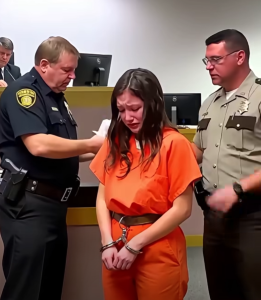
The accompanying image shows a young woman in an orange jail uniform being escorted by two officers through what appears to be a courtroom or correctional facility. However, the image and headline do not provide enough information to establish the identity of the woman, the man supposedly involved, or the location of the alleged incident.
A search for the exact wording primarily leads to a low-credibility story page that does not substantiate the dramatic scenario shown in the headline. (Daily Story) No reliable contemporary reporting located in the search confirms the specific encounter described by the post.
That does not mean stories involving death-row prisoners and emotional final conversations have never occurred. They certainly have. But distinguishing documented cases from fictional or recycled social-media stories is essential.
The Mystery Behind the Viral Headline
The wording is a familiar social-media storytelling technique.
Rather than explaining what happened, the headline deliberately stops at the most suspenseful point:
“He asked as a last…”
The reader is then expected to click a link or interact with the post to find out what supposedly happened.
This style can be extremely effective because it creates several unanswered questions at once.
Who was the woman?
Who was the man?
Why was she in his cell?
Was she an officer, relative, attorney, witness, friend, or another prisoner?
What did he ask?
And most importantly, did the event actually happen?
Without names, dates, court records, prison information, or reporting from a reputable news organization, those questions cannot responsibly be answered as facts.
What the Photograph Can — and Cannot — Tell Us
The photograph accompanying the post shows a woman wearing an orange correctional uniform with her hands restrained in front of her. Two uniformed officers appear to be standing beside her.
Her facial expression suggests distress, but a photograph cannot establish the reason for that emotion.
It also cannot establish that she was “waiting to be executed.”
Images used in viral posts are frequently separated from their original context and paired with new captions. Sometimes the photograph is genuine but unrelated to the accompanying story. In other cases, images can be digitally altered or generated.
For that reason, an image should not be treated as independent confirmation of a dramatic claim.
Death Row and the Long Wait for Execution
The reality of death row is already dramatic without needing an invented story.
People sentenced to death can spend many years or even decades incarcerated while their convictions and sentences are reviewed through appeals and other legal proceedings.
The length of that process varies considerably by state and by individual case.
A 2024 investigation into Kentucky’s death row, for example, reported that people sentenced to death there had spent exceptionally long periods awaiting resolution. The article cited U.S. Department of Justice data indicating that Kentucky death-row prisoners had an average time on death row of about 26 years. (Kentucky Lantern)
That lengthy process means that the phrase “waiting to be executed” can describe a period lasting years rather than simply the hours immediately before an execution.
For prisoners and their families, the uncertainty can become a defining part of their lives.
The Final Hours Can Be Highly Controlled
When an execution is actually scheduled, the final process is governed by detailed prison procedures.
The prisoner may meet with attorneys, relatives, clergy, prison officials, and other approved visitors. Depending on the jurisdiction, there can also be final meals, spiritual counseling, official interviews, and opportunities to make final statements.
The process is carefully regulated because an execution represents the final stage of a criminal case.
There are also legal mechanisms that can interrupt the process at very late stages.
A scheduled execution does not necessarily mean that the execution will ultimately occur.
Courts can issue stays, appeals can produce new developments, governors can grant temporary reprieves, and other legal questions can arise.
One example occurred in Texas in 2017, when Rolando Ruiz was waiting near the execution chamber while his lawyers continued pursuing legal relief. The U.S. Supreme Court eventually rejected his final appeals and the execution proceeded. (The Texas Tribune)
Such cases demonstrate why the period immediately preceding an execution can involve intense legal activity.
Women on Death Row
The viral photograph also appears to have been selected because the woman is wearing a prison uniform, creating the impression that she is a condemned prisoner.
There are women on death row in the United States, although they represent a small proportion of the overall death-row population.
One documented case is Christa Pike in Tennessee. The Death Penalty Information Center reported that Tennessee’s Supreme Court set an execution date for Pike in 2025, with the scheduled date falling in September 2026. The organization described her as the only woman on Tennessee’s death row at the time. (Death Penalty Information Center)
That case illustrates an important point: genuine death-row stories normally contain identifiable details, including the prisoner’s name, state, conviction, legal history, scheduled execution date, and statements from attorneys or authorities.
The viral post in question provides none of those details.
Why Last Conversations Become Powerful Stories
Stories about final conversations have existed for generations.
People naturally become interested in what someone might say when confronted with the possibility of death. Such moments can involve family members, religious advisers, attorneys, victims’ relatives, prison personnel, or other people connected to a case.
Documented accounts sometimes reveal regret, requests for forgiveness, expressions of love, religious statements, or attempts to communicate with people outside prison.
But these stories must be treated carefully.
A person’s final words are often reported through witnesses or official records, and accounts can differ.
For example, the Associated Press and Los Angeles Times reported on the 2021 federal execution of Lisa Montgomery. During the execution procedure, Montgomery was asked whether she had any last words. She answered no. (Los Angeles Times)
That is a documented example of a final exchange.
It is very different from an anonymous social-media story that gives no names or verifiable details.
The Difference Between a True Story and a Viral Story
One of the most important lessons from posts like this is that emotional storytelling and factual reporting are not the same thing.
A compelling story might contain:
- A prisoner awaiting execution
- A mysterious visitor
- A final request
- A shocking revelation
- A dramatic photograph
- An unexpected act of compassion
Those ingredients can make an extremely engaging narrative.
But engagement does not establish truth.
A legitimate news report should allow readers to identify the people involved and independently verify the central claims. Court records, corrections departments, attorneys, police agencies, reputable newspapers, and established broadcasters can provide that kind of evidence.
When all the post offers is an anonymous photograph and an incomplete sentence, skepticism is appropriate.
What We Know About This Particular Claim
At present, the central claim in the viral headline remains unverified.
The search for the exact wording found a page published in April 2026 using essentially the same headline, but its article does not establish the specific scenario shown in the photograph. Instead, it shifts into a broader discussion of juvenile life-without-parole sentences. (Daily Story)
That mismatch is significant.
If the photograph and headline were documenting a real recent execution case, readers would reasonably expect details such as the prisoner’s name, jurisdiction, date, conviction, and source of the photograph.
Those details are missing.
Why Readers Should Pause Before Sharing
Emotional stories involving crime, imprisonment, death sentences, and final conversations can spread extremely quickly.
People may share them because the story seems inspirational, heartbreaking, shocking, or mysterious.
But once an unverified story has been shared thousands of times, repetition can create the illusion of confirmation.
The safest approach is simple: check the names and details before believing the headline.
If there is no name, search the exact wording.
If the story claims an execution occurred, check the relevant corrections department and established news organizations.
If a photograph is central to the story, investigate whether it has appeared in older articles or unrelated cases.
And if the headline deliberately hides the central fact behind “See more,” that is a reason to verify the story—not a reason to assume the missing information is true.
The Human Story Behind Death Row
There is nevertheless a serious human story beneath discussions of death row.
Every capital case involves people: defendants, victims, families, attorneys, prison employees, judges, witnesses, and communities.
The legal process can continue for years, and families on both sides can live with uncertainty for extraordinary lengths of time.
Death-row cases also raise difficult questions about punishment, appeals, fairness, rehabilitation, victims’ rights, and the possibility of wrongful convictions.
Those questions deserve careful reporting rather than sensational headlines.
Final Thoughts
The headline “She was in his cell, waiting to be executed, and he asked as a last…” is clearly designed to leave readers desperate to discover the ending.
But the available evidence does not establish that the pictured woman was actually waiting to be executed, nor does it verify the mysterious conversation described by the headline.
What is documented is that death-row prisoners can spend many years awaiting execution, that final conversations and statements are sometimes recorded by witnesses and officials, and that scheduled executions can remain subject to legal developments until the very end. (Kentucky Lantern)
The most responsible conclusion, therefore, is not to invent the missing ending.
The photograph may be real, and the broader subject is real, but the specific viral story remains unconfirmed without reliable evidence identifying the people and circumstances involved.
That distinction matters—especially when a story concerns someone’s freedom, criminal conviction, or life and death.