“2 Hours Ago! In 2 Minutes, a U.S. International Airport Was Completely Destroyed!” — What the Viral Image Really Shows
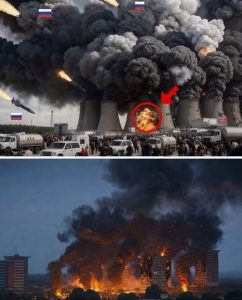
A dramatic post circulating online claims that a U.S. international airport was completely destroyed in just two minutes. The accompanying image shows enormous explosions, thick black smoke, aircraft, and what appears to be a major industrial or urban disaster.
The claim is frightening—but it is not supported by evidence of a real U.S. airport being destroyed.
In fact, searches for the exact headline lead to several websites carrying essentially the same story, and those pages themselves explain that the footage associated with the claim comes from a fictional military scenario created in Arma 3, a military-simulation video game. The scenario is presented as an invented conflict rather than documentation of an actual attack. (Vative Post)
The Headline Creates a False Sense of Urgency
The wording is carefully constructed to make readers believe they are witnessing breaking news:
“2 hours ago! In 2 minutes, a US international airport was completely destroyed!”
Notice what the headline doesn’t tell us.
It doesn’t name the airport.
It doesn’t identify the city.
It doesn’t say what caused the destruction.
It doesn’t identify an attacking country or organization.
It doesn’t provide a statement from airport authorities, police, firefighters, the Federal Aviation Administration, or any other government agency.
Instead, it relies on the words “2 hours ago,” “2 minutes,” “completely destroyed,” and “See more.”
Those phrases create urgency without providing the information necessary to verify the claim.
The Image Is Not Evidence of a Real Airport Attack
The photograph itself is especially dramatic.
The upper portion appears to depict a massive industrial facility surrounded by smoke and explosions, while the lower portion shows buildings engulfed in flames.
There are also flags and military imagery placed throughout the composition.
But a dramatic image does not establish that the depicted event happened.
The websites publishing this exact headline say that the associated material is actually a fictional scenario made using Arma 3. One describes the video as an invented large-scale conflict involving tanks, aircraft, helicopters, and special-operations forces. It explicitly states that the scenario does not depict real-world events. (Vative Post)
That distinction is crucial.
What Is Arma 3?
Arma 3 is a military simulation platform that allows users to create highly detailed combat scenarios.
Unlike a conventional arcade-style game, Arma 3 emphasizes realistic environments, military equipment, vehicles, aircraft, weapons systems, and coordinated operations.
Players and creators can build scenarios involving:
- Fighter aircraft
- Helicopters
- Tanks
- Armored vehicles
- Infantry
- Special-operations units
- Urban environments
- Large-scale explosions
- Complex battlefields
With cinematic camera work and editing, footage from such a simulation can look surprisingly similar to real military video.
That is precisely why fictional military footage can become misleading when someone removes its original context.
The Original Context Matters
The reporting attached to the viral headline explains that the video was created as an imaginary modern conflict.
The scenario includes different military forces operating across urban and rural environments. The creators used the game’s equipment and environments to produce a cinematic depiction of warfare. (Vative Post)
The footage may therefore look authentic, but the scenario itself is fictional.
This is an increasingly important issue online.
A viewer who sees a five-second clip of a fighter jet, missile, explosion, or burning building may have no way of knowing whether the footage comes from:
- A real conflict,
- A military exercise,
- A movie,
- A video game,
- A computer-generated animation, or
- An old event being presented as new.
Without the original source, context can disappear almost completely.
Why an Actual Airport Destruction Would Be Major News
A genuine attack that completely destroyed a major U.S. international airport would be an extraordinary event.
An international airport is not an isolated building.
It is a huge transportation system involving airlines, passengers, airport employees, air-traffic controllers, emergency personnel, security agencies, cargo operators, ground transportation and surrounding communities.
A catastrophic attack would almost certainly produce an enormous trail of independently verifiable information.
There would likely be statements from airport officials and local authorities.
Emergency services would respond.
Airlines would issue notices.
Flights would be diverted or canceled.
The FAA and other federal agencies could become involved.
Major news organizations would report from the location.
Satellite and aviation information would also potentially provide additional evidence.
That is why a single viral picture is nowhere near sufficient evidence for a claim of this magnitude.
The “Two Minutes” Claim Is Another Warning Sign
The phrase “in 2 minutes” is particularly effective because it makes the supposed event sound almost instantaneous.
But the post doesn’t explain what happened during those two minutes.
Was there a missile strike?
A plane crash?
An explosion?
A bombing?
A natural disaster?
A fire?
The absence of basic information makes the claim impossible to independently evaluate from the headline alone.
The underlying Arma 3 scenario, however, is designed specifically to portray rapid and dramatic military action. The reports describing the simulation mention tanks, fighter aircraft, helicopters, infantry, and special forces operating together. (Vative Post)
Why Military Simulations Can Be So Convincing
Modern game engines are capable of producing highly detailed environments.
Smoke can behave realistically.
Buildings can be destroyed.
Vehicles can move through streets.
Aircraft can fly over cities.
Explosions can illuminate the surrounding environment.
When combined with sound effects, camera movement, radio chatter and editing, the result can resemble documentary footage.
This is one reason social-media users sometimes mistake gaming footage for genuine battlefield video.
The problem becomes even greater when someone deliberately adds a sensational headline suggesting that the footage represents a current attack.
The Flags in the Image Don’t Prove Anything
The image appears to include Russian and American flags.
That may encourage viewers to interpret the scene as a real U.S.-Russia conflict.
But flags inserted into a simulation or edited image do not prove that an actual confrontation occurred.
The fictional scenario described by the sources involves an imagined conflict between major global powers, which explains why recognizable military symbols and equipment appear in the material. (Vative Post)
In other words, the flags are part of the storytelling—not evidence that a real attack took place.
The Same Headline Is Appearing on Multiple Websites
Another useful clue is that the exact headline appears across several low-profile websites.
The same “2 hours ago” wording appears on Vative Post and Smart Bear Media, while another version appeared on Smart Orange Media. Their articles share highly similar descriptions of the fictional Arma 3 scenario. (Vative Post)
That pattern suggests the headline is being republished or rewritten across a network of sites rather than representing independently reported breaking news.
Multiple websites repeating the same claim does not necessarily mean multiple independent sources have confirmed it.
If several pages copy the same underlying story, they may effectively count as one source.
Real Airport Emergencies Produce Different Evidence
There is an important contrast between this viral story and genuine airport emergencies.
When a real aviation disaster occurs, investigators and authorities typically release progressively more information.
For example, real aviation investigations can involve cockpit recordings, radar data, airport records, witness statements and reports from transportation-safety agencies.
That process creates an evidence trail.
A supposed airport destruction that occurred “two hours ago” would therefore be expected to generate multiple independent pieces of information.
The viral post provides none of that.
Instead, it provides a dramatic image and an attention-grabbing headline.
Why These Stories Spread So Quickly
Fear is highly shareable.
A normal airport operating thousands of flights isn’t likely to generate millions of clicks.
A picture showing an airport or city engulfed in flames is different.
People immediately want to know:
What happened?
Where did it happen?
Are people safe?
Is America under attack?
That emotional response can cause people to share before verifying.
The “See more” format adds another layer because it deliberately withholds information. The reader must click to discover what supposedly happened.
This can generate engagement even when the underlying claim is fictional.
How to Verify a Claim Like This
If you encounter a similar post in the future, there are several simple checks you can perform.
1. Identify the airport
A legitimate report should normally tell you which airport was affected.
If the headline says only “a U.S. international airport,” be cautious.
2. Check official sources
Look for information from the airport, local emergency services, the FAA, police or other relevant authorities.
3. Search independent news organizations
Don’t rely on several websites that appear to copy the same article.
Look for independent reporting.
4. Investigate the photograph or video
Search for the original footage and determine whether it comes from a game, simulation, movie, exercise or older event.
5. Watch for simulation disclaimers
If the original video mentions Arma 3, gameplay, simulation, fictional scenario or similar language, it should not be presented as real-world footage.
The Broader Problem of Fake Breaking News
This particular story is part of a much larger online problem.
Technology has made it easier than ever to create convincing fictional scenes.
Video games can produce realistic military environments.
Computer-generated imagery can produce realistic disasters.
AI-generated images can create events that never happened.
Old photographs can be given completely new captions.
And social-media algorithms can distribute sensational material to huge audiences before anyone has checked it.
The result is that visual evidence alone has become less reliable.
A picture can show something—but viewers still need to determine what it shows, when it was created, and where it came from.
What the Evidence Actually Shows
The strongest evidence available for this particular headline points toward a fictional Arma 3 military simulation, not the destruction of a real American international airport. The sites carrying the claim describe the scenario as invented and specifically distinguish it from real-world events. (Vative Post)
I found no credible reporting establishing that a U.S. international airport was destroyed in the manner claimed by the viral post.
Therefore, the headline should not be presented as confirmed breaking news.
Final Takeaway
The image is dramatic, but the story behind it is very different from what the headline suggests.
There is no verified evidence that a U.S. international airport was destroyed “in two minutes.”
The material associated with the headline is described by the sources carrying it as a fictional military scenario created in Arma 3. (Vative Post)
That doesn’t make the simulation itself uninteresting. Quite the opposite—it demonstrates how sophisticated modern military simulations have become.
But a simulation should remain a simulation.
When a fictional explosion is presented as a real-world attack, the distinction becomes critically important.
So before sharing the frightening image or telling others that an American airport has been destroyed, check the original footage, identify the location, look for official confirmation, and compare the claim with independent reporting.
In this case, the evidence supports fiction—not a confirmed attack on a U.S. airport.