BREAKING: Israel Carries Out New Strikes as Regional Tensions Rise — What We Know
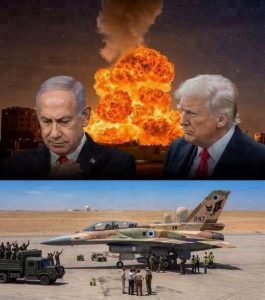
A dramatic image circulating online shows Israeli Prime Minister Benjamin Netanyahu and U.S. President Donald Trump in front of a huge explosion, alongside an Israeli fighter jet. The image is designed to suggest that a major Israeli military operation has just been completed.
However, the image itself does not establish that an event happened “just one hour ago.” Current reporting from September 19, 2026 does confirm that Israel remains involved in active military operations in the region, particularly against Hezbollah positions in southern Lebanon, while the wider confrontation involving Iran, the United States and Israel remains highly volatile. (AP News)
Israel remains on a wartime footing
The latest developments come against the background of an extraordinary year of conflict across the Middle East. Israel’s military campaign against Iranian and Hezbollah-linked threats has continued to affect several countries, while diplomatic efforts have struggled to produce a durable settlement.
On September 19, reports indicated that Israel had conducted strikes against Hezbollah positions in southern Lebanon after two Israeli soldiers were injured. The Associated Press reported that the strikes formed part of continuing regional tensions, alongside developments involving Iran, Yemen and Gaza. (AP News)
The situation is therefore considerably more complicated than a single headline suggesting that Israel has simply “finished” an operation.
Israel has maintained military positions in parts of southern Lebanon and has continued to describe its operations there as measures designed to prevent Hezbollah attacks against northern Israeli communities.
The Israeli military says Hezbollah has continued to operate weapons, drones and other military infrastructure in the area despite understandings reached earlier in the year. The IDF says its forces have responded with strikes against launch sites, weapons facilities and other infrastructure. (את”צ)
Lebanese officials and international organizations, however, have raised concerns about the consequences of continued Israeli military activity for civilians and Lebanon’s sovereignty.
A major unresolved conflict
The latest developments cannot be separated from the broader Israel-Iran confrontation.
Earlier in 2026, Israel and the United States launched major military operations against Iran. According to the Israeli military’s own account, the campaign was intended to damage Iranian military and nuclear capabilities.
A ceasefire was subsequently announced, but the conflict has remained highly unstable.
Reuters reported on September 18 that the United States and Iran remained locked in a diplomatic deadlock, with the conflict continuing to affect the Strait of Hormuz and regional security. President Trump has also been considering whether to resume major military operations against Iran. (Reuters)
That makes every new Israeli military action particularly significant.
An operation against Hezbollah can potentially affect Lebanon. A confrontation involving Iran can affect Gulf countries, American military installations, shipping routes and global energy markets. A separate escalation in Gaza can further complicate diplomatic efforts.
In other words, events that begin in one location can quickly have consequences far beyond the immediate battlefield.
What the fighter jet image tells us
The second half of the circulating image appears to show an Israeli F-16 fighter aircraft on a military airfield.
Israeli F-16s have played an important role in the country’s air operations for decades. The aircraft can carry precision-guided weapons and has been used extensively by the Israeli Air Force.
But the photograph does not prove that the pictured aircraft participated in a particular strike on September 19.
Likewise, the explosion displayed in the upper portion of the image may be a digitally manipulated or composite illustration rather than a photograph of a current event.
This distinction is important because social-media posts frequently combine older military photographs with dramatic graphics and then attach a “BREAKING” headline. Such posts can create the impression that a specific event has been independently confirmed when the underlying image provides no such evidence.
Therefore, the safest interpretation of the image is that it is illustrative, not documentary evidence of a strike occurring exactly one hour before publication.
Israel’s southern Lebanon campaign
Southern Lebanon has become one of the most sensitive fronts in the current regional conflict.
Reuters reported this week that residents in Israeli-controlled parts of southern Lebanon face growing uncertainty as the United Nations peacekeeping mission prepares for withdrawal at the end of 2026. The report said more than 4,300 people had been killed and around 300,000 displaced in this year’s conflict, according to the figures cited by Reuters. (Reuters)
The future of the region is therefore tied not only to military operations but also to questions about international peacekeeping, Lebanese sovereignty and Hezbollah’s weapons.
Israel says it needs security arrangements that prevent Hezbollah from rebuilding offensive capabilities close to Israeli communities.
Lebanon has sought arrangements that restore its territorial sovereignty and prevent a permanent Israeli military presence.
The United States and other governments have attempted to mediate between these competing objectives.
Reuters reported earlier this month that Israel and Lebanon were expected to meet in Rome in October as part of U.S.-brokered efforts to advance a security agreement. (Reuters)
The Hezbollah question
At the heart of the dispute is Hezbollah.
Hezbollah is a powerful Lebanese political and armed organization backed by Iran. Israel considers it a major security threat because of its large arsenal of rockets, missiles and drones.
Israel says Hezbollah’s military infrastructure must be dismantled to prevent attacks against northern Israel.
The IDF has reported numerous operations against Hezbollah weapons facilities and underground networks during 2026. In early September, Israel announced that its troops had dismantled an underground network beneath the Ali al-Taher Ridge in southern Lebanon.
According to the Israeli military, the network extended for more than two kilometers and contained rockets, missiles, drones, anti-tank weapons, mines and other military equipment. (את”צ)
Reuters independently reported the Israeli announcement, while noting that the extent of Israeli troops’ penetration into the underground complex could not be independently established and that Hezbollah had not commented on the claim. (Reuters)
That illustrates why reports concerning military operations should be treated carefully. Initial information often comes from one side of a conflict, while independent verification can take considerably longer.
Gaza remains another major concern
The continuing military activity in Lebanon and the Iran confrontation are occurring while Gaza remains deeply affected by the aftermath of the Israel-Hamas war.
The Associated Press reported this week that a damaged building in Gaza City collapsed, killing at least 21 people, including children and women. The building had reportedly already been damaged by Israeli strikes, and families had continued living there because of the severe shortage of alternative housing. (AP News)
The incident highlights the enormous challenges facing Gaza even when large-scale fighting is reduced.
Humanitarian agencies have repeatedly warned about damaged housing, shortages of essential supplies and the difficulty of reconstruction.
The United Nations has also been involved in efforts to restore basic services. On September 18, Qatar announced an agreement with the UN to provide 1.3 million liters of fuel for Gaza as part of an expanding humanitarian assistance program. (The Jerusalem Post)
Iran adds another layer of tension
The relationship between Israel and Iran remains particularly dangerous.
On September 19, Reuters reported that Iranian authorities had executed a man convicted of spying for Israel’s Mossad. Iranian officials accused him of providing information about missile sites in Iran’s Isfahan province.
The case illustrates how intelligence operations continue even when large-scale military exchanges are reduced. (Reuters)
Meanwhile, satellite imagery reported by the Jerusalem Post showed Iran rebuilding a facility associated with previous nuclear-weapons-related research after Israeli strikes. The report said the reconstruction included additional protective measures. (The Jerusalem Post)
These developments help explain why officials in Israel, Iran and the United States remain focused on military preparedness.
What happens next?
The immediate question is whether the current cycle of strikes remains limited or develops into another major escalation.
President Trump has publicly indicated that he faces a significant decision concerning Iran. CBS News reported on September 19 that Trump had said he was considering a major assault and that two ships had recently been attacked in the Strait of Hormuz. (CBS News)
At the same time, diplomatic contacts continue.
Israel and Lebanon are expected to pursue further discussions, while the United States remains involved in attempts to manage the broader regional crisis. (Reuters)
The possibility of renewed fighting therefore exists alongside diplomatic efforts.
The bottom line
The dramatic headline “Israel finishes…” should not be treated as confirmation of a newly completed military operation solely because it appears alongside the viral image.
What can be established from current reporting is that Israel remains militarily active, including strikes against Hezbollah-related targets in southern Lebanon, while the broader Middle East remains in a highly unstable security environment. (AP News)
The image of Netanyahu, Trump and an enormous explosion captures the atmosphere of confrontation, but it does not independently verify the timing or circumstances of any particular attack.
As developments continue, the most important information will be official announcements backed by independently reported evidence: what target was struck, where it happened, whether casualties occurred, whether the operation has actually ended, and whether opposing forces respond.
For now, the evidence points to continuing military activity rather than a confirmed final conclusion to the wider conflict.