Donald Trump Gets More Bad News: What the Latest Developments Mean
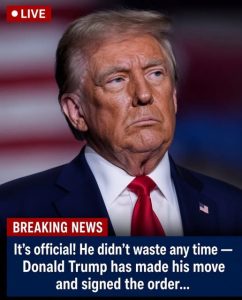
A dramatic social-media graphic showing President Donald Trump with the words “BREAKING NEWS” and claiming that he had “made his move and signed the order” is circulating widely. But the image itself does not identify which order it refers to, and headlines of this kind can easily blur together several different developments.
As of September 19, 2026, however, there have been several significant developments involving the Trump administration in the previous 24 to 48 hours. Among them are new actions concerning the H-1B visa program, a major Russia sanctions law, disputes over White House media access, and continuing controversy over several administration policies. (The White House)
One of the most important developments came on September 18, when Trump signed an executive order concerning the H-1B nonimmigrant visa program and issued a related proclamation extending restrictions on certain H-1B workers. The White House says the actions are intended to address what it describes as abuses of the program and to protect American workers. (The White House)
A new H-1B action
The H-1B program allows U.S. employers to hire foreign workers for certain specialized occupations. It has long been a politically and economically important program, particularly in technology, engineering, medicine, research and other highly skilled fields.
The White House announced on September 18 that Trump had signed an executive order designed to increase coordination among federal agencies involved in administering the program. The order directs the Departments of State, Labor and Homeland Security to work with other agencies and examine additional information involving wages, employment conditions and occupational specialization. (The White House)
The administration argues that some employers have used the program in ways that disadvantage U.S. workers. The White House specifically alleges that certain staffing and outsourcing companies have used H-1B workers to reduce labor costs and replace American employees. Those statements represent the administration’s justification for the policy. (The White House)
The accompanying proclamation also extends restrictions established under an earlier Trump proclamation. According to the White House, the extension will remain in effect until September 21, 2027. (The White House)
The policy has implications for employers, foreign professionals and universities that depend on international talent. Its practical effects will depend on how federal agencies implement the new requirements and how affected employers and applicants respond.
Trump also signed a major Russia sanctions law
Another major development occurred on September 18 when Trump signed the Lindsey O. Graham Sanctioning Russia and Iran Act of 2026 into law.
The legislation targets Russia’s economy and individuals connected with the country’s government and military. It also addresses foreign countries and companies that continue to purchase Russian energy or assist efforts to evade sanctions. (Reuters)
The law gives the president authority to impose tariffs of up to 100% on certain countries that purchase Russian energy or assist Russia in circumventing sanctions. Reuters reported that the legislation was passed by both chambers of Congress before being signed by Trump. (Reuters)
The bill had substantial bipartisan support in Congress. According to reporting from The Associated Press, it passed the Senate 86–11 and the House 262–159 before reaching the president’s desk. (The Washington Post)
The legislation is named in honor of the late Republican Senator Lindsey Graham of South Carolina. Its stated purpose is to increase economic pressure on Moscow over Russia’s continuing war in Ukraine. (Reuters)
The potential international consequences are significant because the measure could affect countries that purchase Russian oil and gas. How the administration uses the authority granted by Congress will determine the actual scope of those consequences.
Another major dispute involves the White House press corps
Trump’s relationship with news organizations has also produced another major controversy.
On September 18, Trump announced that CNN, MS NOW and Politico would be banned from the White House, accusing the organizations of publishing what he characterized as false information. The affected organizations and press-freedom groups criticized the move. (AP News)
The Associated Press reported that the administration had not provided detailed information about how the proposed restrictions would be implemented. At the time of the announcement, journalists from the affected organizations remained on White House grounds. (AP News)
The dispute raises constitutional and press-access questions because the White House is a central source of information about the federal government and presidential actions.
Legal experts and press organizations have raised concerns about whether excluding media organizations because of their reporting could violate constitutional protections. Those are legal arguments that could ultimately be tested through litigation, depending on what actions the administration takes.
Why the viral headline is difficult to interpret
The phrase “Donald Trump has made his move and signed the order” sounds as though it refers to one extraordinary event. In reality, the president has signed multiple executive actions and legislation recently.
The White House’s official presidential-actions page lists the September 18 H-1B executive order along with other executive actions issued during the week. (The White House)
For that reason, a social-media graphic without a date, document title or source link should not automatically be treated as evidence of a particular presidential action.
The photograph used in the graphic also does not establish when the picture was taken or what event it represents. Images can be reused for unrelated headlines, especially when political stories spread rapidly through Facebook, X, TikTok and other platforms.
The underlying documents are much more useful for determining what actually happened.
Other recent developments
The administration has also been dealing with several other major policy issues.
On September 17, Trump announced new executive actions related to hunting and fishing and federal water-quality policy. The White House lists those measures among the administration’s recent presidential actions. (The White House)
On September 18, Trump also spoke publicly about health-care policy. The White House published a video of his announcement that day. (The White House)
Internationally, Trump announced that the United States, Denmark and Greenland had reached an agreement involving Greenland’s security and strategic interests. Reuters reported that the arrangement would expand U.S. military access while restricting certain foreign military and investment activities. (Reuters)
The developments demonstrate how many different policy areas are moving simultaneously: immigration, trade, foreign policy, national security, health care, environmental policy and relations with the news media.
What happens next?
The immediate question is not simply what Trump has signed, but how each action will be implemented.
For the H-1B policy, federal agencies will have to establish procedures for applying the new requirements. Employers and prospective workers will be watching for additional guidance explaining how applications and existing workers may be affected.
For the Russia sanctions legislation, attention will turn to whether and how the administration uses the authority provided by Congress. Any new tariffs or sanctions could have consequences for international trade, energy markets and diplomatic relations.
For the White House-media dispute, the next steps could involve negotiations, administrative decisions or litigation. The constitutional questions surrounding press access could become increasingly important if restrictions are implemented.
A rapidly changing political environment
The current news cycle illustrates why dramatic headlines can be misleading when separated from the underlying documents.
Trump has indeed taken several significant actions in recent days. On September 18 alone, he signed an H-1B executive order and related proclamation, while also signing major legislation concerning sanctions against Russia and Iran. (The White House)
At the same time, his administration has become involved in another dispute concerning access for several news organizations. (AP News)
Whether these developments constitute “bad news” depends on the perspective of the people affected. Supporters and opponents of the administration may interpret the same actions very differently. The concrete facts are the policies themselves, the language of the signed documents, the votes in Congress, and the actions taken by federal agencies afterward.
For anyone encountering the viral image, the safest approach is therefore to look beyond the graphic. Check the date, identify the specific order or law being referenced, and compare the claim with the official presidential document and independent reporting.
The headline may be dramatic, but the actual story is more complicated: Donald Trump has signed several consequential measures, and their effects will unfold through implementation, legal challenges, congressional oversight and international responses in the weeks and months ahead.