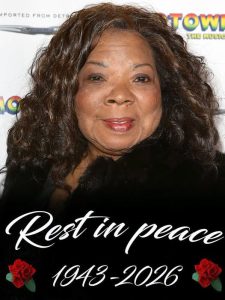
She Sang on “Dancing in the Street.” Then Motown Got a Little Smaller.
The Motown family has lost another of its distinctive voices.
Rosalind Ashford, an original member of Martha and the Vandellas and one of the singers heard on the enduring classic “Dancing in the Street,” died on September 15, 2026, at the age of 83. According to reports citing the Detroit Free Press, Ashford died of natural causes in Redford Township, Michigan. (Los Angeles Times)
Her death closes another chapter in the extraordinary story of Motown’s golden era.
For millions of listeners, Ashford’s voice was part of the soundtrack of the 1960s. Yet her name was never as widely recognized as those of some of Motown’s biggest stars. That was partly because her greatest contributions came as a member of a group rather than as a solo celebrity.
But listen closely to those recordings, and her importance becomes unmistakable.
The voice behind the Vandellas
Rosalind Ashford was born in Detroit on September 2, 1943. Music became part of her life early, with church singing and school music providing an outlet for her developing voice.
In 1957, while still a teenager, she became part of a vocal group that would eventually evolve into one of Motown’s most celebrated acts.
Ashford, Annette Beard and Gloria Williams initially performed together as the Del-Phis. Martha Reeves later joined the group, and their lineup and name evolved as they moved toward a professional recording career. (Los Angeles Times)
The group eventually became Martha and the Vandellas.
That name would become permanently associated with the golden age of Detroit soul.
The group signed with Motown in the early 1960s and soon began establishing itself as one of the label’s major acts.
Their breakthrough came with “Come and Get These Memories” in 1963. What followed was an extraordinary series of recordings that helped define the Motown sound.
Among them were “Heat Wave,” “Nowhere to Run,” “Jimmy Mack” and, most famously, “Dancing in the Street.” (iHeart)
“Dancing in the Street”
Released in 1964, “Dancing in the Street” became much more than another successful Motown single.
The recording captured an infectious sense of movement and celebration. Martha Reeves delivered the lead vocal, while the other Vandellas supplied the harmonies that helped give the record its unmistakable character.
Ashford’s high soprano was an important part of that sound.
The song reached No. 2 on the U.S. Billboard Hot 100 and became one of Motown’s defining recordings. (Los Angeles Times)
Its appeal also lasted far beyond the original release.
Decades later, “Dancing in the Street” continued to appear in films, television programs, commercials and retrospective collections. It became one of those songs that could immediately transport listeners back to the optimism and energy of the 1960s.
And Ashford was part of that recording history.
More than one famous song
It would be easy to remember Ashford solely because of “Dancing in the Street.”
That would undersell her career.
Her voice could also be heard on “Heat Wave,” “Nowhere to Run,” “Jimmy Mack” and many other recordings by Martha and the Vandellas.
According to reports, Ashford performed on nearly two dozen of the group’s Top 40 R&B singles. “Heat Wave” reached No. 1 on the R&B chart, while “Dancing in the Street” became one of the group’s most internationally recognized songs. (Los Angeles Times)
The combination of Reeves’ commanding lead, Ashford’s soprano and the group’s harmonies produced a distinctive sound that helped separate the Vandellas from many other vocal groups of the period.
Their music could be energetic and exuberant, but it also carried emotional weight.
That versatility helped make the group one of Motown’s most durable acts.
The Motown machine
Ashford’s story also provides a glimpse into how Motown operated during its most successful years.
The company wasn’t built solely around individual stars.
Behind every famous lead singer were arrangers, musicians, songwriters, producers, background singers, choreographers and studio personnel.
The Motown sound depended upon all of them.
The Andantes, for example, became the label’s celebrated female background-vocal trio, contributing harmonies to recordings by numerous Motown artists. Motown’s own historical material describes the group as consisting of Louvain Demps, Jackie Hicks and Marlene Barrow. (Classic Motown)
Martha and the Vandellas were different: they were a featured recording group in their own right.
That distinction nevertheless illustrates the collaborative nature of Motown’s music.
Ashford was not simply a singer standing behind a microphone. She was part of a carefully constructed vocal sound that became recognizable around the world.
A career beyond the spotlight
Ashford eventually left Martha and the Vandellas after their great 1960s run. Sources differ slightly over whether her departure was in 1968 or 1969, but there is agreement that she subsequently stepped away from the center of the music business. (Legacy)
She later worked for Michigan Bell, the regional telephone company.
Unlike some of her contemporaries, she did not spend the rest of her life constantly pursuing celebrity.
Yet music never completely disappeared from her life.
Ashford reunited with former members of the Vandellas on various occasions and remained connected to the group’s legacy.
That legacy received one of its most important recognitions in 1995, when Martha and the Vandellas were inducted into the Rock & Roll Hall of Fame. (Los Angeles Times)
Ashford was therefore officially recognized as part of a group whose recordings had already become part of American musical history.
A complicated history with Martha Reeves
Like many long-running musical partnerships, the relationship between members of Martha and the Vandellas was not always simple.
Ashford and Reeves reportedly experienced periods of tension over the years.
But following Ashford’s death, Reeves spoke publicly about the importance of her former bandmate.
Reeves said she was deeply saddened by Ashford’s passing and emphasized the importance of Ashford’s contribution to their recordings. She described Ashford’s voice as something that would continue to live through the group’s music. (Los Angeles Times)
Reports also indicate that the two women had reconciled before Ashford’s death.
That detail adds a deeply human element to the story.
Musical history often remembers groups as if they were perfectly harmonious families. The reality is usually more complicated. Artists work together under enormous pressure, relationships change and people eventually take different paths.
What remains is the music.
“Our Motown family has just gotten a little smaller”
Perhaps the most fitting description came from Reeves herself.
In mourning Ashford, she said, “Our Motown Family has just gotten a little smaller.” (Los Angeles Times)
The phrase captures something important about Ashford’s place in music history.
Motown was never simply a record label.
For the artists who built it, it was a community of singers, musicians, writers, producers and technicians who created an extraordinary body of work during a relatively short period.
As the original participants grow older, that community inevitably becomes smaller.
Ashford’s death is therefore not merely the passing of a former member of a famous group. It represents the loss of another direct connection to the people who helped create the Motown sound.
Remembering Rosalind Ashford
Ashford’s story is ultimately one of musical contribution rather than celebrity spectacle.
She did not need a solo career to leave a permanent mark.
Her voice is preserved on recordings that continue to be played around the world.
When “Dancing in the Street” begins, listeners hear a record created more than six decades ago. Yet its energy remains remarkably immediate.
That is the power of great music.
The people who made it may eventually leave us, but the recordings remain.
Rosalind Ashford was 83 when she died. She is survived by her son, Damon Holmes, four grandchildren and a daughter-in-law, according to published reports. (iHeart)
Her career reminds us that musical history is not created only by the people whose names appear largest on album covers.
Sometimes it is created by the harmony behind the lead.
Sometimes it is the high note that listeners remember without knowing who sang it.
And sometimes, decades later, we discover the person behind that voice and realize just how much of the soundtrack of an era they helped create.
Rosalind Ashford was one of those voices.
She sang with Martha Reeves and the Vandellas during Motown’s remarkable rise. She helped create songs that crossed generations and continents. She became part of the Rock & Roll Hall of Fame history.
And now, with her passing, another link to Motown’s golden generation is gone.
But whenever the opening rhythm of “Dancing in the Street” fills the room, the sound of Rosalind Ashford and the Vandellas remains.
Motown may have become a little smaller, but the music she helped create remains enormous.