Rep. Lauren Boebert Responds to Claims She Had Relationships With Three Staffers
A new ethics complaint has placed Rep. Lauren Boebert at the center of another round of intense public attention after allegations surfaced claiming that she had sexual relationships with three current or former congressional staffers.
Boebert, a Republican who represents Colorado in the U.S. House, has rejected the allegations. Her spokesperson described the claims as false and characterized the complaint as an effort to generate headlines. (People.com)
The allegations became public after a sworn complaint was submitted to the House Committee on Ethics on September 17, 2026. According to reporting by the Colorado Times Recorder, the complaint was filed by David Wheeler of American Muckrakers and names three people who allegedly had relationships with Boebert: former district director Clarice Navarro Ratzlaff, district chief of staff Raven Finegan, and former chief of staff Jeffrey Small. (Colorado Times Recorder)
It is important to emphasize that these are allegations contained in a complaint, not established findings by the House Ethics Committee.
Boebert’s Response
Boebert’s response was direct.
Her spokesperson said the congresswoman “rejects these allegations as utterly false” and said there was “no truth” to them. The spokesperson also described the complaint as a politically motivated effort intended to create headlines and damage Boebert’s reputation. (People.com)
That denial is central to understanding the story because the public allegations and Boebert’s account are sharply different.
The complaint presents the relationships as potential violations of House ethics rules. Boebert’s representatives, meanwhile, say the accusations are baseless.
As of the latest reporting, the House Ethics Committee had not announced that it had opened an investigation into the allegations. (People.com)
That distinction matters. The filing of an ethics complaint does not itself establish that misconduct occurred.
What the Complaint Alleges
According to the Colorado Times Recorder, the complaint alleges that Boebert engaged in sexual relationships with three people who worked in her congressional operation. (Colorado Times Recorder)
The individuals named in the complaint include Clarice Navarro Ratzlaff, who served as Boebert’s district director from January 2021 through January 2025.
It also names Raven Finegan, identified as Boebert’s district chief of staff, and Jeffrey Small, who served as chief of staff before leaving the position in 2025. (Colorado Times Recorder)
The complaint makes additional claims concerning the alleged use of campaign resources and an alleged payment to Navarro Ratzlaff.
Those claims are disputed.
Navarro Ratzlaff has publicly rejected the allegations against her as well, describing them as false and defamatory, according to PEOPLE. (People.com)
That denial is significant because one of the people identified in the complaint is herself disputing the account presented in the filing.
Why House Ethics Rules Matter
The allegations have attracted attention partly because House rules contain a specific prohibition involving sexual relationships between members and certain congressional employees.
The House Code of Official Conduct, under Rule 23, clause 18, states that a Member may not engage in a sexual relationship with an employee of the House who works under that Member’s supervision, or with an employee of a committee on which the Member serves. There is an exception for married couples. (House Committee on Ethics)
The rule is considerably more specific than a general workplace policy.
It addresses the power relationship between elected officials and congressional employees.
Members of Congress have substantial authority over their staffs, including employment decisions and workplace responsibilities. The House therefore has rules intended to prevent certain personal relationships from creating conflicts or abuses of that authority.
The Ethics Committee explains that House ethics rules establish minimum standards for Members, officers and employees and that the rules should be followed both in their letter and spirit. (House Committee on Ethics)
Consequently, if allegations concerning a Member and subordinate employees were ever substantiated, the relevant facts would matter greatly—including the employee’s position, reporting relationship and timing.
The Alleged $200,000 Payment
Another major element of the complaint involves an alleged $200,000 payment to Navarro Ratzlaff.
According to PEOPLE, the complaint alleges that the payment was arranged in March 2025 after Navarro Ratzlaff had left Boebert’s office and allegedly indicated that she planned to file an ethics complaint of her own. (People.com)
Boebert’s representatives deny the broader allegations, while Navarro Ratzlaff has also rejected the claims.
Because the allegations are contested, the existence, purpose and circumstances of any such payment would need to be established through evidence rather than inferred from the complaint alone.
That is especially important when financial allegations are involved.
A complaint can contain claims, interpretations and information supplied by sources, but those elements are not automatically equivalent to findings by an investigative body.
The Role of the Ethics Committee
The House Committee on Ethics is a bipartisan standing committee with responsibility for investigating and adjudicating alleged violations of House rules by Members, officers and employees. (House Committee on Ethics)
Its role is therefore particularly important in cases such as this.
Rather than determining the truth of the allegations through social-media debate, an official investigation—if one were opened—could examine documents, communications, financial records and testimony.
The committee’s own website notes that ethics questions are fact-specific and that even relatively small changes in circumstances can affect how the rules apply. (House Committee on Ethics)
That principle is relevant here.
The allegations involve multiple individuals, different employment periods and claims concerning both personal relationships and financial activity. Establishing what happened would require examining those details individually.
A Story Already Generating Headlines
The allegations have inevitably generated considerable attention because Boebert has long been one of the more recognizable figures in American politics.
Her public career has frequently intersected with controversy, media coverage and intense partisan debate.
That background helps explain why a headline involving her personal life can quickly travel across social-media platforms.
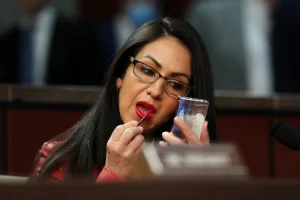
The image accompanying many online versions of the story also contributes to the attention. It shows Boebert dressed in a white jacket over a black patterned outfit, walking outdoors while apparently speaking to someone nearby.
Additional photographs appear alongside the main image.
But the photographs themselves do not establish the truth or falsity of the allegations.
Images are frequently used by online publishers simply because they make a story visually recognizable. Readers should therefore distinguish between the photograph and the claims contained in the article.
Claims, Denials and Evidence
One of the most important lessons from this episode is the difference between an allegation and a finding.
The complaint is a real document submitted to the House Ethics Committee. That makes the filing itself a verifiable fact.
The accusations contained within the document are different.
They remain allegations unless and until supported by evidence and, where appropriate, findings by the relevant authorities.
Boebert has denied the allegations.
Navarro Ratzlaff has also denied the claims involving her.
The person who filed the complaint, David Wheeler, has defended his allegations and said he stands by his reporting and sources. (TMZ)
This leaves the public with competing accounts.
At this stage, responsible reporting requires keeping those accounts separate rather than presenting disputed claims as established facts.
What Happens Next?
The next significant development would be any action by the House Ethics Committee.
The committee could decide whether the complaint warrants further review. If it proceeds, investigators could examine the allegations and determine whether the House’s rules were potentially violated.
The committee’s jurisdiction includes investigating alleged violations of House rules and related statutes. (House Committee on Ethics)
Until such a process produces findings, the public record consists primarily of the complaint, the responses from the people named or implicated, and reporting based on available documents and sources.
That means many questions remain unresolved.
Did the alleged relationships occur?
Were any of the individuals directly supervised by Boebert at the relevant times?
Was any money transferred, and if so, for what purpose?
Were congressional or campaign resources involved?
And, most importantly, does available evidence support the claims contained in the complaint?
Those are factual questions rather than matters that can be settled simply by the competing statements appearing online.
A Developing Political Story
For now, the controversy surrounding Lauren Boebert illustrates how quickly allegations involving public officials can become national news.
The story combines politics, workplace rules, personal relationships and accusations involving money—subjects that naturally attract considerable attention.
But the central fact remains straightforward: an ethics complaint has been filed, Boebert strongly denies its allegations, and the allegations have not been established as facts by the House Ethics Committee. (People.com)
The House’s own rules make clear that relationships between Members and employees under their supervision are specifically regulated. (House Committee on Ethics)
Whether those rules were violated in this case depends on facts that have yet to be determined.
As the story develops, the most consequential information will therefore be any official response from the Ethics Committee and any evidence that emerges to confirm, contradict or clarify the allegations.
Until then, the distinction between what was alleged, what was denied, and what has actually been established remains essential.