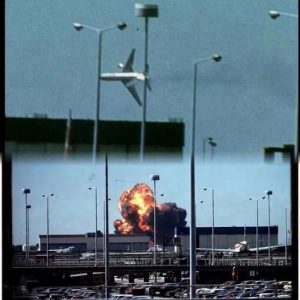
273 People Were Killed in American Airlines Flight 191 at Chicago’s O’Hare Airport
On May 25, 1979, a routine holiday-weekend flight from Chicago to Los Angeles became one of the most devastating aviation disasters in American history.
American Airlines Flight 191, a McDonnell Douglas DC-10, was preparing to leave Chicago O’Hare International Airport when disaster struck just after takeoff. The aircraft lost its left engine and pylon assembly during the critical early moments of the flight. The airplane continued climbing briefly, but it soon rolled sharply to the left and crashed near the airport.
All 271 people aboard the aircraft were killed. Two people on the ground also died, bringing the total death toll to 273. Two additional people on the ground were injured.
More than four decades later, Flight 191 remains a powerful reminder of how a combination of mechanical damage, maintenance procedures, aircraft-system vulnerabilities, and circumstances during takeoff can turn a normal flight into a catastrophe.
A Routine Flight Turns Into Disaster
Flight 191 was scheduled to fly from Chicago to Los Angeles. The DC-10 was a large three-engine wide-body aircraft that had become an important part of commercial aviation during the 1970s.
On that afternoon, weather conditions were clear, with visibility reported at approximately 15 miles. There was no indication that passengers and crew were about to experience anything extraordinary.
The aircraft began its takeoff from runway 32R.
During the rotation—the moment when the aircraft’s nose begins to rise from the runway—the left engine and its pylon assembly separated from the aircraft. Approximately three feet of the wing’s leading edge also separated with it.
The engine and pylon fell onto the runway.
The aircraft, however, continued into the air.
That sequence created an extraordinarily dangerous situation.
The Problem Was More Complicated Than an Engine Failure
The flight crew knew that something had gone wrong, but the aircraft’s condition was more complicated than simply losing an engine.
The separation of the engine and pylon caused extensive damage to systems in the left wing.
According to the Federal Aviation Administration, the separation severed hydraulic lines and caused the outboard leading-edge slats on the left wing to retract. The aircraft also lost electrical power from the engine’s generator, affecting several systems and instruments.
Leading-edge slats are aerodynamic devices that help an aircraft maintain lift at lower speeds, particularly during takeoff and landing.
The damage therefore created an unusual configuration in which the left wing’s ability to generate lift was significantly affected.
The pilots were faced with an emergency immediately after takeoff.
The Aircraft Rose Before Rolling
The DC-10 initially continued climbing.
According to the NTSB investigation, the aircraft reached approximately 325 feet above the ground before beginning to roll left. The roll became increasingly severe until the wings passed through a vertical position and the nose pitched downward.
The FAA’s account states that the airplane ultimately crashed inverted, killing everyone aboard.
The entire sequence happened within seconds.
At such a low altitude, the crew had very little time to understand the aircraft’s configuration, diagnose the underlying problem, and respond.
The aircraft crashed into an open field near a mobile-home community approximately 4,600 feet northwest of the departure end of the runway. Wreckage and fire spread into the adjacent area.
The Human Cost
There were 271 people aboard Flight 191, and none survived.
The victims included passengers traveling for many different reasons: business, vacations, family visits, and other personal journeys.
Two people on the ground were also killed.
The disaster therefore affected not only the families who had loved ones aboard the aircraft but also people who happened to be in the area when the plane came down.
The crash scene was enormous, and the recovery effort was difficult.
For the families, however, the statistics represented something much more personal.
Each number represented a person with a family, friends, memories, plans, and a life that ended unexpectedly.
What Investigators Discovered
The National Transportation Safety Board conducted an extensive investigation into the crash.
Its final determination identified the probable cause as an asymmetrical stall and resulting roll caused by the uncommanded retraction of the left wing’s outboard leading-edge slats, combined with the loss of stall-warning and slat-disagreement indications.
Those conditions resulted from maintenance-induced damage that contributed to the separation of the No. 1 engine and pylon assembly during takeoff.
Investigators also identified contributing factors involving the vulnerability of the aircraft’s pylon attachment design to maintenance damage, vulnerabilities in the leading-edge slat system, and deficiencies involving regulatory surveillance and communication.
In other words, the disaster was not attributed to one simple mistake.
The investigation identified a chain of circumstances.
The Role of Maintenance
One of the most important lessons from Flight 191 involved aircraft maintenance.
The NTSB concluded that improper maintenance procedures had caused damage to the pylon structure.
That damage eventually contributed to the separation of the engine and pylon during the takeoff.
This finding helped demonstrate why aviation maintenance procedures must be performed with extraordinary precision.
Large commercial aircraft contain thousands of components and complex systems. A problem that begins during maintenance can remain hidden until the aircraft is placed under significant aerodynamic and structural stress.
In Flight 191’s case, the critical moment came during takeoff, when the aircraft was accelerating and beginning to climb.
Why the Accident Became So Significant
Flight 191 was already a major tragedy because of the number of lives lost.
But its importance extended beyond the accident itself.
Investigators made numerous recommendations following the crash, including recommendations concerning the Federal Aviation Administration and aircraft maintenance and safety practices.
The accident became an important case study in aviation safety because it demonstrated how multiple failures can interact.
Aviation accidents are rarely the result of a single isolated event.
A mechanical problem may interact with a design vulnerability. A maintenance procedure may interact with an aircraft system. A warning system may fail at the same moment a crew is dealing with an emergency.
Flight 191 showed how quickly these factors can combine during the most demanding phase of flight.
Remembering the Victims
When historical disasters are discussed, it can be easy to focus exclusively on technical details.
Engine separation.
Hydraulic pressure.
Leading-edge slats.
Stall speed.
Maintenance procedures.
But behind every technical term were human beings.
The passengers aboard Flight 191 were beginning what should have been an ordinary journey.
Their families expected phone calls, arrivals, reunions, and ordinary moments at the end of a trip.
Instead, they received devastating news.
The two people killed on the ground also had no reason to expect that an airplane departing from the nearby airport would suddenly become a deadly threat.
Remembering the victims means recognizing that the disaster was not simply an aviation statistic.
A Lasting Aviation Lesson
Today, Flight 191 continues to be studied as an example of the importance of maintenance discipline, aircraft-system design, emergency procedures, and safety oversight.
The FAA’s historical account describes how the loss of the engine and pylon led to hydraulic damage, slat retraction, loss of important indications, and ultimately an uncontrollable roll.
The NTSB’s investigation also emphasized that several factors contributed to the accident rather than treating it as the result of one isolated failure.
That distinction is important.
Modern aviation safety has been shaped by lessons from accidents like this one. Investigators do more than determine what happened. They look for ways to prevent similar chains of events from happening again.
More Than Four Decades Later
The crash of American Airlines Flight 191 happened in 1979, but its memory has not disappeared.
For aviation professionals, it remains a significant safety case.
For historians, it represents one of the defining air disasters of its era.
For the families of those who died, it is a personal tragedy that cannot be reduced to a date or a number.
The accurate figure is 273 fatalities in total—271 aboard Flight 191 and two people on the ground.
The accident lasted only moments.
Its consequences lasted generations.
Flight 191 reminds us that aviation safety is built not only through technology, but through careful maintenance, rigorous procedures, effective communication, strong oversight, and constant attention to lessons learned from the past.
Most importantly, behind every aviation safety lesson are the people whose lives were lost.
Their stories are why those lessons matter.