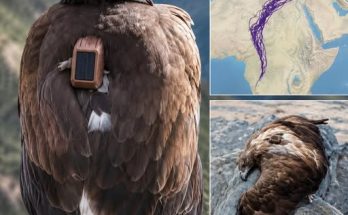
Scientists Tracked an Eagle for 20 Years—What They Learned Reveals the Secrets of These Remarkable Birds
For decades, eagles have captured the human imagination with their enormous wingspans, extraordinary eyesight, and ability to soar high above mountains, forests, and open landscapes. Often regarded as symbols of strength and freedom, these powerful birds are also among the most fascinating subjects in wildlife research.
But observing an eagle for a few hours or even a few days can reveal only a small part of its life. To understand where an eagle travels, how it survives changing seasons, which habitats it depends on, and what dangers it faces, scientists need something much more valuable: time.
Imagine following a single eagle for 20 years, gathering information about its movements and behavior as it navigates the natural world. Such long-term tracking can reveal patterns that short studies might miss, from changes in migration routes to the importance of protected nesting areas.
The broader lesson from long-term eagle research is that these birds are not simply powerful hunters. They are adaptable animals whose survival depends on a complicated relationship between food, habitat, weather, human activity, and the changing environment.
1. The First Discovery: Eagles Do Not All Travel the Same Way
One of the most important findings from real eagle-tracking research is that individual birds can follow very different movement patterns, even when they belong to the same species.
A study published in 2017 examined 28 bald eagles in southeastern Alaska and western Canada. Researchers tracked their movements between May 2010 and January 2016 using GPS transmitters.
The results revealed four broad strategies. Some breeding adults stayed close to their nesting areas throughout the year. Other eagles migrated between northern summer habitats and southern wintering grounds. Some remained near particular feeding areas, while others moved more irregularly from place to place.
PMC
This finding challenges the assumption that every eagle follows a predictable seasonal route.
An eagle’s movements may depend on its age, breeding status, access to food, and the conditions in its surroundings. A young bird searching for suitable habitat may travel differently from an experienced adult that has already established a territory.
Tracking helps scientists understand these individual differences rather than treating every member of a species as if it behaved identically.
2. How GPS Tracking Changed Wildlife Research

In the past, researchers often relied on physical observations, bird banding, and reports from people who encountered marked birds. These methods provided valuable information, but they could leave enormous gaps between sightings.
Satellite tracking has transformed the process.
Scientists can attach appropriately designed tracking devices to selected birds and collect information about their locations over time. Depending on the equipment, researchers may also investigate flight altitude, movement speed, and the relationship between flight routes and weather conditions.
The U.S. Geological Survey explains that tracking golden eagles can help researchers understand how the birds use rising air currents during migration. Eagles may fly at different altitudes depending on the terrain, using air currents to reduce the energy required for long journeys.
U.S. Geological Survey
This is particularly important for large birds. Rather than flapping their wings continuously over long distances, eagles can take advantage of thermals and other rising air currents to remain airborne while conserving energy.
By studying the relationship between flight paths and landscape features, scientists can better understand the routes eagles use and the areas they need to survive.
3. The Hidden Importance of Familiar Places
A tracking map may reveal that an eagle repeatedly visits particular locations. These repeated visits can help researchers identify important feeding grounds, nesting territories, and resting areas.
Why would a bird return to the same place?
The answer may involve reliable food supplies, suitable nesting trees or cliffs, favorable flying conditions, or access to undisturbed habitat.
An eagle that finds a productive feeding area may benefit from returning to it rather than constantly searching for new locations. Likewise, a breeding adult may remain attached to a territory that offers suitable nesting conditions.
However, repeated visits do not necessarily prove that an eagle remembers a location in exactly the same way a human would. Scientists must interpret movement records alongside observations of habitat, prey, weather, and behavior.
This is where long-term research becomes especially useful. A single observation may show that an eagle visited a location once. Records collected over multiple seasons can help establish whether that location plays a recurring role in its life.
4. Migration Can Connect Distant Countries

An eagle that nests in one region may depend on habitats hundreds or thousands of miles away during another part of the year.
Research on golden eagles in Alaska has demonstrated how extensive these movements can be. Young birds tracked after leaving Denali National Park have traveled across western North America, with some wintering in areas ranging from central Alberta to the high deserts of central Mexico. Their subsequent movements have also revealed that some immature birds travel far from their original nesting areas during the breeding season.
National Park Service
These discoveries matter because protecting an eagle’s nest alone may not protect the bird throughout its life.
A bird may spend several months in a protected area before traveling through landscapes containing roads, power lines, energy infrastructure, or other potential hazards.
Tracking allows conservationists to identify important migration corridors and understand how conditions far from a nesting site can affect a bird’s survival.
5. Weather Can Shape an Eagle’s Journey
Eagles depend on environmental conditions that people on the ground may barely notice.
Wind direction, rising air currents, storms, and temperature differences can influence when and where a bird flies. Mountain ridges can produce rising air that helps soaring birds travel with less effort, while changing weather can make some routes more difficult.
Scientists studying eastern imperial eagles in Central Asia found that tracked birds used different kinds of rising air currents during autumn and spring migration. The research also documented their movements between breeding areas in Kazakhstan and wintering regions across the Arabian Peninsula, Iran, and India.
U.S. Geological Survey
Such findings show why a migration route cannot always be understood as a fixed line on a map. A bird may adjust its movements to the conditions it encounters.
Long-term datasets allow researchers to compare journeys across different seasons and years, helping them distinguish regular patterns from unusual movements.
6. The Dangers Eagles Face Along the Way
The tracking of eagles is not only about discovering where they travel. It can also reveal where they face danger.
Golden eagles may encounter hazards far from their nesting sites, including collisions with vehicles, electrocution from power infrastructure, and human disturbances. Research at Denali documented eagles killed by electrocution, shooting, and vehicle collisions, demonstrating that threats in distant locations can affect birds that breed in protected wilderness areas.
National Park Service
Wind energy development presents another challenge that requires careful planning. Wind turbines can create risks for birds when facilities are placed in areas frequently used by soaring and migrating raptors.
Tracking information can help researchers identify flight corridors and areas where eagles regularly travel. This information can then contribute to decisions about infrastructure placement and wildlife protection.
The goal is not necessarily to prevent all human development, but to use reliable scientific evidence to reduce avoidable harm to wildlife.
7. What Does a Twenty-Year Study Really Tell Us?
The headline “Scientists Tracked an Eagle for 20 Years—What They Learned” suggests a single bird was followed continuously for two decades and that researchers discovered one extraordinary secret.
However, the headline should be treated cautiously. The available scientific sources establish that researchers have tracked eagles over extended periods and have collected valuable information about migration, habitat use, and survival. They do not establish the specific story of one eagle being continuously tracked for 20 years and revealing a single dramatic discovery.
For example, a U.S. Geological Survey dataset preserves satellite-tracking records for 21 golden eagles studied in western North America between 1993 and 1997. That is an important research project, but it is not evidence that one individual eagle was tracked for 20 years.
U.S. Geological Survey
This distinction matters because scientific discoveries are most useful when the evidence is presented accurately.
A genuine long-term study can reveal remarkable things without requiring an exaggerated mystery. Years of movement records may show how animals respond to environmental changes, which habitats they repeatedly use, and where conservation measures could make a difference.
Conclusion: An Eagle’s Journey Is Bigger Than One Bird
The greatest lesson from eagle-tracking research is that wildlife lives within a connected and constantly changing environment.
Eagles respond to food availability, weather, geography, breeding needs, and human activity. Some remain close to established territories, while others travel vast distances. Their journeys can connect protected wilderness areas with agricultural landscapes, cities, mountain ranges, and distant wintering grounds.
Modern tracking technology gives scientists an opportunity to understand these movements with a level of detail that earlier generations could scarcely imagine.
And the discoveries have practical consequences. They can help conservationists identify important habitats, understand migration routes, and reduce risks to birds of prey.
Although the specific claim about one eagle being tracked for 20 years needs stronger verification, the real science is fascinating in its own right. Every reliable location recorded by a tracking device adds another piece to a much larger picture of how eagles survive.
Sometimes the most extraordinary discovery is not a mysterious secret hidden inside a single bird’s journey. It is the realization that understanding and protecting wildlife requires us to look beyond one animal, one location, or one season—and consider the entire world that sustains it.
Further reading
- U.S. Geological Survey: Bird Movement and Migration
- Research study: Different movement strategies in bald eagles
- U.S. Geological Survey: Eastern imperial eagle movements