Report Finds 412 Incidents of Crowd-Control Weapon Misuse at U.S. Immigration Protests, With 203 Injuries
A new investigation by Physicians for Human Rights and the University of California, Berkeley’s Human Rights Center has raised serious questions about the use of crowd-control weapons during protests against federal immigration enforcement across the United States. The report documents 412 verified incidents of weapon misuse between June 2025 and May 2026, resulting in 203 documented injuries, including serious head injuries, fractures, and cases of vision loss.
The investigation, titled Charting the Crackdown, examines how federal, state, and local law enforcement agencies used chemical irritants and kinetic impact projectiles during demonstrations. Researchers identified incidents in 16 U.S. cities, finding that federal agencies accounted for approximately 86 percent of the documented cases. The findings have intensified debate over police accountability, public safety, and the rights of people participating in demonstrations.
The Department of Homeland Security (DHS), which oversees several federal immigration enforcement agencies, maintains that its officers are trained to use the minimum force necessary to resolve dangerous situations while prioritizing the safety of the public and law enforcement personnel.
The findings present a difficult question for officials and communities alike: how can authorities respond to genuine public safety threats while protecting demonstrators, journalists, legal observers, and bystanders from preventable harm?
A Nationwide Investigation Documents Hundreds of Incidents
The report was produced by Physicians for Human Rights (PHR), a medical and human rights organization, in partnership with the Human Rights Center at UC Berkeley School of Law.
Researchers examined incidents connected to protests against immigration enforcement operations during a period of heightened demonstrations across the country. Their investigation relied on publicly available evidence, including photographs, video footage, news reports, and legal filings.
By reviewing and verifying these materials, the researchers assembled a detailed record of incidents in which crowd-control weapons were allegedly used in ways that violated manufacturer instructions, agency policies, established policing practices, or international standards governing the use of force.
The investigation identified 412 verified incidents across 16 cities between June 2025 and May 2026. Researchers documented 203 injuries associated with these incidents.
The injury total includes cases in which individuals sustained more than one injury. The researchers also cautioned that the documented numbers likely underestimate the full extent of the harm because some injuries cannot be identified through photographs or video alone.
The report is significant because it attempts to establish a broader picture of crowd-control weapon use across multiple locations, rather than focusing on a single confrontation or isolated complaint.
According to the researchers, the incidents followed identifiable patterns, with large concentrations occurring in cities where federal immigration enforcement operations generated sustained public protests.
The findings do not mean that every use of a crowd-control weapon was improper. Instead, the report focuses on specific incidents that researchers assessed against safety guidance and relevant standards.
Its central concern is whether weapons intended to control crowds were used in circumstances or in ways that exposed people to avoidable risks.
Tear Gas, Pepper Balls, and Rubber Bullets Among the Weapons Used
The investigation identifies several categories of crowd-control weapons involved in the documented incidents.
Chemical irritants, including tear gas and powerful pepper sprays, were prominent in the findings. Kinetic impact projectiles, commonly described as rubber bullets, were also frequently involved. Pepper balls, which combine a projectile with an irritant compound, accounted for more than one-quarter of the documented misuse incidents.
Although these weapons are often described as less-lethal alternatives to conventional firearms, the term does not mean they are harmless.
Tear gas can cause intense irritation of the eyes, skin, and respiratory system. Exposure can be particularly dangerous for people with respiratory conditions, young children, and other vulnerable individuals. The severity of the effects can depend on the chemical agent, the concentration, the duration of exposure, and the surrounding environment.
Pepper spray and pepper balls can also cause significant pain and inflammation. When used at close range, they may expose individuals to concentrated doses of irritants or cause injuries from the impact of the projectile itself.
Kinetic impact projectiles present a different set of risks. Depending on their design, the distance from which they are fired, and the body area struck, they can cause fractures, deep wounds, eye injuries, or traumatic brain injuries.
The researchers identified incidents involving projectiles fired toward people’s heads, deployments at unsafe distances, and tear gas canisters directed at individuals rather than used in ways intended to disperse crowds.
Such practices raise concerns because a weapon designed to reduce the risk of fatal injury can still cause severe or permanent damage when used improperly.
Researchers Document Serious and Potentially Lasting Injuries
The report’s 203 documented injuries include head trauma, fractures, lacerations, bruising, and cases of blindness or other serious vision impairment.
The findings highlight the potential consequences of deploying crowd-control weapons in situations where people may be standing close together, attempting to leave an area, or unable to protect themselves from incoming projectiles.
Some injuries can require immediate emergency treatment, while others may lead to lasting physical consequences.
Head injuries are particularly concerning because the full extent of the damage may not be apparent immediately. A person struck by a projectile may initially appear to have a minor injury but later develop symptoms requiring medical evaluation.
Eye injuries can also have life-changing consequences. Damage to the eye or surrounding structures may affect vision permanently, depending on the nature and severity of the impact.
Chemical irritants create additional challenges for researchers attempting to measure the full health effects of crowd-control tactics. Videos may show people coughing, rubbing their eyes, or struggling to breathe, but those images cannot establish the complete medical consequences of exposure.
Long-term respiratory problems, hearing damage, psychological distress, and other effects may not be captured in the documented injury total.
For that reason, the researchers describe the numbers as an incomplete record rather than a comprehensive count of every person harmed.
The findings underscore the importance of reliable medical documentation, transparent incident reporting, and independent investigations whenever the use of force results in serious injuries.
Federal Agencies Accounted for 86 Percent of Documented Incidents
One of the investigation’s most significant findings concerns the agencies involved.
Researchers attributed approximately 86 percent of the documented incidents directly to the Department of Homeland Security and other federal agencies, with local law enforcement playing a substantial role in Los Angeles.
The concentration of incidents in particular cities suggests that the pattern was not evenly distributed across the country.
More than 90 percent of the documented cases occurred in five metropolitan areas: Los Angeles, Chicago, Minneapolis, Newark, and Portland.
These cities experienced extensive immigration enforcement operations and sustained public demonstrations during the period examined.
In some locations, the investigation found that incident numbers rose sharply around the time federal enforcement operations intensified or additional personnel arrived.
The researchers also described waves of documented incidents moving between cities as enforcement activity and protests developed.
These findings provide a basis for examining whether agency practices, operational decisions, training, or supervisory arrangements contributed to recurring problems.
However, the numbers alone do not establish that every incident resulted from a single national policy or a uniform command decision. Individual incidents can involve different circumstances, officers, weapons, and operational environments.
Determining responsibility requires examining the evidence surrounding each event, including the conduct of the officers involved, the threat they faced, the instructions they received, and the availability of safer alternatives.
Nevertheless, the scale of the documented incidents raises questions about whether existing safeguards are adequate to prevent repeated misuse.
DHS Defends Its Officers’ Use-of-Force Training
DHS has defended its approach by emphasizing the training federal officers receive.
In a statement reported by news organizations covering the investigation, the department said its officers are trained to use the minimum amount of force necessary to resolve dangerous situations while prioritizing the safety of the public and officers.
That position reflects the government’s responsibility to maintain public safety and protect law enforcement personnel during potentially volatile demonstrations.
Crowd-control situations can be complicated. Demonstrations may involve large numbers of people, rapidly changing conditions, and occasional incidents of violence or property damage. Officers may need to respond to immediate threats while trying to prevent injuries and maintain access for emergency services.
However, the existence of a use-of-force policy does not, by itself, establish whether officers followed it during a particular incident.
The central question raised by the report is whether the documented deployments complied with applicable rules and whether agencies adequately investigated instances in which weapons were used unsafely.
A full assessment would require detailed information about the circumstances of each incident, including any warnings given, the behavior of the people present, the distance between officers and demonstrators, and whether individuals had a reasonable opportunity to leave.
The report’s findings also make transparency important. Public access to incident records, clear explanations of agency policies, and independent review can help determine whether officers acted appropriately and whether changes are needed.
DHS’s stated commitment to minimizing force provides a standard against which its conduct can be assessed. The documented incidents raise questions that require evidence-based answers.
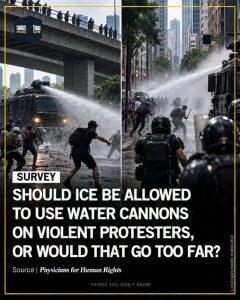
Why Water Cannons and Other Crowd-Control Weapons Raise Human Rights Concerns
The debate extends beyond chemical irritants and projectiles to the broader question of which weapons should be used during public demonstrations.
International human rights guidance places significant restrictions on the use of less-lethal weapons, emphasizing necessity, proportionality, and the obligation to minimize harm.
The United Nations Human Rights Office’s guidance on less-lethal weapons states that water cannons should generally be used only in situations of serious public disorder where there is a significant likelihood of loss of life, serious injury, or widespread destruction of property.
The guidance also stresses careful planning and senior-level oversight when water cannons are deployed.
These restrictions reflect the potential physical dangers of high-pressure water streams. Depending on the pressure, distance, and circumstances, the force can knock people off their feet, cause fractures, or contribute to serious head and eye injuries. People standing on elevated surfaces may face additional risks if the force causes them to fall.
Water cannons can also affect people who are not involved in violence, particularly when used in crowded public spaces.
The United Nations guidance emphasizes that weapons with wide-area effects can create risks for bystanders and may cause dangerous crowd movements if people attempt to flee simultaneously.
Chemical irritants present similar concerns. International guidance generally discourages the use of tear gas in confined spaces because exposure can become concentrated and people may have difficulty escaping.
The broader principle is that authorities should not use a weapon simply because it is available. Its deployment must be justified by the circumstances, and officials must consider whether the expected benefits outweigh the risks.
These international standards do not automatically resolve the legality of every incident in the United States. Individual cases must be assessed under applicable domestic law, constitutional protections, agency policies, and relevant international obligations.
Nevertheless, the guidance provides an important framework for evaluating whether crowd-control tactics unnecessarily endanger people exercising their rights.
The Right to Protest and the Responsibility to Maintain Public Safety
The investigation has renewed debate about the balance between public order and freedom of expression.
Peaceful assembly and protest are protected under the First Amendment to the U.S. Constitution. Journalists and legal observers may also have important roles in documenting demonstrations and law enforcement activity, subject to applicable legal restrictions.
Those protections do not mean that every action during a demonstration is lawful or that authorities cannot intervene when a genuine threat arises.
Law enforcement agencies have responsibilities to protect people, respond to violence, and prevent serious harm. At the same time, those responsibilities must be exercised within legal limits.
The distinction between responding to an immediate threat and using force against people who pose no such threat is central to evaluating crowd-control incidents.
The researchers reported cases involving journalists, legal observers, and other individuals whose presence at demonstrations raises additional concerns about the ability to document public events and monitor official conduct.
When force is used against people who are not posing an immediate danger, questions may arise about whether the response was necessary and proportionate.
The investigation does not eliminate the need to examine the circumstances of individual encounters. Instead, it creates a body of evidence that journalists, policymakers, researchers, and oversight bodies can use to investigate those questions.
Calls for Accountability and Better Oversight
The findings have strengthened calls for clearer reporting requirements, independent investigations, and improved oversight of crowd-control weapons.
Researchers and human rights advocates argue that agencies should maintain detailed records of weapon deployments, the reasons force was used, injuries reported, and the outcomes of internal investigations.
Consistent reporting would make it easier to identify recurring problems and determine whether specific weapons, tactics, or operational practices contribute disproportionately to injuries.
Independent reviews could also help establish whether existing training adequately prepares officers to use these weapons safely and whether supervisors intervene when practices create unnecessary risks.
Another concern is the limited ability of publicly available information to capture the full consequences of chemical exposure and other injuries. Better coordination between law enforcement agencies, medical professionals, and independent investigators could improve the quality of the evidence.
Any reforms would need to account for the realities of policing while ensuring that the use of force remains subject to meaningful oversight.
The findings also raise questions about whether certain high-risk weapons should be restricted more tightly or phased out in circumstances where their potential for serious injury outweighs their usefulness.
Such decisions require careful consideration of medical evidence, operational needs, legal standards, and the availability of safer alternatives.
What the Report Means for Future Immigration Protests
The investigation provides a detailed record of documented incidents during a year of intense public disagreement over immigration enforcement.
Its findings do not settle every dispute about the conduct of federal agents or the circumstances surrounding individual protests. They do, however, establish a substantial basis for further examination of how crowd-control weapons were used and what injuries followed.
The 412 incidents and 203 documented injuries point to a problem that cannot be adequately assessed through isolated videos or individual complaints alone.
The concentration of incidents in five metropolitan areas, together with the large share attributed to federal agencies, gives oversight bodies a starting point for examining operational practices and supervisory decisions.
For communities affected by immigration enforcement operations, the findings also highlight the importance of protecting both public safety and the right to peaceful assembly.
Ultimately, the challenge for authorities is to demonstrate that force is necessary, proportionate, and used in a manner that minimizes foreseeable harm. For researchers and advocates, the challenge is to ensure that injuries are documented, evidence is preserved, and allegations of misuse receive meaningful scrutiny.
The report’s central message is that weapons described as less-lethal can still inflict severe harm when used improperly.
Whether the findings lead to changes in training, reporting, oversight, or weapon policies will depend on how government agencies and policymakers respond.
For now, the investigation has placed a substantial body of evidence into the public record and renewed an important national debate: how can the United States enforce its laws and maintain public order while protecting the safety, dignity, and constitutional rights of the people affected by those actions?