New Footage Reportedly Raises Questions in Investigation of Ill-Fated July 4 Boat Trip
Authorities continue investigating the circumstances surrounding an ill-fated July 4 boating incident after newly surfaced video reportedly prompted renewed public discussion about the movements of those involved before the tragedy unfolded.
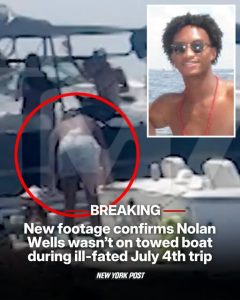
A video circulating online has been described by some outlets as showing that Nolan Wells was not aboard a boat being towed during part of the excursion, a claim that has generated widespread attention on social media. However, while the footage has fueled speculation, investigators have not publicly announced that the video alone definitively resolves key questions surrounding the case.
The clip, which has been widely shared across digital platforms, appears to show multiple boats on the water as people move about near a vessel being towed. A red circle highlights one portion of the footage, directing viewers’ attention to an individual whose identity and actions have become the subject of online debate.
As with many videos circulating after high-profile incidents, experts caution against drawing firm conclusions without additional context. Camera angles, image quality, timing, and incomplete footage can all influence how events are interpreted.
Officials investigating boating accidents typically rely on a combination of witness statements, GPS data, marine patrol reports, photographs, cellphone records where appropriate, and physical evidence rather than a single video clip.
Public interest in the case has remained high because many questions surrounding the day’s events have yet to be fully answered. Family members, friends, and community members continue to seek clarity regarding exactly what occurred during the holiday outing.
The emergence of additional footage has inevitably intensified discussion online, with users offering competing interpretations of what they believe the video shows. Some argue the footage supports one version of events, while others caution that it captures only a brief moment and should not be viewed as conclusive evidence.
Marine safety specialists note that investigations involving recreational boating incidents are often complex. Establishing timelines may require investigators to compare multiple videos, interview numerous witnesses, examine weather conditions, review vessel movements, and analyze communications made before and after the incident.
In many cases, authorities release verified findings only after carefully reviewing all available evidence. Premature conclusions based on incomplete information can complicate investigations and create confusion for families and the public.
The widely shared headline claiming the footage “confirms” Nolan Wells was not aboard the towed boat reflects one interpretation of the video. At this stage, however, any conclusion should be considered alongside official investigative findings rather than social media commentary alone.
Digital forensic specialists frequently remind the public that online videos can be cropped, edited, slowed, zoomed, or presented without their original context. Even authentic footage may fail to capture the complete sequence of events.
For that reason, investigators generally compare multiple independent sources before reaching conclusions.
The boating community also views tragedies like this as reminders of the importance of safe recreational practices. Wearing properly fitted life jackets, avoiding impaired operation, maintaining effective communication between vessels, monitoring weather conditions, and ensuring all passengers understand emergency procedures remain among the most important recommendations promoted by marine safety organizations.
As the investigation continues, officials are expected to determine an accurate timeline of the day’s events using all available evidence rather than relying solely on any single recording.
For the families and friends affected, the priority remains understanding exactly what happened and ensuring that the facts are established through a thorough and impartial investigation.
Until investigators publicly verify the significance of the newly surfaced footage, claims that it definitively confirms any individual’s location or actions should be treated cautiously. Responsible reporting requires distinguishing between what a video appears to show, what has been independently verified, and what remains under investigation.
Ultimately, the investigation—not social media speculation—is expected to provide the clearest picture of the events surrounding the tragic July 4 boating incident.