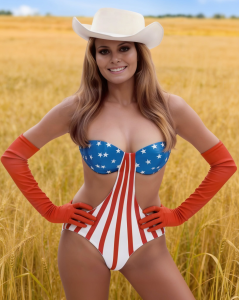
NAME THE STARS-AND-STRIPES SCREEN SIREN!
🇺🇸 Bonus answer: Myra Breckinridge (1970)
Released on this day in 1970, Myra Breckinridge arrived in theaters surrounded by enormous publicity, sky-high expectations and no shortage of controversy. Adapted from Gore Vidal’s bestselling satirical novel, the film was intended to be a bold, provocative comedy that challenged Hollywood conventions, gender roles and American pop culture. Instead, it became one of the most talked-about—and divisive—movies of its era.
At the center of the film stood Raquel Welch, already one of the biggest international stars of the late 1960s. With her striking screen presence, athletic beauty and undeniable charisma, Welch had become a symbol of Hollywood glamour. In Myra Breckinridge, however, she took on one of the most unusual roles of her career, playing a character unlike anything audiences had previously associated with her.
The stars-and-stripes costume seen in promotional photographs became one of the film’s most recognizable images. Bold, playful and impossible to ignore, it reflected the movie’s deliberately outrageous tone. At a time when American flag-inspired fashion frequently sparked debate, the eye-catching outfit added yet another layer of publicity to a production that seemed determined to provoke conversation wherever it went.
Raquel Welch at the Height of Her Fame
By 1970, Raquel Welch had already established herself as one of Hollywood’s most recognizable faces.
Born Jo Raquel Tejada in Chicago in 1940 and raised in California, she first found success through beauty pageants, modeling and television before breaking into films.
Her appearance in the science-fiction adventure Fantastic Voyage (1966) introduced her to a wider audience, but it was One Million Years B.C. later that same year that turned her into an international sensation. Although she had relatively little dialogue, the now-iconic fur bikini promotional image became one of the defining pop-culture photographs of the decade.
Unlike many performers who relied solely on glamour, Welch worked hard to prove herself as a capable actress, appearing in westerns, thrillers, comedies and dramas throughout the late 1960s and beyond.
A Film Unlike Any Other
Myra Breckinridge was based on Gore Vidal’s controversial 1968 novel, which had already generated headlines for its satirical approach to sexuality, Hollywood and gender identity.
The story follows Myra Breckinridge, an ambitious woman who arrives in Hollywood determined to overturn traditional ideas about masculinity, femininity and power. She becomes involved with an acting academy run by her wealthy uncle while manipulating those around her in increasingly outrageous ways.
Rather than presenting a straightforward comedy, the film embraced surreal humor, sharp satire and deliberate absurdity. It also incorporated clips from classic Hollywood movies, blending old and new cinema in ways that were highly unconventional for the time.
An All-Star Cast
One reason the film attracted so much attention was its remarkable ensemble cast.
Alongside Raquel Welch appeared:
- Mae West, making her final film appearance.
- John Huston, as Buck Loner.
- Rex Reed, in his first major acting role.
- Farrah Fawcett, in one of her earliest screen appearances.
- Roger Herren and several familiar Hollywood character actors.
The combination of legendary performers, rising stars and controversial source material ensured that the movie remained in the headlines throughout its production and release.
Hollywood Meets Satire
Director Michael Sarne approached the project with an experimental style that divided critics and audiences alike.
The film mixed broad comedy, fantasy sequences, visual gags and frequent references to classic Hollywood history. It attempted to parody the film industry while simultaneously celebrating its larger-than-life personalities.
Many viewers admired its ambition, while others found its tone confusing or uneven.
Regardless of opinion, almost everyone agreed that it was unlike any mainstream studio release of its time.
The Controversy
Even before its premiere, Myra Breckinridge generated intense public discussion.
The novel’s reputation, the film’s themes and its irreverent treatment of Hollywood traditions all attracted significant media attention. Critics debated whether it was brilliant satire, an overly ambitious experiment or simply too chaotic for mainstream audiences.
Upon release, reviews were largely negative, and the movie struggled commercially.
Over time, however, it developed a reputation as a fascinating Hollywood curiosity—an ambitious production whose willingness to take risks has made it an enduring subject of discussion among film historians.
Raquel Welch’s Performance
Welch embraced the role with confidence and energy, demonstrating a willingness to tackle material that challenged expectations.
At a time when many studios cast her primarily as a glamorous leading lady, Myra Breckinridge allowed her to explore comedy and satire in a highly stylized setting.
Although the film itself received mixed reactions, Welch’s commitment to the role has often been recognized as one of its strengths.
She later built an impressively diverse career, starring in films such as Hannie Caulder (1971), The Three Musketeers (1973), The Four Musketeers (1974) and numerous television productions.
In 1975, she won the Golden Globe Award for Best Actress in a Motion Picture – Musical or Comedy for The Three Musketeers, helping silence critics who believed she was merely a screen beauty.
A Cult Reputation
In the decades since its release, Myra Breckinridge has undergone something of a reassessment.
While it remains one of Hollywood’s most notorious studio productions, many modern viewers appreciate it as an ambitious, if uneven, attempt to push the boundaries of mainstream filmmaking.
Its themes of celebrity culture, media image and gender continue to inspire discussion, even as aspects of the film clearly reflect the era in which it was made.
For collectors and classic-film enthusiasts, original posters and publicity stills—especially those featuring Welch in the memorable stars-and-stripes outfit—remain highly sought after.
Raquel Welch’s Enduring Legacy
Beyond any single role, Raquel Welch left an extraordinary mark on popular culture.
She challenged stereotypes about beauty and talent, worked steadily for more than five decades and became an enduring symbol of classic Hollywood glamour. Yet she also demonstrated versatility, appearing in westerns, adventures, comedies, dramas and television movies while continually reinventing herself.
Following her passing in 2023, tributes poured in from across the entertainment industry celebrating not only her iconic screen image but also her professionalism, determination and lasting influence on generations of performers.
Remembering a Hollywood Original
More than fifty years after Myra Breckinridge premiered, it remains one of the most unusual films ever produced by a major Hollywood studio. Whether viewed as an audacious satire, a fascinating curiosity or an ambitious misfire, it continues to occupy a unique place in cinema history.
For Raquel Welch, it represented another chapter in a career built on taking chances and refusing to be confined to a single screen persona. The stars-and-stripes costume became one of the film’s defining visual symbols, reflecting both the playful excess of the era and the fearless spirit of one of Hollywood’s most unforgettable stars.
So if you recognized the patriotic swimsuit and dazzling smile, the answer is Raquel Welch, and the controversial 1970 film is Myra Breckinridge—a bold, eccentric Hollywood satire that remains one of the most talked-about cult films of its generation.