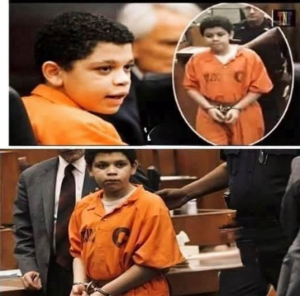
She Was in His Cell, Waiting to Be Executed, and He Asked for One Last Conversation
A fictional story inspired by the prompt
The prison was unusually quiet that evening.
Even the guards, men who had spent decades surrounded by steel bars and heavy doors, spoke in whispers. The execution chamber had been prepared. Witnesses would begin arriving within an hour.
Cell 14 held seventeen-year-old Daniel Reyes.
He sat on the edge of the narrow cot, staring at the concrete floor as the final minutes of his life slipped away.
For years the newspapers had called him a monster.
Television commentators had debated whether someone so young deserved mercy.
The victims’ families wanted justice.
Others believed there had been too many unanswered questions.
But tonight, none of that mattered.
The sentence would be carried out before midnight.
A guard stopped outside Daniel’s cell.
“You’ve been granted one final request,” he said quietly.
Daniel looked up.
“I don’t want a special meal.”
The guard nodded.
“I don’t want music.”
Another nod.
“I don’t want to make a phone call.”
The guard hesitated.
“Then what do you want?”
Daniel swallowed.
“I want to speak with the woman in Cell Nine.”
The request surprised everyone.
Cell Nine held Sarah Mitchell.
She had once been the lead prosecutor in Daniel’s case before her own conviction years later for accepting bribes and suppressing evidence in several unrelated criminal trials.
Her conviction had shocked the nation.
Although her crimes had nothing to do with Daniel’s prosecution, she had become one of the prison’s most infamous inmates.
The warden frowned when he heard the request.
“They’ve never spoken since the trial.”
“That’s what he wants,” the guard replied.
After a long silence, the warden approved the meeting.
An hour later, Sarah entered Daniel’s cell under heavy security.
She looked older than the confident attorney who had once stood before jurors demanding the harshest punishment possible.
Gray streaks lined her dark hair.
Her hands trembled slightly.
She expected anger.
Instead, Daniel stood and quietly offered her the only chair.
She remained standing.
“You asked to see me,” she said.
“I did.”
“Why?”
Daniel looked toward the small window where the fading sunlight barely reached the bars.
“For years,” he said softly, “I’ve wondered if you ever lost sleep.”
Sarah stiffened.
“I believed I was doing my job.”
“I know.”
“I believed the evidence.”
“I know.”
She folded her arms.
“So why am I here?”
Daniel looked directly into her eyes.
“Because I don’t want my last words to be hate.”
The sentence struck her harder than she expected.
For months after her own conviction, Sarah had replayed countless courtroom moments in her mind.
She remembered standing before juries.
She remembered speaking with certainty.
She remembered believing she was serving justice.
Yet prison had taught her something unexpected.
Certainty can be dangerous.
“What if…” she whispered.
Daniel waited.
“What if we were wrong?”
The words barely escaped her lips.
Daniel smiled sadly.
“I’ve asked myself that every day.”
She looked away.
“There were things I never questioned.”
“What things?”
“The eyewitness changed his story.”
Daniel nodded.
“I remember.”
“The forensic report wasn’t as clear as we claimed.”
Another nod.
“And… I never asked why.”
Silence filled the cell.
Outside, footsteps echoed through the corridor.
Sarah felt tears forming.
“For years,” she admitted, “I convinced myself that doubt was weakness.”
Daniel spoke gently.
“Sometimes doubt is honesty.”
The clock continued ticking.
Sarah reached into her pocket and removed a folded piece of paper.
“I wasn’t sure whether to bring this.”
Daniel accepted it.
It was a handwritten letter.
“I started writing it after my conviction,” she explained.
“I never had the courage to send it.”
Daniel unfolded the page.
The first line simply read:
If I ever helped send an innocent person to prison, I hope they can forgive me.
His hands trembled.
“I don’t know if I’m innocent,” he admitted.
Sarah looked confused.
“What do you mean?”
“I made terrible choices.”
He lowered his eyes.
“I ran with dangerous people.”
“I lied to protect friends.”
“I carried weapons.”
“I was angry.”
He took a deep breath.
“But I never committed the crime they convicted me of.”
The words lingered between them.
Sarah felt something inside her collapse.
For the first time since becoming a lawyer, she wondered whether winning had mattered more than finding the truth.
The execution team knocked gently on the door.
“It is time.”
Neither of them moved.
Daniel stood.
“I have one more request.”
The guards exchanged glances.
“What is it?”
He turned toward Sarah.
“Would you tell my mother that I wasn’t afraid?”
Sarah covered her mouth.
“I will.”
“And tell her…”
He smiled faintly.
“…that I forgave everyone.”
She could no longer hold back her tears.
“I’m sorry,” she whispered.
“So am I.”
The guards escorted Daniel into the hallway.
Sarah watched until he disappeared around the corner.
The prison fell silent once more.
Months later, new evidence emerged.
A retired detective admitted that key information had never reached the defense.
DNA testing unavailable at the time of the original trial pointed toward another suspect.
The case was officially reopened.
For many, the announcement came too late.
Sarah devoted the rest of her life to advocating for reforms in the justice system, speaking publicly about the dangers of tunnel vision, unchecked certainty, and the responsibility every prosecutor carries.
Whenever she addressed law students, she ended with the same sentence:
“Justice is never about winning. It is about finding the truth—even when the truth is difficult to face.”
And she never forgot the young man whose final request had not been revenge, anger, or condemnation.
It had simply been one last conversation.