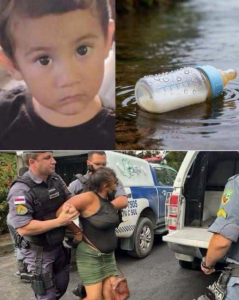
The Missing Two-Year-Old: A Mother’s Secrets Unraveled (Fiction)
The quiet riverside town of Ashford had always been the kind of place where everyone knew everyone else. Parents felt comfortable letting their children play in fenced backyards while neighbors exchanged friendly waves from their porches. It was a community built on trust, making what happened one rainy Tuesday morning almost impossible to comprehend.
Just after dawn, emergency dispatchers received a frantic 911 call from 26-year-old Melissa Carter. Through sobs, she reported that her two-year-old son, Noah, had disappeared from their home during the night.
“I woke up, and he was gone,” she cried. “Please help me find my baby.”
Within minutes, police officers, firefighters, and volunteers began searching every street, wooded trail, and nearby creek. Search dogs followed faint scents before losing the trail near the riverbank. Divers entered the water while helicopters scanned the surrounding countryside.
The story dominated local news.
Residents shared Noah’s photograph online by the thousands. Churches opened their doors for prayer vigils. Businesses donated food for volunteers who spent long days searching fields and forests.
Melissa appeared before television cameras, clutching Noah’s favorite stuffed bear.
“I just want my little boy home,” she pleaded through tears. “If anyone knows anything, please tell the police.”
Her emotional appeal touched hearts across the nation.
Yet behind the scenes, investigators quietly noticed details that didn’t quite fit.
Melissa’s timeline changed each time she was interviewed. At first she claimed she had checked on Noah around midnight. Later she insisted it had been closer to 10 p.m. She couldn’t explain why the back door showed no signs of forced entry.
Detectives also learned that security cameras from nearby homes captured no evidence of anyone entering or leaving the property during the night.
Still, investigators kept an open mind.
For four exhausting days, hundreds of volunteers searched tirelessly. The weather worsened, turning dirt roads into mud and making the river more dangerous.
Then came the heartbreaking discovery.
A child’s blanket was found caught among branches along the riverbank. Nearby, search crews located evidence that suggested Noah had entered the water.
The recovery team worked carefully.
When they finally confirmed the child’s identity, the entire town fell silent.
A memorial of flowers, candles, and stuffed animals quickly appeared outside the Carter home. Parents hugged their own children a little tighter that evening.
Although the community mourned, detectives continued their investigation.
The medical examiner’s report raised difficult questions.
Some injuries were inconsistent with an accidental drowning. Toxicology findings required further examination.
Investigators returned to Melissa for another interview.
This time, they confronted her with inconsistencies in her previous statements.
She denied any involvement.
But digital evidence told another story.
Cell phone records showed movements that conflicted with her version of events. Surveillance footage from a nearby gas station captured her vehicle traveling toward the river during the early morning hours.
The evidence continued to grow.
Forensic experts examined the vehicle, discovering traces of river sediment that matched the location where Noah had been found.
Neighbors also came forward with information they had initially dismissed as unimportant.
One reported hearing loud arguments inside the house the evening before Noah disappeared.
Another recalled seeing Melissa washing her vehicle unusually early the next morning.
Bit by bit, the investigation shifted dramatically.
Months later, prosecutors presented the evidence before a grand jury.
Melissa was arrested and charged with crimes related to Noah’s death.
As officers escorted her to the patrol vehicle, television cameras captured the emotional scene.
Many who had comforted her during the search watched in disbelief.
At trial, prosecutors carefully outlined the investigation, emphasizing physical evidence rather than speculation or emotion.
Defense attorneys argued that the evidence was circumstantial and maintained Melissa’s innocence.
Jurors listened for weeks.
Expert witnesses testified about forensic findings, digital records, and timelines reconstructed from hundreds of pieces of evidence.
The courtroom often became emotional as photographs of Noah smiling and playing were displayed.
Family members quietly wiped away tears.
After lengthy deliberations, the jury returned.
The courtroom became completely silent.
The foreperson announced the verdict.
Melissa was found guilty.
The judge described Noah as “a child whose life ended far too soon” before imposing a lengthy prison sentence according to the law.
Outside the courthouse, Noah’s grandparents thanked investigators, volunteers, and the community.
“Nothing can bring Noah back,” his grandfather said softly. “But today, justice was served.”
In the years that followed, Ashford established the Noah Carter Children’s Foundation, dedicated to supporting families with young children and funding child safety education programs.
Every spring, residents gathered along the river—not to remember tragedy alone, but to celebrate the brief life of a little boy whose smile had once brightened everyone around him.
Parents brought blue balloons, Noah’s favorite color.
Children laughed as they played nearby, reminding everyone why protecting the innocent matters so deeply.
The town never forgot the lessons learned during those difficult weeks.
Investigators later used the case in training programs, emphasizing the importance of following evidence rather than assumptions. They reminded new detectives that emotional appearances can be misleading and that careful, methodical investigation remains the foundation of justice.
For the people of Ashford, Noah’s memory became a symbol of resilience, compassion, and determination.
Though grief remained, the community refused to let tragedy define it.
Instead, they honored a little boy whose life inspired neighbors to care for one another more deeply than ever before.