Trump Says Strait of Hormuz Has Been De-Mined and Is “Open and Operating” After 60-Day Iran Talks Window Shuts
President Donald Trump says the Strait of Hormuz is now free of naval mines and “open and operating,” but the declaration comes at a moment of intense uncertainty over the strategically vital waterway and the future of U.S.-Iran diplomacy.
Trump’s statement on August 18, 2026, followed the expiration of a 60-day memorandum of understanding between Washington and Tehran that was intended to provide time for negotiations toward a broader agreement. No comprehensive deal was reached before the deadline, and the two sides continue to disagree sharply over the status of the strait, sanctions, military operations and the conditions required for a lasting settlement. (Reuters)
The result is an unusual and potentially dangerous situation: Trump says the waterway is open, while Iranian officials maintain that it remains effectively closed until Washington meets conditions set out in the earlier interim arrangement.
Trump’s Declaration
Trump said there were no ongoing or scheduled talks with Iran and maintained that the U.S. naval blockade remained in effect. At the same time, he said the Strait of Hormuz had been cleared of mines and was operating.
That combination of statements immediately raised questions about what “open and operating” means in practical terms.
A waterway can be physically navigable while commercial traffic remains severely restricted because shipping companies, insurers and vessel operators may judge the security risks too high. Current reporting indicates that traffic through the strait remains far below normal levels despite Trump’s assertion that the waterway has been cleared. (Reuters)
The distinction is important because the Strait of Hormuz is not simply another shipping route.
It is one of the world’s most strategically important maritime passages.
Why the Strait Matters
The strait connects the Persian Gulf with the Gulf of Oman and the wider Arabian Sea. Energy exporters including Saudi Arabia, Iraq, Kuwait, Qatar and the United Arab Emirates depend heavily on maritime routes in and around the region.
Before the current crisis, enormous volumes of oil and liquefied natural gas moved through the waterway. Reporting has indicated that roughly one-fifth of global oil and LNG shipments normally pass through the strait, making any prolonged disruption a major concern for governments and energy markets around the world. (Reuters)
That is why developments in Hormuz can affect people thousands of miles away.
If fewer tankers can safely transit the region, global oil supplies can become tighter. Traders may respond by bidding up crude prices. Higher crude prices can eventually affect gasoline, diesel, transportation and manufacturing costs.
The economic consequences can therefore extend well beyond the Middle East.
The 60-Day Window
The latest confrontation is also connected to an agreement reached earlier in the summer.
The U.S. and Iran had established a 60-day period intended to provide an opportunity for negotiations over a broader settlement. The memorandum addressed issues including the Strait of Hormuz, sanctions and Iran’s nuclear program. (Al Jazeera)
The arrangement was supposed to create enough breathing room for diplomacy.
Instead, the process deteriorated.
The deadline expired without a comprehensive peace agreement, and both Washington and Tehran have blamed the other side for the breakdown.
The Associated Press reported that the agreement’s key objectives—including reopening the strait and resolving broader disputes—were not fulfilled. (AP News)
Trump has now indicated that he does not intend to extend the negotiating window.
That means the diplomatic uncertainty that existed before the deadline is now being replaced by an even more unpredictable phase.
Iran Disputes the U.S. Position
Iranian officials have rejected the idea that the Strait of Hormuz has simply returned to normal.
Iran’s chief negotiator, Mohammad Baqer Qalibaf, said the strait would remain closed until the United States met conditions associated with the interim agreement. Those demands reportedly include lifting the blockade of Iranian ports, removing oil sanctions, releasing frozen Iranian assets and ending military threats and operations. (Reuters)
That position directly conflicts with Trump’s declaration.
Washington says the route is open.
Tehran says it remains closed until its demands are satisfied.
The disagreement creates a potentially dangerous ambiguity for commercial shipping.
A tanker operator deciding whether to send a vessel through Hormuz does not necessarily need to know which government has the stronger political argument. The operator needs to know whether the ship, crew and cargo can safely make the journey.
The Importance of Mines
Trump specifically said the mines had been removed or detonated.
Naval mines are particularly dangerous because they can be difficult to detect and can threaten commercial vessels as well as military ships.
The claim that all mines have been cleared therefore has enormous practical significance.
However, reports on August 18 indicated that the situation remained unsettled. Reuters reported that shipping movement was still limited and that a vessel had been struck by an unidentified projectile while transiting the area. (Reuters)
That incident illustrates why the security question is larger than mines alone.
Even if every mine were removed, ships could still face other threats.
Missiles, drones, small boats, military confrontations and unidentified attacks can all create serious risks for commercial shipping.
For that reason, “de-mined” and “safe” are not necessarily synonymous.
A Ship Is Attacked
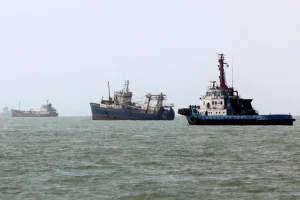
The timing of Trump’s declaration was particularly striking because reports emerged of an attack on a commercial vessel in the Strait of Hormuz.
The vessel was reportedly struck by a projectile as it exited the strait, damaging its engine room and resulting in a crew casualty. Oman’s Coast Guard was involved in assisting the remaining crew, according to reporting citing the United Kingdom Maritime Trade Operations organization. (Reuters)
The incident immediately complicated the message that the strait was fully operational.
For international shipping companies, the difference between theoretical access and reliable access is enormous.
A route can technically remain navigable while shipping companies continue avoiding it because of the possibility of attacks.
That appears to be one of the central problems facing Hormuz now.
The Oil Market Reacts
Energy markets have already been sensitive to the deterioration in U.S.-Iran relations.
Oil prices moved higher as traders assessed the possibility that the disruption could continue. Reporting on August 18 put Brent crude around the low-$90s per barrel, while West Texas Intermediate was also elevated compared with earlier periods. (The Wall Street Journal)
Markets tend to react not only to actual shortages but also to the possibility of future shortages.
That makes the Strait of Hormuz particularly important.
Even the fear of a prolonged disruption can cause companies to build inventories, traders to increase risk premiums and consumers to face higher fuel costs.
If the situation deteriorates further, the effects could spread through global transportation and manufacturing networks.
The Diplomatic Puzzle
Despite Trump’s assertion that there are no talks scheduled with Iran, reports suggest that communication channels have not necessarily disappeared completely.
Jared Kushner, Trump’s son-in-law and envoy, indicated that informal communications were continuing, although there was no evidence of a breakthrough. (Reuters)
That distinction matters.
Formal negotiations can stop while governments continue communicating through intermediaries, diplomats or regional partners.
In the Middle East, countries such as Oman have historically played important roles as intermediaries between Washington and Tehran.
But Oman’s position has now become a source of tension as well.
Tensions With Oman
Oman has been involved in efforts concerning the Strait of Hormuz and has discussed arrangements involving maritime management and fees.
Trump has criticized Oman’s role and reportedly threatened military action if the country interferes with U.S. efforts involving the strait. The warnings have generated concern because Oman has traditionally maintained close relationships with the United States while also maintaining communication channels with Iran. (AP News)
Any direct confrontation involving Oman could dramatically widen the crisis.
Oman sits at the mouth of the Strait of Hormuz and has historically been an important regional partner for Washington.
Escalation involving another Gulf state would therefore add another layer of complexity to an already dangerous situation.
What Happens Next?
The immediate question is whether commercial shipping will actually return to the strait in substantial numbers.
That will depend on more than a presidential statement.
Shipping companies will examine military warnings, insurance costs, attacks on vessels, navigation conditions, escort arrangements and the broader political situation.
If traffic begins returning consistently, it would provide tangible evidence that the waterway is becoming operational again.
If traffic remains sparse, however, the declaration that the strait is “open and operating” will remain contested.
Another major question is whether Washington and Tehran eventually return to negotiations.
The expiration of the 60-day window does not necessarily mean diplomacy is permanently finished. Governments frequently return to negotiations after deadlines collapse, particularly when economic and security pressures become severe.
But the rhetoric surrounding the current crisis suggests that the road back to negotiations could be difficult.
Why This Matters Beyond the Middle East
The Strait of Hormuz crisis is ultimately a reminder of how interconnected the global economy remains.
A narrow waterway in the Persian Gulf can influence energy prices, shipping costs, inflation expectations and financial markets around the world.
For ordinary consumers, the consequences may eventually appear at the gas pump or through higher transportation and product costs.
For governments, the stakes are even higher.
The United States must balance military pressure against the possibility of a wider regional war. Iran must decide how far it is willing to push its control over a strategically important waterway. Gulf states must protect their economic interests while avoiding becoming direct participants in the conflict.
And shipping companies must make decisions where the cost of being wrong can be measured in lives and billions of dollars.
A Claim That Still Needs to Be Tested
Trump’s declaration that the Strait of Hormuz has been de-mined and is “open and operating” is significant, but it should not be confused with evidence that normal commercial traffic has already returned.
Current reporting shows a major discrepancy between Washington’s description of the waterway and Iran’s position. Shipping traffic remains limited, and the reported attack on a vessel demonstrates that serious security concerns persist. (Reuters)
The next several days could therefore be crucial.
If more vessels begin passing safely through Hormuz, confidence may gradually return.
If attacks continue or Iran maintains its blockade, the crisis could deepen.
And if Washington and Tehran find a way back to serious negotiations, the 60-day deadline that just expired could eventually be remembered not as the end of diplomacy, but as one failed chapter in a much longer effort to prevent a wider conflict.
For now, however, the contradiction remains at the heart of the story.
Trump says the Strait of Hormuz is open.
Iran says it is not.
The mines are reportedly gone, but the security risks have not disappeared.
The talks have reached their deadline, but diplomacy may not be finished.
And the world’s energy markets are watching closely.
In a crisis involving one of the planet’s most important waterways, those distinctions could determine whether the region moves toward de-escalation—or toward another dangerous confrontation.