Amazon Boeing 767 Jet Crashes Near Miami Airport: What We Know About the Terrifying Incident
A dramatic aviation incident unfolded near Miami International Airport on Sunday, September 6, 2026, after an Amazon-operated Boeing 767 cargo aircraft crashed onto a roadway close to the airport shortly after arriving from San Juan, Puerto Rico.
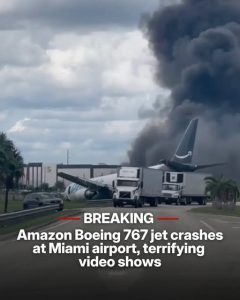
Videos circulating from the scene showed a large cargo aircraft lying across the roadway while thick black smoke rose into the sky. Flames were also visible around part of the aircraft, creating an alarming scene as motorists stopped nearby. Early reports indicate that the aircraft had just landed at Miami International Airport when the accident occurred. (New York Post)
The circumstances remain under investigation, and several important details—including precisely what caused the aircraft to leave the runway and the full extent of any injuries or damage—have not yet been established.
A frightening scene near Miami International Airport
The first images from the scene were striking.
The Boeing 767 appeared to have come to rest across a roadway outside the airport perimeter. Large clouds of dark smoke could be seen rising from the aircraft, while flames appeared to be burning from part of the fuselage.
Vehicles and trucks were stopped around the crash site as people attempted to stay clear of the wreckage. Witnesses could be heard reacting with alarm as emergency crews responded.
According to initial reporting, the cargo aircraft had arrived from San Juan, Puerto Rico, at approximately 2 p.m. local time. Other footage appearing on social media seemed to show the aircraft beyond the runway, leading to early speculation that it may have overrun or veered off the runway during landing. However, that possibility had not been established as the official cause at the time of reporting. (New York Post)
That distinction is important. In the immediate aftermath of an aviation accident, photographs and videos can reveal what happened physically, but they rarely explain why it happened. Investigators must reconstruct the aircraft’s final moments using flight-data recordings, air-traffic-control communications, weather information, maintenance records, runway conditions and eyewitness accounts.
What happened to the aircraft?
The aircraft involved was an Amazon Prime Air Boeing 767 freighter. One early aviation report identified the aircraft as a Boeing 767-300 freighter and reported that it had apparently overrun the runway at Miami International Airport. (The Aviation Hub –)
The Boeing 767 has been an important aircraft in the cargo industry for decades. Its combination of range, payload capacity and relatively efficient operation has made it particularly useful for express freight.
Cargo versions of the 767 operate very differently from passenger aircraft in terms of their interior configuration, but they remain complex commercial airplanes requiring highly trained flight crews and extensive ground support.
In this case, the aircraft’s position after the accident suggested that it had traveled beyond the normal runway environment. The exact sequence—from touchdown to the aircraft’s final resting position—will be one of the central questions for investigators.
At this stage, it would be premature to attribute the crash to mechanical failure, pilot error, weather, runway conditions or any other specific factor.
A ground stop was ordered
The accident also had an immediate effect on operations at Miami International Airport.
Following the incident, airport authorities ordered a ground stop that prevented departures while the situation was being handled. Reports described the airport as dealing with a disabled aircraft and the resulting disruption to airport operations. (New York Post)
That kind of response is understandable after an aircraft accident near an active airport.
Runways and taxiways must be inspected for debris before aircraft can safely resume normal operations. Emergency vehicles may also need access to areas normally occupied by aircraft, airport personnel and ground equipment.
Even an accident that involves a cargo aircraft rather than a passenger flight can therefore have consequences throughout an airport’s operation.
Flights may be delayed, diverted or temporarily held while emergency crews and airport officials secure the area.
The importance of eyewitness video
One of the most striking elements of this incident has been the amount of video captured by people near the crash site.
Footage obtained by NBC 6 reportedly showed the aircraft lying across a roadway with smoke and flames coming from the wreckage. Other videos circulating online appeared to show the aircraft beyond the runway. (New York Post)
Modern smartphones can provide investigators with valuable evidence during major accidents.
A video recorded by an ordinary bystander can potentially capture the aircraft’s attitude, speed, direction of travel, smoke, sounds or other details that may later help investigators establish a timeline.
However, social-media footage also needs to be treated carefully.
Videos can be uploaded without accurate descriptions, posted out of chronological order, edited or incorrectly attributed to an event. Investigators therefore typically use original recordings and corroborate them against official sources and other evidence.
The dramatic image accompanying this story should similarly be viewed in the context of developing reports rather than treated as proof of the cause of the accident.
What investigators will look for
Aviation accident investigations are deliberately methodical.
Investigators will want to establish exactly where the aircraft touched down, its speed and configuration at different points during the landing, how it responded to control inputs and braking, and what happened during the final seconds before it left the normal runway area.
They will also examine weather conditions.
Rain, wind, visibility and runway surface conditions can all influence aircraft performance. Investigators will determine what the conditions were at the time and whether they played any role.
Mechanical systems will also receive careful attention.
The aircraft’s engines, landing gear, brakes, flight controls and other critical systems can be inspected for evidence of failure or malfunction. Maintenance records can help determine whether there had been previous issues involving particular components.
Flight-data and cockpit-voice recordings, where available, can be particularly important.
Together, these sources can help investigators reconstruct the crew’s actions and the aircraft’s behavior with remarkable precision.
A reminder of why cargo aviation matters
The incident also highlights the enormous role cargo aircraft play in modern life.
When people think about commercial aviation, they often imagine passenger airplanes carrying travelers between cities. But cargo aircraft form an equally important part of the global transportation network.
Amazon and other logistics companies rely on air transportation to move packages rapidly between distribution centers and markets.
A Boeing 767 freighter can therefore be part of a complicated logistics chain involving warehouses, delivery hubs, trucks and aircraft operating around the clock.
The accident near Miami is a reminder that every flight in that network involves sophisticated planning and coordination.
Avoiding premature conclusions
Perhaps the most important point at this stage is that the investigation is still developing.
The visual evidence is dramatic, but dramatic footage does not necessarily explain the underlying cause.
It is easy for online discussions to move quickly from what happened to why it happened. Those are two very different questions.
What appears reasonably clear from early reporting is that an Amazon Boeing 767 cargo aircraft arrived in Miami from San Juan, experienced an accident after landing, and ended up on a roadway near the airport amid heavy smoke and flames. (New York Post)
What remains unclear is precisely why the aircraft ended up there and what sequence of events produced the crash.
Those answers will require evidence rather than speculation.
The investigation now begins
For investigators, the work continues long after the flames are extinguished.
The aircraft will become an important piece of evidence. Investigators will examine damage patterns, recover relevant components, analyze recorded data and compare the physical evidence with information from air-traffic controllers and witnesses.
Airport authorities will also assess the condition of runways and surrounding infrastructure before normal operations fully return.
For the public, the most responsible approach is to wait for verified information as officials establish what happened.
The pictures from Miami are undeniably alarming: a large Boeing 767 freighter across a roadway, smoke filling the sky and emergency crews working around the wreckage.
But behind those frightening images is a complex aviation investigation that will take time to complete.
As of the latest reports available on September 6, the cause of the accident and the full extent of its consequences had not yet been established. The situation remains a developing story, with additional information expected as authorities examine the crash and release verified findings. (New York Post)
In short, this is a developing aviation incident—not a story with all the answers yet. The dramatic footage tells us where the aircraft ended up; the investigation will determine how and why it got there.