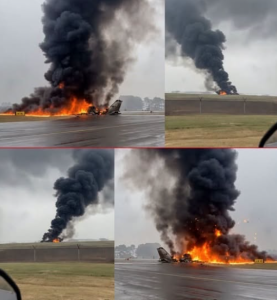
Viral Images of Burning Aircraft Spread Online as Unverified Claims Circulate About Major Plane Crash
Images showing what appears to be a passenger aircraft engulfed in flames have spread rapidly across social media, prompting widespread concern and speculation. The posts claim that a plane carrying more than 244 people has crashed, but as of this writing, the details accompanying the images have not been independently verified.
The four-photo collage depicts what appears to be an aircraft burning on or near an airport runway. Thick columns of black smoke rise high into the sky while large flames consume what appears to be part of the aircraft’s fuselage. The dramatic scenes have led thousands of users to share the images alongside captions suggesting a catastrophic aviation disaster.
Despite the emotional reactions generated by the photographs, the images alone do not establish what happened, where the incident occurred, or whether the accompanying claims are accurate.
Images Do Not Confirm the Details
One of the challenges with viral breaking-news posts is that photographs often circulate without reliable context. A single image can be reposted thousands of times with different captions, making it difficult to determine whether the accompanying description accurately reflects the event shown.
In this case, the collage contains no visible airport name, airline logo that can be clearly identified, flight number, registration number, or timestamp. Without that information, it is impossible to confirm the aircraft’s identity or verify claims regarding the number of passengers.
Images may also originate from previous aviation incidents and later be reshared during unrelated events, creating confusion among viewers.
Aviation Accidents Require Careful Verification
When a serious aviation emergency occurs, authorities typically release information in stages.
Airport officials usually confirm that an incident has taken place before investigators determine exactly what happened. Airlines generally verify the aircraft involved, while emergency responders provide updates regarding rescue operations. Passenger numbers are normally confirmed only after flight manifests have been reviewed.
As a result, the first reports following an aircraft accident are often incomplete and may change as investigators gather more information.
For this reason, responsible news organizations avoid presenting casualty figures or causes until they have been confirmed by official sources.
Why Passenger Numbers Can Change
Social media posts frequently include specific numbers, such as the claim that more than 244 people were aboard the aircraft.
However, passenger totals often change during the early hours of an investigation. Initial reports may confuse passenger capacity with the number actually on board, or they may omit crew members from early estimates.
Official figures are generally released only after airlines reconcile boarding records and verify crew manifests.
Until then, any specific passenger count should be regarded as provisional unless confirmed by authorities.
Emergency Response Is the First Priority
Whenever an aircraft accident occurs, emergency response teams focus on protecting lives before determining the cause.
Airport fire and rescue crews are specially trained to respond within minutes of an aircraft emergency. Their priorities include extinguishing fires, evacuating survivors, assisting injured passengers, and preventing additional hazards such as fuel explosions.
Medical teams also establish triage areas to assess injuries and coordinate transportation to nearby hospitals if necessary.
If the aircraft involved was carrying a large number of passengers, emergency operations typically involve local fire departments, police agencies, ambulance services, airport authorities, and national aviation officials working together.
Investigators Seek Answers
Once the immediate emergency has ended, aviation investigators begin examining what caused the accident.
Their work may include:
- Inspecting the wreckage.
- Reviewing maintenance records.
- Examining weather conditions.
- Analyzing communications between pilots and air traffic control.
- Recovering flight data and cockpit voice recorders, when available.
- Interviewing witnesses and surviving crew members.
These investigations are often complex and can take months before final conclusions are published.
Investigators generally avoid drawing early conclusions because many factors—including mechanical failures, weather, human performance, wildlife strikes, runway conditions, or other operational issues—can contribute to an accident.
Social Media Can Spread Misinformation
Breaking-news events frequently generate misinformation online.
Old photographs, unrelated videos, artificial intelligence-generated images, and incorrect casualty figures often circulate before official information becomes available.
Some posts unintentionally spread inaccurate information by repeating rumors, while others deliberately use sensational captions to attract attention.
Because aviation disasters receive intense public interest, they are particularly vulnerable to this type of misinformation.
Experts therefore encourage readers to rely on official announcements rather than viral social media posts.
Supporting Families During Emergencies
Whenever an aircraft accident is reported, airlines establish procedures designed to assist passengers’ families.
These typically include emergency hotlines, family assistance centers, and dedicated communication teams responsible for providing verified information.
Authorities generally avoid releasing passenger identities until relatives have been notified.
This process helps prevent families from learning potentially inaccurate or incomplete information through social media.
The Importance of Accurate Reporting
Responsible journalism emphasizes verification over speed.
Publishing unconfirmed casualty figures or assigning blame before investigators complete their work can create unnecessary confusion and distress.
Instead, experienced reporters seek confirmation from airport authorities, airlines, aviation regulators, and emergency services before reporting key facts.
This approach ensures that public understanding develops on the basis of evidence rather than speculation.
What Can Be Confirmed From the Image
Based solely on the uploaded collage, only a few observations can be made with confidence:
- The photographs appear to show an aircraft involved in a fire.
- Thick black smoke is visible rising from the scene.
- Flames appear to have engulfed part of the aircraft.
- The photographs seem to have been taken from different viewpoints.
Beyond these visual observations, the image does not establish:
- The location.
- The date.
- The airline.
- The aircraft type.
- The number of passengers.
- The cause of the fire.
- Whether fatalities or injuries occurred.
Those details require confirmation from official sources.
Waiting for Verified Information
If the images are connected to a genuine aviation emergency, investigators and emergency responders will likely provide updates as more information becomes available.
Until then, caution is warranted when sharing dramatic claims that have not been independently confirmed.
Major aviation incidents understandably generate intense public concern, but accuracy remains essential. Sharing verified information helps ensure that families, travelers, and the public receive reliable updates rather than rumors.
For now, the viral images should be viewed as unverified visual evidence of an apparent aircraft fire, not proof that the accompanying claims—including the reported passenger count or other details—are accurate. As with any developing story, official statements from aviation authorities and the airline involved will provide the most reliable account of what occurred.